The 11th Taiwan–Japan Exchange Summit convened on Nov. 4, marking the first time the event was held in Japan’s Kanto region.
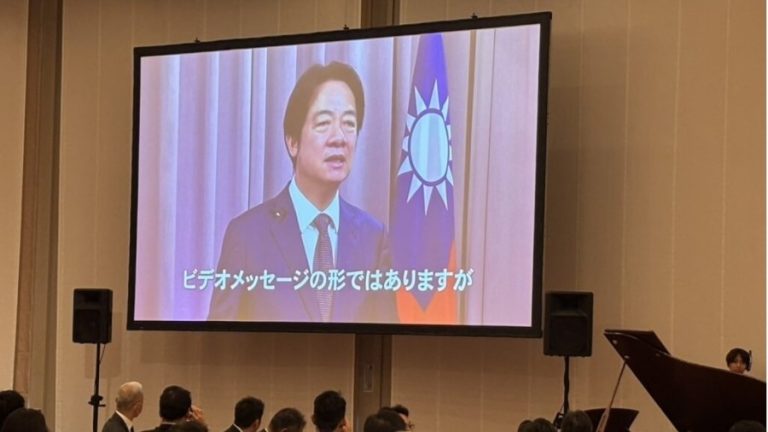
Taiwanese President Lai Ching-te delivered a congratulatory video message, noting that Kamakura’s turn to host after last year’s summit in Tainan symbolized a “heritage of ancient capitals” and opened a new chapter in Taiwan–Japan friendship. Lai also extended his congratulations to Sanae Takaichi on her election as Japan’s 104th prime minister, expressing confidence that under her leadership Japan will continue to prosper and that bilateral friendship will deepen.
Taiwan’s representative to Japan, Lee Yi-yang, highlighted that Japan’s local assemblies once again expressed clear support for Taiwan’s international participation and rejected Beijing’s distortion of UN General Assembly Resolution 2758.
He called the declaration “highly meaningful,” noting that Japan’s local leaders have taken a principled stand in defending Taiwan’s right to be heard on the global stage. Lee said Japan’s local assemblies had made clear that Resolution 2758 should not be misused as a political tool, and that their firm support helps Taiwan speak truth to the world.
Kanagawa declaration: Peace, democracy, and regional stability
The summit brought together more than 300 participants from Taiwan and Japan’s local governments and civic organizations. Delegates discussed diplomacy, security, economics, and culture, and jointly adopted the Kanagawa Declaration.
Success
You are now signed up for our newsletter
Success
Check your email to complete sign up
The declaration affirms that peace and stability in the Taiwan Strait are central to the Indo-Pacific’s prosperity and security. It reasserts that UN Resolution 2758 should not be misinterpreted as excluding Taiwan, warning that any distortion undermines the international community’s collective interests.
It further calls for advancing Taiwan’s participation in global and regional frameworks—including the World Health Organization (WHO), International Civil Aviation Organization (ICAO), International Criminal Police Organization (INTERPOL), and the Comprehensive and Progressive Agreement for Trans-Pacific Partnership (CPTPP). It also encourages cooperation in economic security, disaster prevention, and public health to build resilient democratic partnerships.
Building a ‘democratic supply chain’
In his remarks, Lee Yi-yang emphasized the need to strengthen a “democratic supply chain” to counter authoritarian regimes’ so-called “red supply chain.”
He noted that both Taiwan and Japan play vital roles in global high-tech industries:
- Taiwan manufactures roughly 90 percent of the world’s most advanced semiconductors and AI servers, leading in packaging and testing.
- Japan provides about 30 percent of global semiconductor manufacturing equipment and 50 percent of semiconductor materials, and ranks second worldwide in quantum technology—behind only the United States.
Lee said these complementary strengths make Taiwan and Japan natural partners in emerging technologies such as AI, renewable energy, robotics, low-orbit satellites, 6G communications, AI healthcare, biotechnology, and advanced materials. He added that both sides should work together to drive innovation, stabilize supply chains, and strengthen their democratic alliance.
Summit chair Matsuda Yoshiaki, a Kanagawa Prefectural Assembly member, remarked that the Republic of China (Taiwan) has existed for over 110 years, while the People’s Republic of China has a history of just over 70. He said the contrast speaks for itself, adding that Taiwan has never been truly ruled by China and remains one of Japan’s most understanding and friendly partners. His comments drew strong applause from the audience.
Participants agreed that local exchanges between Taiwan and Japan form the foundation of a broader democratic partnership and serve as a model for regional cooperation.
Bilateral dialogue at APEC
Just days before the Kamakura summit, Taiwan’s APEC representative Lin Hsin-i met with Prime Minister Sanae Takaichi on Nov.1 during the APEC meetings in Gyeongju, South Korea.
According to Taiwan’s delegation, the 20-minute meeting reaffirmed shared democratic values and close economic ties. Lin expressed hopes for deeper cooperation in AI and digital trade while conveying President Lai’s congratulations to Takaichi.
Takaichi reiterated Japan’s commitment to peace and stability across the Taiwan Strait and extended condolences for Taiwan’s recent natural disasters. She also reaffirmed Japan’s support for Taiwan’s meaningful participation in international organizations.
Takaichi later posted a photo with Lin on social media, writing that she looked forward to deeper practical cooperation between Japan and Taiwan.
Since its inception in Kanazawa in 2015, the Taiwan–Japan Exchange Summit has become an annual platform for strengthening ties between local governments and civic groups. Past hosts include Wakayama, Kumamoto, Kaohsiung, Toyama, Kaga, Kobe, Kochi, Sendai, and Tainan.
The summit announced that the next meeting will be held in Nagoya in 2026, to be co-hosted by the Japan–Taiwan Friendly Parliamentarians Association and the Nagoya City Council.
By Li Zexu