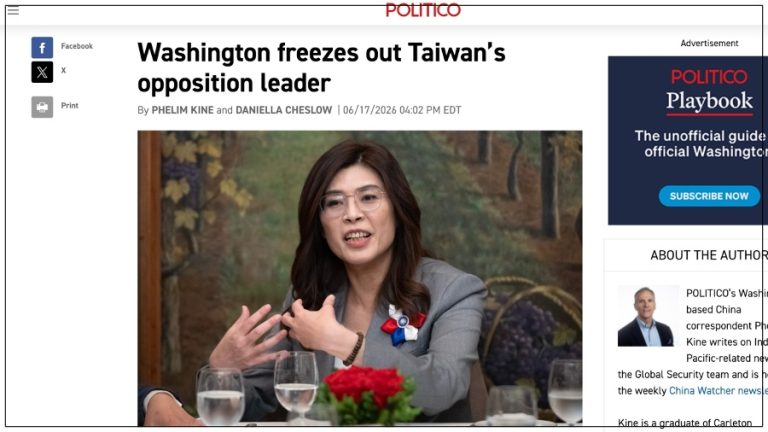
On June 17, the cover story of National Security Daily, published by Politico, was headlined “Washington freezes out Taiwan’s opposition leader.” The report says that Cheng Li-wen received a cool reception during her visit to Washington, with the primary reason being her role in significantly reducing the Taiwanese government’s proposed special defense budget.
The article further stated that the United States Department of State remains deeply upset over her actions regarding the defense budget, and that the White House even cancelled a previously scheduled meeting between Cheng and officials from the National Security Council.
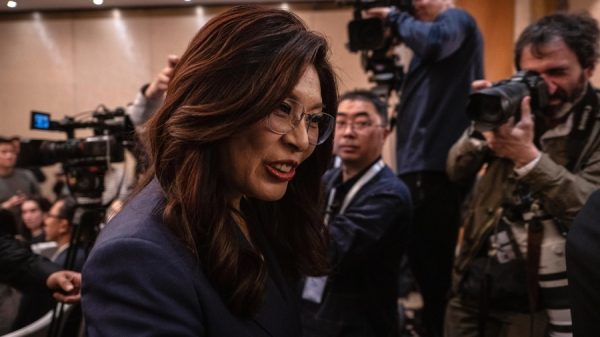
Politico: Cheng Li-wen received a ‘cold reception’ because of her opposition to the defense budget
Politico’s National Security Daily column cited four people familiar with Cheng Li-wen’s itinerary as saying that she had sought meetings with officials at both the White House and at the United States Capitol, but achieved only limited success.
One source said: “They asked for meetings with a lot of lawmakers but didn’t get many.”
The report states bluntly that this outcome stemmed from Cheng’s leading role in blocking Taiwan’s proposed defense budget.
Success
You are now signed up for our newsletter
Success
Check your email to complete sign up
According to one person familiar with interactions between the U.S. State Department and Cheng’s team: “The State Department is still pissed off at Cheng’s behavior over defense spending.”
Two other people familiar with the matter said that the White House cancelled a previously scheduled meeting between Cheng and officials from the National Security Council.
The report states that the frosty reception appeared to be retaliation for Cheng Li-wen’s role last year in blocking the Lai Ching-te administration’s proposed US$40 billion emergency defense budget. At the time, members of the United States Congress warned that the budget impasse weakened Taiwan’s ability to deter potential Chinese aggression. It was not until last month that the Kuomintang agreed to a significantly reduced US$25 billion defense budget.
Two additional people familiar with the matter said that the White House had originally scheduled a meeting between Cheng and officials from the National Security Council, but later cancelled it.
One of the sources said National Security Council (NSC) officials “were very upset with her gutting the special [defense] budget that they provided extensive consultations on.”
A second source said that the Financial Times reported last week the names of the U.S. officials whom Cheng had been scheduled to meet. According to the source, the NSC was also angered by the disclosure, believing that the Kuomintang had leaked the list.
The source added, “They also were frustrated that names of those she was supposed to be meeting with appeared in a Financial Times story last week, and suggested that the KMT had leaked the names. That constituted breaking of simple protocol that was delineated as a precursor to meeting with NSC, which was to not leak the meeting ahead of time.”
Cheng Li-wen: ‘I never expected a warm reception’
Cheng Li-wen’s office said that during her visit she met with nine members of the U.S. Congress, including Republican Dan Sullivan, Representatives Don Bacon and Young Kim, as well as Democratic Representative Tom Suozzi.
Among them, Young Kim and Tom Suozzi did not respond to requests for comment by Politico. Following the meeting, Dan Sullivan posted on X, urging the Kuomintang (KMT) and the Democratic Progressive Party (DPP) to work together to swiftly approve Taiwan’s defense budget, while also expressing support for developing natural gas resources in Alaska.
Only Don Bacon offered a notably positive assessment. His office told Politico, “The KMT is moving in the right direction on our joint desire to defend Taiwan.”
Responding to U.S. media reports that she had received a “cold reception” in Washington, Cheng said she had never expected an unprecedentedly warm welcome in the first place, adding that the trip’s actual achievements far exceeded her original expectations.
Nikkei: Trump administration wanted to avoid sending the wrong signal
Cheng’s reportedly cool reception in Washington has attracted widespread attention in the international media.
Nikkei reported that the Trump administration has sought to avoid establishing a close relationship with Cheng, the chair of Taiwan’s largest opposition party, the Kuomintang. In April, Cheng visited China and met with Xi Jinping. Before departing for the United States, she had also requested a meeting with Donald Trump.
According to the report, the Trump administration likely wanted to avoid being perceived as endorsing Xi Jinping—or as weakening its support for the Lai Ching-te administration—by appearing too close to a politician widely viewed as sympathetic toward Beijing.
The report further states that the administration was concerned that a close association with Cheng could benefit the Chinese Communist Party’s messaging strategy, which seeks to promote the narrative that “not all Taiwanese oppose China or oppose unification.”
In addition, according to the report, U.S. officials have been dissatisfied with the Kuomintang’s cautious approach toward the Trump administration’s calls for Taiwan to substantially increase its defense spending.
The report concludes that Washington also wanted to avoid creating the impression that any interaction between Cheng and Trump signaled a change in longstanding U.S. policy toward Taiwan. Such a political signal, it says, could trigger highly sensitive interpretations in Taiwan, Beijing, and the broader international community. Therefore, the simplest and safest course of action was to keep a distance.
According to Nikkei, although the United States does not challenge Beijing’s position that mainland China and Taiwan are parts of one China, Washington adheres to its own “One China” policy, under which Taiwan’s security remains a central concern. The United States prioritizes maintaining the status quo, stating that it “opposes any unilateral attempt by either side to change the status quo and does not support Taiwan independence.”
The report says that Donald Trump’s decision not to accept Cheng Li-wen’s request for a meeting reaffirmed that U.S. policy toward Taiwan remains unchanged, which the article describes as good news for the administration of Lai Ching-te.
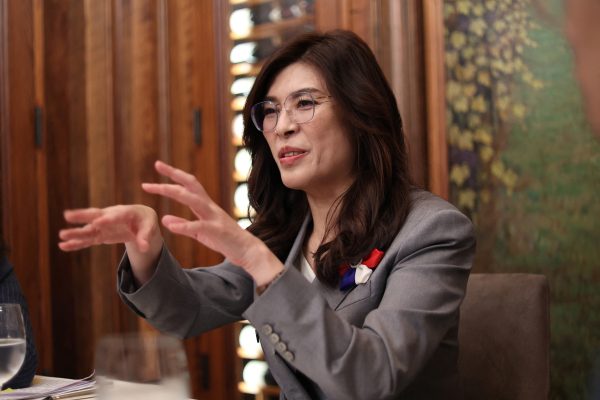
The Straits Times: Washington views Cheng Li-wen as ‘too naïve’
Meanwhile, The Straits Times reported that many in Washington are skeptical of Cheng Li-wen’s efforts to strengthen engagement with Beijing, viewing her approach as overly naïve.
The report cites Dennis Wilder—a professor at Georgetown University and Texas A&M University, and former Senior Director for East Asian Affairs at the National Security Council—as saying that Cheng’s explanation of cross-strait relations led many observers to suspect that “she has been used by Beijing.”
Wilder said this reflects the deep distrust within the United States toward Xi Jinping’s stated goal of “peaceful reunification.”
The report also quotes Amanda Hsiao, the Taiwan lead at Eurasia Group, who said that many people in Washington believe Cheng Li-wen is “overly naïve” in her optimism about managing differences across the Taiwan Strait.