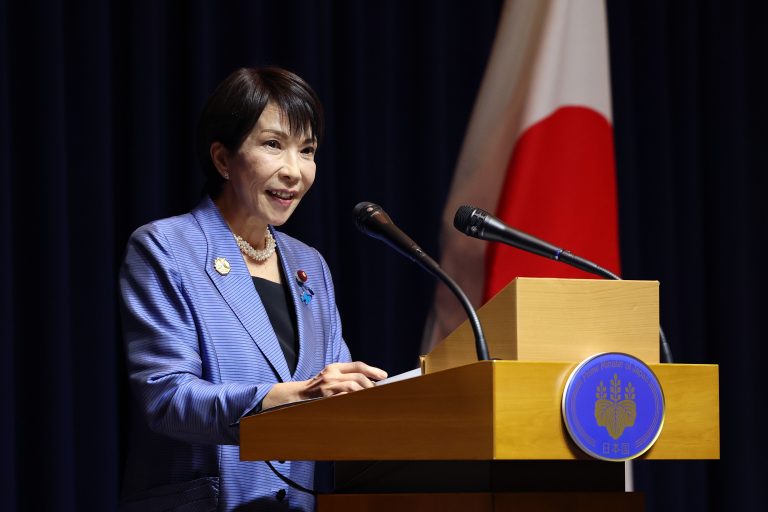
Japan’s political scene has entered a new era of excitement. According to the latest opinion poll released by Japan News Network (JNN) on Nov. 3, 2025, the newly formed Cabinet of Sanae Takaichi has achieved a staggering 82 percent approval rating — the second-highest support ever for a new cabinet, just behind Junichiro Koizumi’s 88 percent in 2001.
This extraordinary level of public support reflects not only widespread expectations for the new administration but also highlights Prime Minister Sanae Takaichi’s unique leadership style, particularly her warm and engaging “Kansai-style diplomacy,” which has won praise both at home and abroad. Netizens have affectionately nicknamed her “the Naniwa Auntie,” a playful term that overturns the traditional stern image of Japanese politicians.
The Takaichi Cabinet’s 82.0 percent approval marks a dramatic 38.3-point increase from the previous Ishiba Cabinet’s rating last month — a resounding vote of confidence in the new government’s early performance. Only 14.3 percent of respondents said they “do not support” the cabinet, showing minimal disapproval — a remarkably strong start for any incoming administration.
To ensure accuracy and representativeness, JNN conducted the survey on Nov. 1–2 using a rigorous methodology:
- Random-digit dialing (RDD)
- Professional interviewers conducting both landline and mobile calls
- Target: 2,607 Japanese men and women aged 18 and older
- Valid responses: 1,013 (response rate: 38.9 percent)
This hybrid of landline and mobile polling avoided biases common in online surveys and ensured broad demographic coverage. The exceptionally high support gives Takaichi’s government a solid base of public confidence.
Success
You are now signed up for our newsletter
Success
Check your email to complete sign up
In addition, 52 percent of respondents approved of the new coalition between the Liberal Democratic Party (LDP) and Nippon Ishin no Kai (Japan Innovation Party) — signaling general public confidence in the alliance’s legitimacy and effectiveness. Despite the usual uncertainty surrounding coalition governments, Takaichi’s cabinet appears to enjoy a smooth start.
Policy vision and economic confidence
In her inaugural policy speech, Prime Minister Takaichi outlined her guiding principle: “Responsible proactive fiscal policy” — using national resources strategically while maintaining fiscal discipline.
According to the poll, 58 percent of respondents believe Japan’s economy will improve under her leadership, while 23 percent think it will not — showing a clear sense of optimism toward her economic approach. This optimism may help boost consumer confidence and investment sentiment.
On defense policy, Takaichi announced plans to raise Japan’s defense spending to two percent of GDP by 2027, two years earlier than previously scheduled, citing growing global security challenges.
- 56 percent support this decision
- 33 percent oppose it
While the increase is controversial, most Japanese agree that enhancing national security is essential. The early two percent of GDP goal signals Tokyo’s seriousness about defense readiness.
Regarding inflation relief, the poll revealed citizens’ strongest wishes:
- Eliminate the consumption tax on food – to counter rising food costs.
- Reduce social insurance premiums – to ease burdens on working-age citizens and increase disposable income.
These results highlight key areas for the government to address as it formulates anti-inflation measures.
The rise of ‘Kansai-Style’ people-centered diplomacy
Takaichi’s first international appearances — especially her meeting with U.S. President Donald Trump — have drawn praise from 83 percent of respondents, who see her diplomatic debut as fresh and impressive.
Her so-called “Kansai-style diplomacy” — warm, candid, and personable — contrasts sharply with Japan’s typically formal and restrained political demeanor.
Born in Nara and educated at Kobe University, Takaichi’s formative years in the Kansai region (which includes Osaka and Kyoto) shaped her open, friendly manner. Kansai people are known for their humor, straightforwardness, and lack of pretension — qualities that naturally shine through in her diplomatic engagements.
Netizens have affectionately dubbed her “Naniwa no Obachan” (“the Osaka Auntie”), not as an insult but as an endearing tribute to her warmth and accessibility. One popular comment read: “If Trump spoke in Osaka dialect, it’d be hilarious!”
Another joked: “Osaka people and New Yorkers actually have the same tempo.”
Such reactions show how her informal, genuine communication style resonates with both Japanese and foreign audiences — giving diplomacy a human touch.
Real-world examples on the global stage
Takaichi’s Kansai-style diplomacy isn’t just talk — her behavior at international meetings has visibly reflected it.
At the APEC Summit in Gyeongju, South Korea, she was seen sliding her chair closer to Indonesian President Prabowo Subianto — a spontaneous gesture that broke the ice and embodied her approachable manner.
In another viral moment, Chilean President Gabriel Boric posted a video on X (formerly Twitter) showing Takaichi with her arm around his shoulder, chatting intimately. He congratulated her on becoming Japan’s first female prime minister. Netizens jokingly commented, “That’s the kind of distance only a Kansai Auntie could manage!”
Such moments not only humanize Japan’s image abroad but also help build genuine personal rapport — often the key to effective diplomacy.
Prime Minister Sanae Takaichi has brought a wave of vitality to Japanese politics. Starting her administration with an 82 percent approval rating, she has won over the public through her clear fiscal vision, firm defense stance, and refreshingly personable diplomacy.
Her combination of “responsible proactive fiscal policy,” early defense expansion to two percent of GDP, and down-to-earth interactions with world leaders — from Trump to Boric — has reshaped how Japan’s leadership is perceived.
Far from diminishing her authority, her “Naniwa Auntie” image has strengthened her connection with citizens, proving that authenticity and warmth can coexist with political strength.
Takaichi’s leadership represents more than policy — it embodies a new kind of Japanese politics, one rooted in sincerity, confidence, and human connection.
By Yang Tianzi