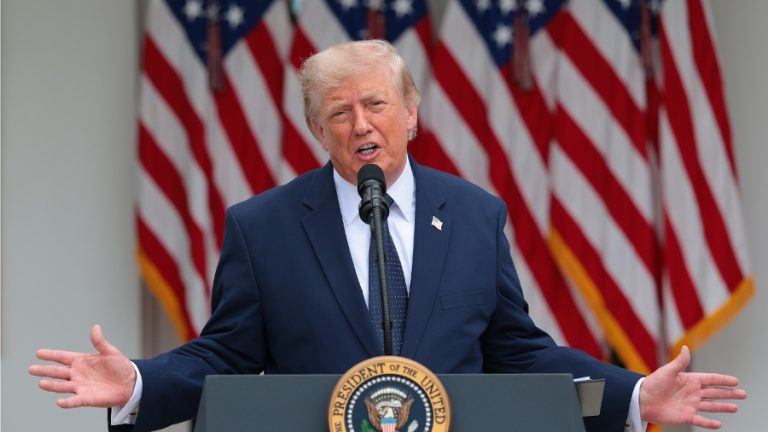
During a dinner with Republican Party lawmakers this week, U.S. President Donald Trump offered an unusually candid behind-the-scenes look at his recent meeting with Chinese President Xi Jinping — a moment he described as “one of the strangest things” he had ever witnessed.
The highly anticipated Trump–Xi summit in Busan took place as U.S.–China relations remained tense. Trump, known for his unscripted and often humorous style, told lawmakers that Xi “is a tough man, very strong and very smart,” reiterating a view he has expressed about world leaders he considers formidable — friend or foe alike.
But what followed, he said, left him astonished.
“At the meeting table, Xi was sitting there with about six people on each side. Every one of them sat up perfectly straight — like they were standing at attention,” Trump recalled, describing a scene of rigid discipline unlike the more relaxed atmosphere typical of Western diplomatic talks.
Trying to break the tension, Trump said he made small talk with one of the Chinese officials. “I said something friendly — but he didn’t react at all,” Trump recounted.
Success
You are now signed up for our newsletter
Success
Check your email to complete sign up
“When I joked, ‘Aren’t you going to answer me?’ he still didn’t move a muscle.”
Perplexed, Trump pressed the matter — until he realized why: “Turns out, Xi wouldn’t allow him to speak.”
The revelation drew laughter from the dinner crowd. But to Trump, it revealed something deeper. “I’ve never seen anyone sit so straight,” he said. “And I’ve never seen anyone so afraid of another person.”
‘All questions are answered by me’
To test whether it was a coincidence, Trump said he turned to another senior Chinese official, “someone whose rank looked about the same as a vice president.”
“I asked him a question too — same thing, no response,” Trump said.
Finally, Xi intervened, explaining matter-of-factly: “All questions are answered by me.”
For Trump, that moment crystallized what he saw as the defining contrast between the two systems: absolute hierarchy and fear versus independence and debate.
He quipped to laughter, “I wish my Cabinet could be that disciplined sometimes.”
Then, turning to Vice President J.D. Vance, who was present at the dinner, Trump joked: “JD never sits that quietly — he’s always interrupting me!”
The comment brought another round of laughter — but it also underscored a deeper point about political culture. In the U.S., even a vice president is expected to speak freely, a far cry from the rigid obedience Trump said he witnessed around Xi.
Trump’s retelling blended humor with insight into what he saw as the profound difference between Chinese and American leadership styles.
On one hand, Xi’s circle projected strict order, where even the smallest gestures signaled deference to a single authority.
On the other, Trump’s own environment was one of constant debate and interruption — often to his frustration, but ultimately reflective of democratic norms.
“I’d like JD to stay quiet for a few days,” Trump said with a grin, “but I’ll still keep him around — he’s too good to let go.”
That line, equal parts jest and acknowledgment, reflected Trump’s own understanding of governance in a democratic system: disagreement is inevitable, and even disruptive voices have a place.
Two political systems, two sources of power
Beyond the humor, the “strange scene” offered an unfiltered glimpse into two vastly different political cultures.
Xi’s command structure, Trump suggested, relies on fear and total obedience — the embodiment of centralized power. Every question, every response, must pass through the top.
Trump’s offhand remark — “I’ve never seen anyone so afraid” — hinted at the authoritarian discipline underpinning China’s leadership culture.
By contrast, in the American model, authority stems from law, institutions, and open debate. Even the president’s team can challenge him without fear.
For observers, Trump’s anecdote inadvertently illustrated how personal authority in autocratic systems contrasts sharply with institutional authority in democracies — a difference that continues to define U.S.–China relations.
The Busan meeting, held on the sidelines of the APEC Summit, was the first face-to-face encounter between Trump and Xi since the start of Trump’s second term. It took place against a backdrop of trade negotiations, fentanyl agreements, and regional security concerns.
While official readouts from both sides described the talks as “constructive,” Trump’s off-the-record remarks revealed the personal impressions shaping his approach to diplomacy.
His retelling — half-humorous, half-analytical — highlighted not only the human side of great-power politics but also the cultural gap between two leaders who command global influence in entirely different ways.
As Trump’s laughter-filled dinner story made its rounds in Washington, it served as both entertainment and subtle commentary: even in high diplomacy, personality, hierarchy, and political culture can define the tone of the world’s most consequential relationship.