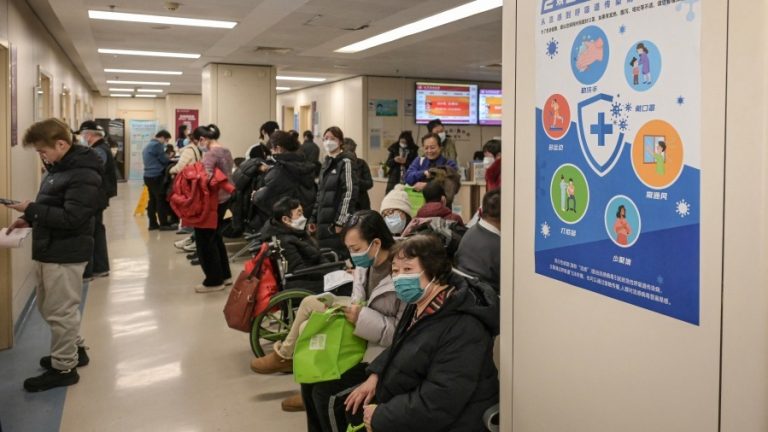
Hospitals across China are being swamped with patients as a wave of respiratory illnesses sweeps the country. Doctors say influenza is spreading rapidly alongside rhinovirus and respiratory syncytial virus (RSV) — both of which have no vaccine or antiviral treatment.
China’s CDC said several respiratory viruses are circulating at the same time. Influenza has become the leading pathogen detected at national sentinel hospitals, making up 17.5 percent of all positive respiratory samples.
Children aged 5 to 14 are the most affected group, and outbreaks in schools have climbed sharply, according to Red Star News.
Rhinovirus infections are also rising, particularly among children under 14, while northern provinces are reporting an uptick in RSV cases. Health authorities warned that China has now entered its peak season for respiratory diseases.
At Peking University People’s Hospital, Dr. Zhang of the Department of Respiratory and Critical Care Medicine said RSV primarily affects infants and toddlers under two years old. Typical symptoms include runny nose, fever, and cough, while severe cases can cause wheezing and breathing difficulties.
Success
You are now signed up for our newsletter
Success
Check your email to complete sign up
Rhinovirus, by contrast, tends to cause milder cold symptoms such as nasal congestion and sneezing.
Neither virus has a specific treatment, and doctors rely mainly on fever relief and supportive care.
H3N2 influenza driving hospital crowds
The H3N2 flu strain is fueling the surge in hospital visits. According to CDC data, influenza activity increased in both northern and southern China between Oct. 27 and Nov. 2.
During that week, 347 influenza outbreaks were reported nationwide — including 245 cases of A(H3N2) and three of A(H1N1)pdm09 — more than double the previous week’s total and nearly 90 times higher than in early October.
Analysts note that the true number of cases could be far higher than official figures suggest.
A Shenyang-based news outlet reported on Nov. 7 that school outbreaks have spiked sharply. In Henan Province, the First Affiliated Hospital of Henan University of Chinese Medicine saw pediatric visits exceed 4,000 in a single weekend.
Many Chinese social media users are calling the current H3N2 variant a “new strain,” describing symptoms that “knock people down instantly” and infect entire families.
Local reports cited studies showing that a single sneeze can release droplets carrying up to 260,000 flu virus particles that can travel as far as eight meters.
Videos posted on Douyin (China’s TikTok) show packed hospitals in Ningbo, Shanghai, Wuhan, Nanjing, Hefei, Changchun, and Tianjin. In some pediatric wards, patients line the hallways as beds run out. “It’s impossible to get admitted,” one user said.
On Nov. 5, China’s CDC issued an alert urging the public to guard against influenza and other acute respiratory diseases, including avian influenza, hand-foot-and-mouth disease, norovirus gastroenteritis, chikungunya, dengue fever, monkeypox, and carbon monoxide poisoning.
The agency said current surveillance data point to rhinovirus, enterovirus, influenza, and RSV as the main causes of acute respiratory infections. Influenza and enterovirus positivity rates are climbing, while RSV remains high and continues to rise in northern provinces.
By Li Muzi