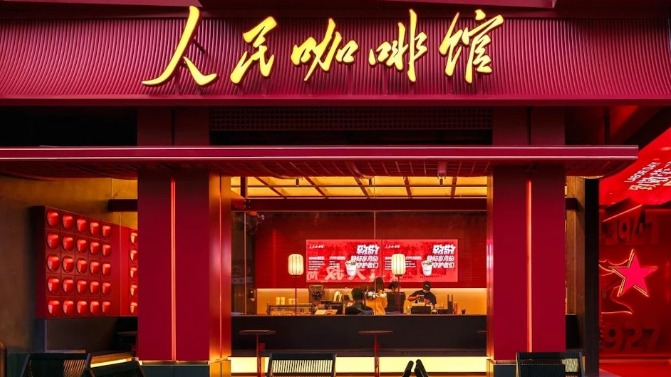
Recently, a mainland Chinese shop called “People’s Cafe” (人民咖啡館) was denounced by Chinese Communist Party (CCP) state media for “using the name of the people” to sell products, with authorities demanding rectification. The incident triggered a storm of discussion online, with many comments expressing the sentiment that “in China, even selling coffee has to be politically correct.”
The interior of People’s Cafe is decorated primarily in red, with political slogans covering the walls. At the entrance, the slogan “People’s Coffee for the People” is prominently displayed. Many customers initially thought it was a state-owned enterprise or a government-backed brand, though it is in fact privately owned and operated.
Recently, the CCP’s People’s Daily Online published a commentary stating that People’s Café is a private business, and that the word “people” carries strong public and political significance. Therefore, it should not be used as a logo for a commercial coffeehouse.
The calligraphy used for the logo of “People’s Café” is written in the same style as the Chinese characters for “People’s Daily,” posibly leading to the criticism.
The People’s Daily article noted that the café chain has opened nearly 30 directly operated stores across 20 cities in 18 provinces in China. Its parent company, Yaochao Culture Communication Co., Ltd., has repeatedly applied to trademark the name People’s Café, but all applications were rejected. The company currently holds only the registered trademarks “Chao People’s Café” and “Yaochao People’s Café.” Nevertheless, similar stores using the People’s Café label have appeared nationwide, drawing in customers eager to “check in” and post online.
Success
You are now signed up for our newsletter
Success
Check your email to complete sign up
According to Legal Daily, lawyer Li Changqing of Beijing Longan Law Firm saod that the term “people” is a core symbol of China’s political system, and using it for a commercial brand could mislead the public into thinking the company has a state background, thus “deceiving consumers.” He added that such behavior could be deemed as “violating public order and good customs” or “causing adverse social impact.”
The Nanjing Morning Post reported that on Oct. 8, the café released a statement pledging to strictly follow trademark registration rules in all its branding. Shortly after, all its stores on the mainland swiftly renamed themselves “Yaochao People’s Café.” However, its branches in Hong Kong, Macau, and overseas continue to operate under the original name People’s Café.
Although the company has quietly rebranded, the controversy fueled opnline debate over the “privatization of political language” and excessive censorship of expression, with amny users criticizing the absurd and hypersensitive political boundaries that pervade everyday commercial life in China.
Netizens quickly joined the discussion:
“Why can hospitals use the word people but he can’t? You pay money, and he gives you coffee — where’s the deception? Meanwhile, hospitals take huge sums and sometimes still can’t cure your illness.”
“If he truly serves the people, why not let him use the name? And if he doesn’t, what harm does the name do?”
Others mocked:
“The people can’t drink People’s Coffee — they can only accept People’s Criticism.”
“Even naming a café now requires political vetting. What’s next — pledging loyalty to the Party before you can drink coffee?”
“People’s Court, People’s Procuratorate, People’s Hospital, People’s Bank — which of them actually serves the people?”
Current affairs commentator Li Linyi remarked that the CCP has long monopolized both the use and interpretation of the term “people,” claiming to represent the entire Chinese nation. But more and more citizens are realizing that the so-called government institutions “serving the people” are in fact oppressing the people, while in fact existing to serve the Party and its officialdom.
By Cai Siyun (蔡思雲).