A senior People’s Liberation Army (PLA) official has called on the Chinese military to “live a tight life” and redirect all resources toward combat readiness, raising speculation about Beijing’s strategic intentions.
In an article published in a “study guide” for the Chinese Communist Party’s upcoming 15th Five-Year Plan, Qiu Yang, deputy director of the General Office of the Central Military Commission (CMC), urged the PLA to eliminate “bottlenecks” that hinder fighting capacity and ensure that “all efforts are focused on preparing for war.”
Qiu outlined five key priorities, including unified planning of war and construction readiness, greater efficiency, and sustainable development. He also proposed stricter audits of the defense budget and procurement system to reduce training and logistics costs.
The South China Morning Post reported that Qiu’s comments mark a rare instance of the PLA using the phrase “live a tight life,” a slogan more commonly applied to China’s civilian bureaucracy. His remarks followed a 2024 CMC directive promoting “frugality in the military” and improving the efficiency of defense resources.
Analysts: Military spending strained despite rising budget
Shen Ming-shih, a researcher at Taiwan’s Institute for National Defense and Security Research, said the PLA’s call for austerity reflects growing financial strain.
Success
You are now signed up for our newsletter
Success
Check your email to complete sign up
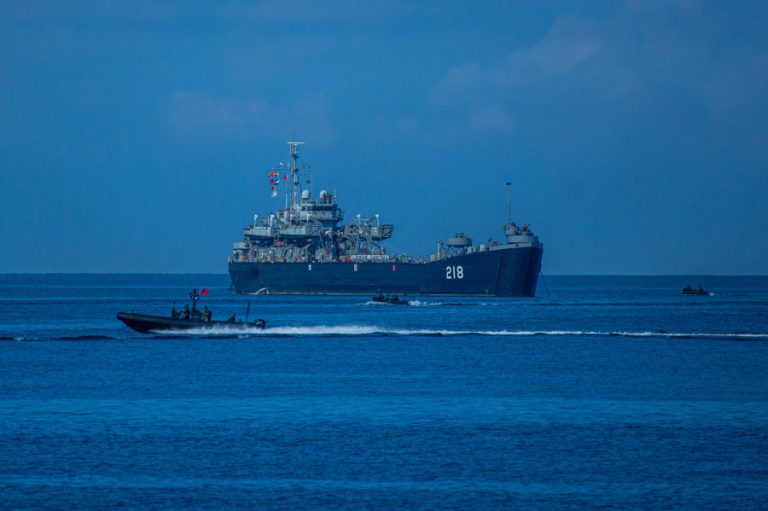
“Large-scale exercises around Taiwan, continuous flights and naval patrols — all of these cost enormous sums,” Shen said. “The fact that Beijing is invoking ‘frugality’ shows the military budget is under severe pressure.”
Exiled Chinese legal scholar Yuan Hongbing, based in Australia, told overseas Chinese media that Qiu’s essay signals preparations for “comprehensive war.” He argued that the CCP leadership is attempting to prove that, despite an ongoing purge within the armed forces, Xi Jinping can still command full wartime readiness to project strength internationally.
Yuan claimed that although China faces a deep economic crisis, Xi continues to divert confiscated corruption proceeds from purged officials into expanding the security and intelligence apparatus — resources he believes could also support war preparations against Taiwan.
Since mid-2023, China’s military has undergone an extensive anti-corruption campaign targeting the PLA Rocket Force, procurement departments, and major defense contractors.
By late 2025, senior leaders such as Vice Chairman He Weidong and CMC member Miao Hua were formally expelled from the Party.
According to Yuan, the purge has implicated more than 3,000 senior officers above the colonel rank. “The damage to command structures is profound,” he said, comparing the crisis to the political fallout from the Lin Biao incident under Mao Zedong.
Yuan added that the campaign has left many key posts vacant, describing the PLA’s leadership apparatus as “crippled,” a scenario that poses a serious challenge to Xi’s centralized control.
German media: Beijing could exploit US election chaos
Adding to growing international concern, Germany’s Bild newspaper recently cited intelligence assessments suggesting that if the United States experiences political unrest following its Nov. 3, 2026 midterm elections, the CCP leadership might attempt a military strike on Taiwan.
The report, discussed by U.S.-based commentator Tang Jingyuan on his online program, said Chinese strategists expect the U.S. to face internal divisions — potentially between the Republican and Democratic parties — that could distract Washington’s attention from the Indo-Pacific.
Citing German security expert Ulrich Schmid-Sturmbaum, Bild said Beijing is converting dozens of civilian ferries for military use and plans to build at least 70 large vessels by late 2026.
In August 2025, German Foreign Minister Johann Wadephul voiced similar concerns, warning that “China’s increasingly aggressive behavior in the Taiwan Strait, East China Sea, and South China Sea threatens global stability.” He added that democratic nations must jointly uphold an international order “based on law and universal rules.”
Between ambition and reality
Although the Chinese Communist Party may still harbor ambitions to seize Taiwan by force, its sweeping purge of the People’s Liberation Army has left the military severely weakened.
Exiled legal scholar Yuan Hongbing noted that the “political disloyalty” cases involving Miao Hua and He Weidong have implicated more than 3,000 PLA officers at the rank of colonel or above.
According to Yuan, insiders within China’s system believe the fallout from the scandal could deal Xi Jinping a heavier blow than the so-called Lin Biao “treason case” once did to Mao Zedong.
He added that after the purge, many key command posts remain vacant, leaving the PLA’s leadership apparatus “incomplete and fragmented” — a situation he described as a major crisis for Xi’s one-man rule.
On the eve of the CCP’s Fourth Plenary Session, China’s Ministry of National Defense announced the expulsion of nine PLA generals, including He and Miao, underscoring the scale of Xi’s purge of his own loyalists.
Meanwhile, U.S. President Donald Trump made no public mention of Taiwan during his latest meeting with Xi.
Taken together, analysts say that even if Beijing retains the intent to invade Taiwan, the combination of internal disarray and shifting global dynamics has turned that ambition into little more than wishful thinking.