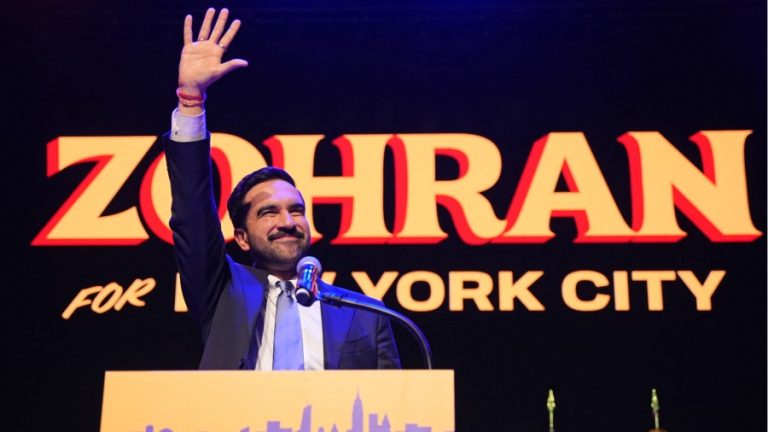
Newly elected socialist mayor Zohran Mamdani delivered his first post-election remarks, which drew a range of reactions from supporters and critics.
Before the election, Mamdani campaigned on a platform focused heavily on affordability for working‑class New Yorkers. His slogan emphasized ideas such as “a city we can afford,” with policy promises like making city buses fare‑free, freezing rents for rent‑stabilized units, expanding permanently affordable housing, and providing universal childcare.
However, immediately after his victory, he said: “There were a few months ago where I told supporters across the city to stop donating, and today I am asking them to start once again.”
The remark quickly sparked widespread discussion online, with some critics questioning the feasibility and funding of his proposed social programs.
‘So, the free lunch requires us to pay first!’
Social media platforms were flooded with critical comments. Netizens expressed sentinents such as:
Success
You are now signed up for our newsletter
Success
Check your email to complete sign up
“So, the free lunch requires us to pay first!”
“He asks for donations today, and tomorrow he’ll demand a ‘revolutionary tax.'”
“There is such a thing as a free lunch—it’s just bought with other people’s money.”
Some observers argued that Mamdani’s agenda, while rooted in ideals of equality and welfare, may face significant financial and practical challenges similar to those seen in past attempts at large-scale social programs.
As one netizen wrote, “Mamdani’s victory will be the most expensive political lesson in U.S. history—when people vote for ‘free everything,’ they may soon discover that nothing comes free—except regret.”
Within days, some New York voters expressed second thoughts about their choice, saying they wanted to see how Mamdani’s promises translate into policy. A few even suggested that public demonstrations could follow if expectations aren’t met.
Mamdani provokes Trump? He may have chosen the wrong battle
In his victory speech, Mamdani struck a defiant tone toward the Trump administration, saying, “Donald Trump: If you come for one of us, you’re going to have to go through all of us.”
Trump responded, “I think it’s a very dangerous statement… He has to be a little bit respectful of Washington, because if he’s not, he doesn’t have a chance of succeeding.” Trump further warned that federal appropriations are controlled by the President, and “If Mamdani wants to make New York work, he better learn to bow his head first.”
Some observers interpreted Trump’s response as a subtle reminder that federal funding remains under White House control, potentially limiting Mamdani’s influence. Others noted that the contrast between Trump’s fiscal approach and Mamdani’s expansive social agenda could make the new mayor’s tenure a political test case closely watched by both parties.
During his victory anniversary address, Trump stated, “On Nov. 5, 2024, the American people took back their government and reclaimed our national sovereignty. We saved the economy, and we saved this country.” Some analysts viewed the remark as a veiled critique of Mamdani and other progressive leaders, while others saw it as a broader reaffirmation of Trump’s political agenda.
Democratic party splits: Showdown between radicals and reality
After taking office, Mamdani criticized the Democratic Party leadership, calling it “weak, compromising, and losing its soul.” His confrontational stance surprised some within the party and highlighted growing divisions between its progressive and establishment wings.
Several party insiders warned that Mamdani’s “extreme-left label” could drag down the Democratic Party’s moderate voter base nationwide, further splintering the already fragile “anti-Trump front.”
As House Speaker Mike Johnson said: “Socialists win most easily when they run by promising everything for free—who doesn’t like to hear that? But this is just a sweet trap, because the promises cannot be fulfilled. The ultimate victims are the voters who were drawn in by those promises.”
The exodus and collapse of trust
Mamdani’s victory prompted mixed reactions among residents, with some expressing concern about the city’s direction and with many considering leaving the state.
The New York Post reported that shortly after the election results, several families reached out to educational consultants about transferring their children to private schools outside the city. Some cited concerns about Mamdani’s positions on Middle East issues, like Palestine, and how they might affect the local community climate.
Adding to concerns, Mamdani had publicly stated that if Israeli Prime Minister Benjamin Netanyahu were to visit New York City, he would direct the NYPD to take legal action in line with international law.
This comment drew strong protests from the Israeli government and American Jewish communities.
At the same time, Mamdani’s Muslim identity was also subjected to polarization. According to statistics, negative rhetoric targeting Islam on the X platform (formerly Twitter) soared by 450 percent from September to October. The consequences of this “politicization of faith” will likely not be limited to New York.
The socialist myth
London Mayor Sadiq Khan congratulated Mamdani, saying, “New York has chosen hope over fear.” At the same time, some reports indicate that a number of New Yorkers are considering leaving the city, reflecting mixed reactions to the election outcome.
Mamdani’s story serves as a mirror reflecting the state of American politics. As one commentator put it: “Mamdani is not New York’s hope, but America’s warning bell.”
Mamdani’s tenure is being closely watched as a potential test case in political leadership, illustrating the challenges of delivering on ambitious promises while maintaining public trust and confidence.
His landslide victory was seen as part of a growing wave of far-left influence within major U.S. cities. However, analysts warned that his idealistic agenda could strain public finances and accelerate urban decline.
By Chen Jing, Wendy Xue.