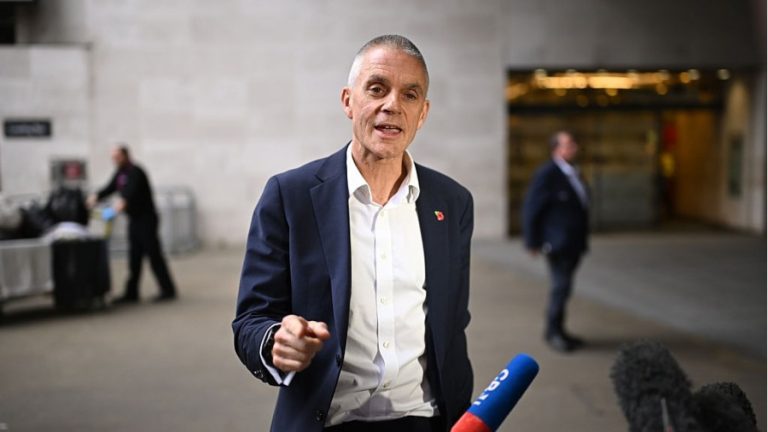
The British Broadcasting Corporation (BBC) has plunged into an unprecedented leadership crisis following the resignations of Director-General Tim Davie and BBC News Chief Executive Deborah Turness.
The resignations were triggered by mounting controversy over the Panorama documentary Trump: Second Chance?, which allegedly misrepresented Trump’s remarks from his Jan. 6, 2021 speech. The scandal has shaken confidence in the editorial independence and impartiality of one of the world’s most influential public broadcasters.
Profiles of the key figures
Tim Davie: The BBC’s Chief Executive
Appointed in September 2020, Tim Davie served as the BBC’s Director-General — the corporation’s highest administrative post overseeing editorial, operational, and creative functions.
Before taking the top job, he led BBC Studios for seven years, gaining extensive experience in production and commercial management. His earlier corporate background included executive positions at Procter & Gamble and PepsiCo, providing him with a diverse understanding of branding and organizational governance.
Success
You are now signed up for our newsletter
Success
Check your email to complete sign up
Deborah Turness: The Head of BBC News
Turness became CEO of BBC News in 2022, overseeing a team of roughly 6,000 staff delivering content in more than 40 languages to nearly 500 million viewers worldwide.
She previously served as CEO of ITN (Independent Television News) and, before that, as President of NBC News, becoming the first woman to head a major U.S. television news network. Her international newsroom experience gave her a deep understanding of editorial accountability and global media standards.
The panorama documentary controversy
The storm centers on BBC’s Panorama episode Trump: Second Chance?, aired just one week before the 2024 U.S. presidential election.
A leaked internal memo — first reported by The Daily Telegraph — revealed serious editing issues that misrepresented Trump’s Jan. 6 speech.
The memo, written by Michael Prescott, a former external advisor to the BBC’s Editorial Standards Committee, alleged that the production team spliced together portions of Trump’s speech delivered more than 50 minutes apart, creating a misleading impression that he had directly incited violence at the U.S. Capitol.
In the original speech, Trump said: “We will walk down to the Capitol to cheer on our brave senators and congressmen.”
However, in the Panorama edit, it was rearranged as: “We will walk down to the Capitol… I will go with you. We are going to fight. We will fight to the death.”
The phrase “fight like hell,” which appeared elsewhere in the speech, was taken out of context and combined with the Capitol reference — a manipulation that dramatically altered meaning. Prescott’s memo warned that such editing “distorted the event” and could lead the public to ask: “Why should anyone trust the BBC again — and where does this end?”
Even more concerning, the memo alleged that BBC management refused to acknowledge a breach of editorial standards when confronted with the issue.
The resignations and their reasons
Facing escalating criticism, both Davie and Turness tendered their resignations.
Turness admitted that the Panorama documentary controversy was “the direct cause” of her decision, writing: “The debate surrounding the Trump documentary has reached a point where it is damaging the BBC — an institution I deeply love. As CEO of BBC News and Current Affairs, I take full responsibility.”
She added: “While mistakes were made, I must be clear that the recent claims of systemic bias in BBC News are wrong.”
Davie’s statement was broader in tone. Although he did not explicitly reference the Panorama film, he conceded that “recent controversies contributed” to his decision: “Overall, the BBC is performing well, but mistakes have been made — and as Director-General, I take ultimate responsibility.”
During his five-year tenure, Davie had weathered multiple crises — from the Gary Lineker neutrality dispute to the Bob Vylan Glastonbury controversy, and complaints about the documentary Gaza: Surviving the War Zone. His reputation as “Teflon Tim” reflected his ability to survive repeated storms, but this one proved decisive.
The timing of his resignation is also strategic: the BBC’s Royal Charter is due for renewal in 2027, with the government set to review the corporation’s funding model, governance, and public mission.
Davie explained: “I want to create the best conditions for my successor to lead the next Charter process. As we move forward, I hope public debate about the BBC’s future remains calm, rational, and informed.”
Observers saw the move as an attempt to “cut off the infected limb” — a crisis management measure aimed at protecting the institution’s standing ahead of critical negotiations.
Erosion of trust and public reactions
Trump welcomed the resignations, declaring that the executives “were caught red-handed doctoring my beautiful (perfect!) Jan. 6 speech.”
He accused the BBC of “dishonesty and election interference,” adding, “This is terrible for democracy.”
Within Britain’s media industry, the reaction was equally severe.
Former BBC News head Roger Mosey said the network’s response was “too slow,” and that the Panorama edit “appears indefensible.”
Dorothy Byrne, former head of Channel 4 News, criticized the BBC for making “a fundamental error in editing” and for taking “too long to issue an apology.”
The BBC Board, chaired by Samir Shah, oversees the corporation’s governance and is responsible for ensuring its public mission. Davie’s successor will become the 18th Director-General in the BBC’s 103-year history.
Potential candidates reportedly include Charlotte Moore, former BBC Chief Content Officer; Jay Hunt, veteran television executive; and James Harding, BBC News Director from 2013 to 2018.
Systemic Issues and Broader Implications
Prescott’s leaked memo pointed to other concerns within the BBC, including alleged anti-Israel bias in its Arabic-language reporting of the Gaza conflict and imbalance in coverage of transgender issues.
The BBC has also faced 20 ongoing complaints regarding anchor Martine Croxall, who altered phrasing in live scripts.
The Panorama fallout strikes at the heart of the BBC’s credibility — its commitment to editorial independence and accuracy.
It could also increase scrutiny from Ofcom, the UK’s broadcasting regulator, and push the BBC to elevate editorial compliance to a board-level risk management priority.
For the incoming leadership, challenges include addressing funding uncertainty, digital transformation, and global competitiveness while restoring public trust.
The resignations of Tim Davie and Deborah Turness mark the end of a defining chapter in the BBC’s century-long history.
More than a single editorial blunder, the crisis has become a test of the BBC’s ability to uphold its founding principles — impartiality, fairness, and trust — in an era of political polarization and media skepticism.