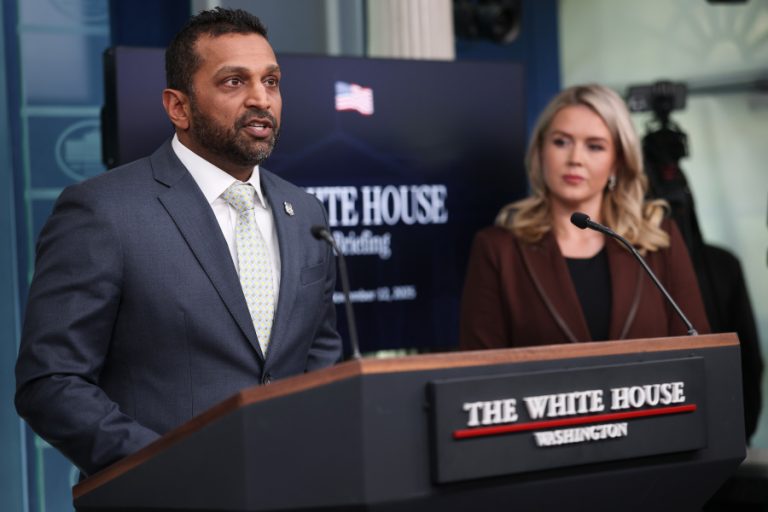
On Wednesday. Nov. 2, U.S. Federal Bureau of Investigation (FBI) Director Kash Patel said at the White House that following his visit to China, Chinese authorities had agreed to strengthen regulation of fentanyl precursor chemicals and related companies. He described this as a “historic” development and credited the progress to direct high-level communication between the U.S. and China.
Patel said that after meeting with Chinese counterparts, the Chinese government agreed to list all 13 fentanyl precursor chemicals under regulatory control and to strengthen oversight of seven chemical subsidiaries involved in the production of the deadly drug.
At a White House press briefing, he stated that the agreement “effectively cuts off the pipeline for fentanyl production.” He emphasized that the “sole purpose” of his China trip was to eliminate these precursors. Once successful, this would cripple the ability of drug trafficking organizations in Mexico and elsewhere to manufacture fentanyl.
Patel credited the progress to direct communication between former President Donald Trump and Chinese President Xi Jinping, noting that a “historic interaction” between the two leaders several weeks ago paved the way for this announcement.
He also noted that his visit to China last week marked the first time in more than a decade that an FBI director had visited China, with direct meetings with Chinese counterparts to handle these issues. During his time in Beijing, he received “unprecedented” cooperation and commitments.
Success
You are now signed up for our newsletter
Success
Check your email to complete sign up
Patel pointed out that in 2023, the U.S. had designated China as a major producer of illegal drugs. He cited FBI data showing that fentanyl seizures this year increased 31 percent compared to the same period last year, emphasizing that the seized amount—based on its toxicity—could potentially kill 127 million people.
He stressed that while interagency teams and the Department of Justice have been combating drug trafficking, it is essential to tackle the problem at the source—precursor chemicals required to manufacture fentanyl.
Patel also referenced the Trump administration’s 10 percent tariffs on Beijing, accusing China of failing to curb the outflow of precursor chemicals. China later imposed tariffs on the U.S. as well. The Trump administration claimed that Beijing, by subsidizing the export of precursors, did not effectively stop companies from selling to drug cartels, which fueled illegal production in places like Mexico.
According to Newsmax, the measures aim to shift regulatory focus from border seizures to the “chemical source,” with the FBI, Department of Justice, and State Department monitoring China’s implementation. Sanctions and criminal prosecutions may be pursued as needed to continue pressuring transnational drug trafficking organizations.
Patel emphasized that the policy reflects the Trump administration’s principle of “pressuring adversaries, strengthening law enforcement, and protecting the interests of American victims.”
By Gao Yun