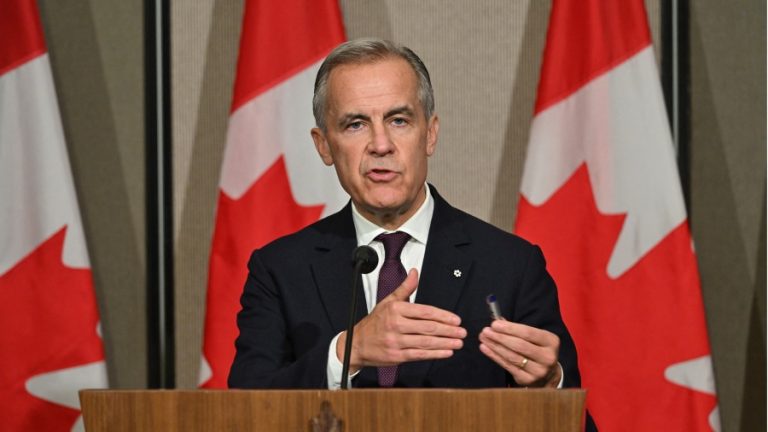
Six months into his tenure, Canadian Prime Minister Mark Carney faces a daunting challenge as Donald Trump’s return to the White House brings steep tariffs on Canadian steel, aluminum, and lumber. Ontario Premier Doug Ford’s $75 million anti-tariff ad campaign has further enraged Trump, stalling U.S.-Canada negotiations. Meanwhile, Carney is pivoting to mend ties with China, meeting Chinese President Xi Jinping at the APEC summit in late October—the first high-level interaction since 2017. Carney also accepted an invitation to visit China. A WSJ article titled “U.S.-Canada Trade War Pushes Carney Toward Xi Jinping” noted the shift, but commentator Jonathan Feng argues that ideological differences make it unlikely for Canada to fully pivot to China, urging Carney not to “seek a tiger’s pelt” for short-term economic gains.
On Oct. 31, during the APEC summit in South Korea, Carney and Xi met for 39 minutes, marking the first formal leader-level interaction since 2017. Carney called it a “turning point” for Canada-China relations, with both sides agreeing to meet again and reduce “friction points,” including Canada’s 100 percent tariffs on Chinese electric vehicles and China’s retaliatory tariffs on Canadian canola, pork, and other agricultural products. Xi invited Carney to visit China, and Carney accepted, aiming to advance cooperation in clean energy and agricultural trade. However, no specific tariff reductions or quantified agreements were announced. China’s reinstatement of Canada as an approved destination for group tourists signals diplomatic thawing, but balancing cooperation with China against USMCA constraints and domestic security concerns remains a core challenge for Carney’s tenure.
Background: U.S.-Canada trade tensions drive China outreach
Since Trump’s return, the U.S. has imposed up to 50 percent tariffs on Canadian steel, aluminum, and lumber, severely impacting Canada’s economy. Trump’s provocative remarks about making Canada the “51st state” have further strained bilateral ties. Canada’s repeated attempts to negotiate tariff reductions have yielded little progress. Ontario Premier Doug Ford’s $75 million ad campaign in the U.S., invoking former President Reagan to criticize Trump’s trade policies, backfired, infuriating Trump and halting talks last week. U.S. Ambassador to Canada Pete Hoekstra publicly criticized Canada for “burning bridges,” and Trump refused to meet Carney at the APEC summit.
Jonathan Feng called Ford’s ads “reckless and laughable,” arguing they embarrassed Canada internationally and severed delicate U.S.-Canada negotiation channels. He dismissed claims that Trump’s actions are “pushing Canada into China’s arms,” noting that U.S.-Canada trade disputes are mere “family squabbles” over economic shares, while Canada and China face irreconcilable ideological divides. Canada, he argued, won’t pivot to China, as Beijing lacks the capacity to absorb Canada’s trade volume with the United States. Feng blamed Ford’s recklessness for forcing Carney into a humiliating position of seeking to restart U.S. talks, which remain stalled.
Amid U.S. tensions, Carney is exploring China’s market to bolster Canada’s economy. Canada seeks to reopen markets for canola, pork, and seafood, hit by China’s retaliatory tariffs over Canada’s 100 percent electric vehicle duties. Carney emphasized, “China is our second-largest trading partner and the world’s second-largest economy with immense influence. The seven-year gap in high-level contact must end.” Since the 2018 Huawei executive Meng Wanzhou incident, Canada-China relations have been strained, exacerbated by China’s detention of Canadians Michael Kovrig and Michael Spavor, Canada’s accusations of Chinese election interference, and its labeling of China as a “disruptive global power” in its Indo-Pacific strategy. Carney’s meeting with Xi marks a critical step toward breaking the deadlock.
Success
You are now signed up for our newsletter
Success
Check your email to complete sign up
Is Carney ‘seeking a tiger’s pelt?’
Carney’s plan to repair Canada-China ties focuses on economic benefits to offset U.S. tariffs. Canada has begun exporting natural gas to China, calling it a “strategic partner.” China noted “positive momentum” in bilateral ties. Carney’s June call with Premier Li Qiang and September meeting in New York laid groundwork for the APEC summit. However, Beijing insists Canada must lower its 100 percent electric vehicle tariffs before China lifts restrictions on Canadian agricultural products, forcing Carney to balance protecting Canada’s agriculture and auto industries.
While the Carney-Xi meeting may have reached preliminary agreements on limited agricultural trade, CBC and CTV reported no specific tariff reductions or quantified deals, noting uncertainty over whether “devastating tariffs” on Canadian canola and Chinese electric vehicles will ease. Michael Kovrig, detained by China for over 1,000 days as a “diplomatic hostage,” told CBC in late October that seeing Canadian leaders shake hands with those who detained him was “uncomfortable.” He warned that China might use “diplomatic packaging” to mask threats, urging transparency in assessing risks and weighing economic benefits against China’s history of coercion.
Bruegel senior researcher Jacob Funk Kirkegaard noted, “China is adept at weaponizing relationships.” He cautioned that China’s market access offers could pressure Canada to ease electric vehicle tariffs, potentially flooding Canada with cheap Chinese vehicles and harming its auto industry. While canola-producing region leaders support trading tariffs for market access, Carney remains cautious, warning that an auto deal with China could damage U.S. relations. “It’s not simple,” he said before the meeting. “The auto industry is complex, and we can’t expect to open doors to China without impacting U.S. ties.” Former Trudeau deputy chief of staff Brian Clow also warned to be wary of China’s tariff tactics.
Jonathan Feng criticized Carney’s approach as shortsighted, arguing that seeking China’s help across the Pacific to address Canada’s trade woes is unwise. With global trade systems decoupling from China under U.S. pressure, Carney’s strategy risks leading Canada into a “dead end,” potentially making it collateral damage in China’s economic struggles. He claimed China doesn’t take Canada seriously, and lowering electric vehicle tariffs for agricultural market access is mere lip service. Feng argued China values Canada’s geographic proximity to the U.S., using it for “asymmetric warfare” like exporting fentanyl precursors, harming North American youth. Carney’s strategy, he warned, is akin to “seeking a tiger’s pelt” or “climbing a tree to catch fish.”
USMCA constraints and geopolitical risks
Carney’s strategy is limited by the USMCA, which prohibits signatories from entering agreements with “non-market economies” like China. Feng noted that while USMCA may not fully suit current dynamics, Canada’s geographic and economic dependence on the U.S. is a double-edged sword. Deepening trade with China could weaken U.S.-Canada trade, as U.S. laws may block Canadian exports containing Chinese components or technology, deemed national security threats. Feng warned that pivoting to China or the Indo-Pacific risks Canada walking a “tightrope on thin ice.”
Carney’s outreach to India faces similar hurdles. Feng argued that India, under Modi, opportunistically capitalizes on global supply chain shifts, attracting Western investment while buying cheap Russian energy. Historical tensions over immigration and a past airline hijacking make India an unlikely priority partner for Canada. Feng questioned whether deals with China or India offer long-term benefits, calling them “short-term, quenching thirst with poison.”
Carney’s China outreach faces domestic scrutiny, fueled by concerns over Chinese election interference, investment security, and human rights since the Meng Wanzhou incident. While the Xi meeting may signal progress, it risks criticism for compromising national security and values. Feng warned that Carney’s moves could undermine Canada’s security and shared cultural values with the U.S., noting Canada’s 200-year struggle to avoid U.S. annexation. Aligning with an “ideological outlier” like China, he argued, risks a “Faustian bargain,” sacrificing long-term interests for short-term relief and eroding the natural goodwill with the U.S.
Carney faces a high-stakes geopolitical gamble: managing U.S. tariff pressures, cautiously engaging China without provoking its key ally, and addressing domestic security concerns. Feng’s critique reflects fears among some Canadians that Carney’s strategy is misguided. Rather than choosing sides between the U.S. and China, Canada should focus on strengthening its role in the democratic supply chain alliance.
By Xiao Ran