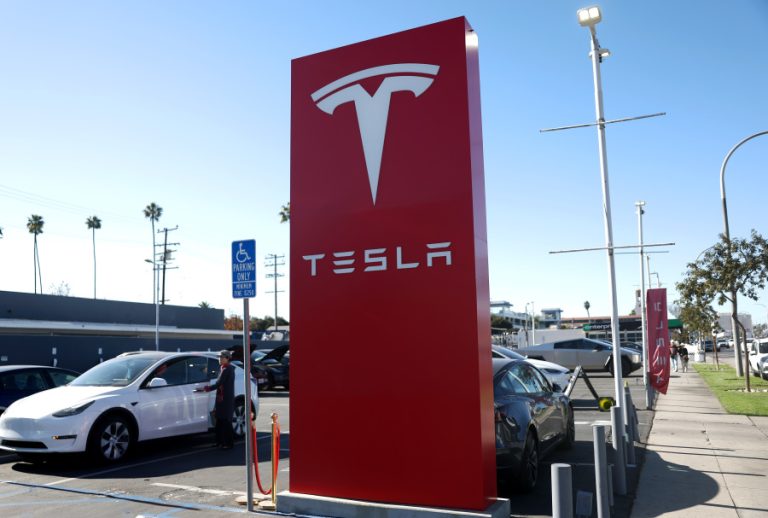
On Friday, Nov. 14, The Wall Street Journal reported that electric-vehicle maker Tesla has begun requiring its suppliers to remove China-made components when producing vehicles for Tesla’s U.S. factories.
Sources told the Journal that under CEO Elon Musk’s direction, Tesla and its suppliers have already replaced some China-made parts and plan to shift all remaining related components to production outside China within the next one to two years.
The report noted that years of ongoing U.S.–China trade disputes—and the constant tariff adjustments that come with them—have complicated how automakers set pricing strategies.
A Reuters report in April said Tesla had significantly increased its reliance on North American suppliers for its U.S. factories over the past two years to counter the risk of rising tariffs.
Meanwhile, Tesla’s performance in the Chinese market has been uneven. Earlier this month, data from the China Passenger Car Association showed that Tesla’s China-made EV sales reached 61,497 units in October, down 9.9 percent year-on-year, reversing the 2.8 percent year-on-year growth seen in September.
Success
You are now signed up for our newsletter
Success
Check your email to complete sign up
Production of the Shanghai-built Model 3 and Model Y (including exports) also fell 32.3 percent from September.
Reuters reported that growing U.S.–China tensions throughout 2025 have kept auto-industry executives in “crisis mode.” Under President Trump’s tariff policies, along with repeated panic over rare-earth bottlenecks and chip shortages, more automakers are re-evaluating their dependence on China as a key source of components and raw materials.
GM orders suppliers to remove China-made parts
This week, General Motors (GM) was also reported to have instructed thousands of suppliers to remove China-made parts from its supply chain.
According to a Nov. 12 Reuters report, GM issued the directive to strengthen the company’s “resilience” amid geopolitical tensions. Some suppliers were told to fully end procurement from China as early as 2027.
GM began conveying this requirement to certain suppliers in late 2024, but the rapid escalation of the 2025 U.S.–China trade war has made the process more urgent. GM executives said this move is part of a broader strategy to improve supply-chain stability and control.
Industry sources said that geopolitical tensions, fluctuating tariffs, and supply-chain risks involving rare earths and chips have kept auto executives in “emergency response mode” throughout 2025. The Trump administration’s push for reshoring investment has also driven companies to reassess their long-term dependence on China.
Reuters noted that GM has already been restructuring its EV battery-material and chip supply chains, partnering with U.S. rare-earth companies and investing in Nevada lithium mines. But the new directive is broader in scope, targeting more fundamental and high-volume components and raw materials.
GM CEO Mary Barra said in a quarterly earnings call that the company has spent recent years building supply-chain resilience and aims to source as many parts as possible in the same country where vehicles are assembled. GM’s global purchasing chief Shilpan Amin stressed that supply-disruption risks mean automakers can no longer rely solely on the lowest-cost country.
The report added that China dominates fields such as automotive lighting, electronics, molds, and stamped parts, making supply-chain relocation slow and costly. Colin Shaw, head of the U.S. Vehicle Suppliers Association, said many supplier relationships took 20–30 years to build, and dismantling them in just a few years is “nearly impossible.”
Although China and the U.S. agreed to roll back some tariffs and export restrictions after the late-October Biden–Xi meeting, concerns continue to rise over rare-earth export controls and chip-supply disruptions. For example, China’s recent suspension of shipments to Nexperia triggered industry warnings of potential large-scale factory shutdowns.
Tesla and Samsung in talks as Tesla advances ‘de-China-ization’ of its supply chain
At the same time, Tesla is aggressively restructuring its supply chain for its energy and storage business. According to a Reuters report on Nov. 4, South Korea’s Samsung SDI confirmed it is in talks with Tesla to supply energy-storage batteries—considered another key step in reducing Tesla’s reliance on China-made critical components. Samsung SDI said the deal is not yet finalized.
The Korea Economic Daily reported that the potential three-year contract could exceed 3 trillion won (about US$2.11 billion). China’s “Autohome” later reported, citing Samsung SDI regulatory filings, that the discussed volume is 30 GWh of storage batteries over three years—about 10 GWh per year—valued at 1–1.5 trillion won annually.
If finalized, the deal would mark a major shift in Tesla’s energy-storage business. According to Chinese media, Tesla currently relies heavily on Chinese suppliers (especially CATL) for storage batteries, and U.S. tariffs have had an “excessive impact” on Tesla’s energy division.
In April, Tesla CFO Vaibhav Taneja said the company is actively seeking suppliers outside China to ease tariff pressures.
Tesla has also signed chip and battery-supply agreements with Samsung Electronics and LG Energy Solution. In July, LG Energy Solution announced a three-year, 5.9-trillion-won LFP battery order widely believed to be from Tesla.
Analysts say that if Samsung SDI successfully enters Tesla’s North American storage-battery supply chain, Samsung and LG would form a “dual-insurance” setup. This would help Tesla meet Inflation Reduction Act tax-credit requirements, reduce costs, and strengthen competitiveness.
By Gao Yun