The dust has settled from the CCP’s 20th Central Committee Fourth Plenum in October 2025, but the political tremors triggered by the downfall of He Weidong and a wave of senior PLA commanders continue to spread.
He Weidong’s purge marks the first time in nearly six decades that a sitting vice chairman of the Central Military Commission has been removed from office. The last occurred during the Cultural Revolution with the fall of He Long.
As state media rushed to defend Xi Jinping, questions swirled over what lay behind the narrative—and how deeply He’s rise and fall were tied to Xi’s political fortunes.
To understand the impact, one must start with He Weidong’s origins.
A grassroots past in Jiangsu
Born in May 1957 in Nanping, Fujian, He Weidong was rooted in Dongtai, Jiangsu. Both parents hailed from Xuhe Town. His father, He Liangyu, joined the army in 1946; official records do not list his mother’s name. Once he reached the upper ranks, he often described his father as a “southbound cadre,” referring to those who moved south after the civil war to take over newly controlled territories.
Success
You are now signed up for our newsletter
Success
Check your email to complete sign up
After He Liangyu transferred to Nanjing, young He returned with his mother to Dongtai and attended a local school for a year—an episode missing from his official biography. A now-scrubbed local newspaper profile captured fragments of his early life: waterways, bridges, fields of corn and wheat, and memories of his grandfather roasting unripe wheat into a simple snack. He also recalled breakfasts of corn grits mixed with crab paste and steamed clams.
Another online post described his grandfather’s trade of fluffing cotton by hand, traveling from house to house and earning meals—details that painted He’s background as decidedly modest.
Insiders later suggested that He’s father had never been more than a regular soldier, eventually becoming an instructor at the Nanjing Military Academy but never holding rank.
Beginning a military life in Fujian — And meeting Miao Hua
In December 1972, He enlisted at age 15, joining the 91st Division in Fujian. He would not return to Dongtai for more than forty years, until he became deputy commander of the 31st Group Army.
Three years before he enlisted, a fellow Jiangsu native also entered the PLA from Fujian: Miao Hua, serving in the 274th Regiment of the 92nd Division. The two met during training and became close.
Miao, born in Fuzhou in 1955, quickly married into military leadership—the daughter of the 31st Group Army’s political commissar—and rose rapidly. He, by contrast, spent more than six years as an ordinary soldier before being selected for officer training in 1978. It took him nearly two decades to reach the role of division chief of staff.
Miao’s promotions continued, eventually making him He’s superior.
Two men climbing through patronage
From 1985 to 2002, Xi Jinping held a series of posts in Fujian. During this period, he visited the 31st Group Army at least 14 times, often meeting officers like Miao Hua, who was then rising in political work.
Compared with He, Miao’s connection to Xi was closer. But Xi—still politically constrained by his father’s marginalization—was not yet in a position to elevate others.
Miao also benefited from the patronage of Chen Bingde, a fellow Jiangsu native who later became PLA chief of staff. This support propelled Miao through a sequence of political posts, culminating in his leadership of the PLA’s political system after 2015.
He Weidong’s path was slower. His early promotions came from commanders in the Nanjing Military Region, including Lin Bingyao and Wang Ning. Both played key roles in helping him advance beyond the bottlenecks of his early career.
But He’s most powerful backer was Zhao Keshi, who later joined Xi on the CMC. Zhao promoted Wang Ning, and Wang, in turn, promoted He Weidong.
By 2013, He’s advancement accelerated. He became deputy chief of staff of the Nanjing Military Region, then commander of Jiangsu’s military district, then commander of the Shanghai Garrison. After the 2016 military reforms, he was appointed the first commander of the Western Theater Army. By 2017 he was a lieutenant general.
In 2019, He became a full general and commander of the Eastern Theater Command—Xi’s primary strategic front for Taiwan operations. In 2022, he quietly entered the CMC Joint Operations Command Center. Despite not being a Central Committee member at the 19th Party Congress, he was vaulted directly into the Politburo and appointed vice chairman of the CMC at the 20th Congress.
The Fujian military network emerges
Xi’s preference for “trusted acquaintances” produced several power clusters, including a Fujian military faction centered on He Weidong and Miao Hua.
After Xi dismantled the networks of Xu Caihou and Guo Boxiong, younger officers rose rapidly—particularly after the 2015 military reforms. Many of them later became targets of the sweeping corruption crackdown:
He Weidong, Miao Hua, Lin Xiangyang, Qin Shutong, Wang Xiubin, Yuan Huazhi, and others.
Many had served in the 31st Group Army in Fujian. Others had long-standing ties to Miao’s political system. Together, they formed a recognizable network inside Xi’s military rise.
Two ‘tigers’ in collision
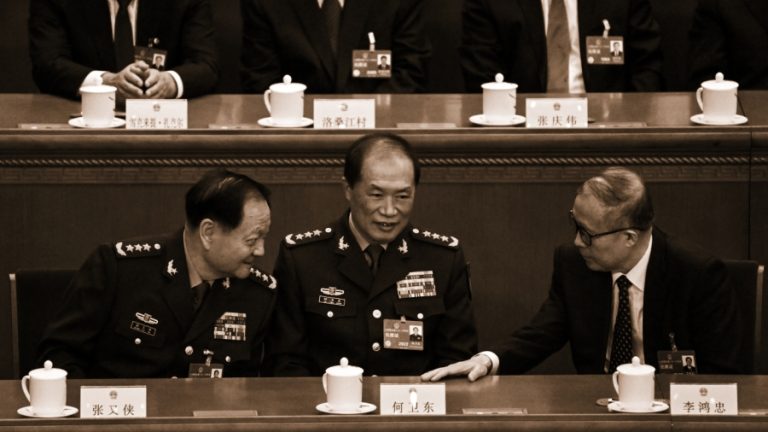
At the 20th Congress, two men were named vice chairmen of the CMC.
Zhang Youxia, the senior of the two, oversaw training, equipment, and operational systems.
He Weidong was responsible for political work—Party discipline, cadre management, and internal oversight.
But He’s ambitions soon grew.
In July 2023, under pressure from both He and Miao, the CMC Equipment Development Department called for reporting corruption in procurement reviews dating back to October 2017. Zhang pushed back, insisting that investigations must not extend into his tenure.
However, rocket force disclosures later suggested corruption reached as far back as 2016, implicating Zhang’s time in office and exposing deep factional tensions.
The rocket force scandal then erupted, bringing down several top officers—including Li Yuchao, Xu Zhongbo, and former defense minister Li Shangfu, a Zhang ally.
He and Zhang’s relationship deteriorated rapidly.
By March 2024, He publicly criticized the PLA’s “fake combat capability” during meetings at the National People’s Congress—remarks widely interpreted as aimed at Zhang.
The crash of the Fujian Clique
According to insiders, Miao Hua fell first after Zhang’s allies reported him for selling offices. Xi approved the investigation, initially offering leniency, but Miao still could not survive politically. After China’s national legislative meetings in March 2025, He Weidong vanished from public view.
In October 2025, the Ministry of National Defense announced investigations into nine full generals—including He, Miao, He Hongjun, Wang Xiubin, Lin Xiangyang, Qin Shutong, Yuan Huazhi, Wang Houbin, and Wang Chunning. Nearly twenty generals were absent from the Fourth Plenum, and hundreds more officers were reportedly implicated.
PLA Daily accused the generals of “severe violations of Party discipline,” betraying the Party’s trust, and damaging the principle of Party control of the military.
Party media then argued that their removal “eliminated political risks,” even though Xi had personally promoted the same officers.
Rumors spread before the plenum that Party elders and Zhang Youxia had pressured Xi. Later, former Central Party School professor Cai Xia claimed He and Miao had built a private military network for Xi—ironically the very reason Zhang was able to move against them.
Seen through this lens, He appears more like Xi’s loyal enforcer than a rival—later rebranded as a scapegoat.
A political earthquake and Xi Jinping’s enduring fear
The outcome of the Fourth Plenum left Xi in power, while Zhang Shengmin—a relatively neutral figure—was elevated to CMC vice chairman without entering the Politburo. Analysts viewed this as a compromise meant to prevent open conflict between Xi and Zhang Youxia.
Despite post-plenum messaging, the purge exposed a hollowed-out command structure: nearly thirty full generals removed, large numbers of mid-ranking officers implicated, and factional networks collapsed.
State media quoted verses to portray Xi as revitalizing the system. Critics instead saw a barren political landscape—“a withered forest”—after years of internal purges.
The Fujian military scandal has become a lingering threat to Xi.
Beyond corruption, He Weidong and Miao Hua were accused of undermining the Party’s control of the military—language often used as shorthand for coup suspicions. Some observers compared He to “a second Lin Biao.”
Even with official claims that risks were removed, Xi remains surrounded by unknown loyalties. Zhang Youxia, who commands real influence, may ultimately pose the kind of threat Mao once faced.
The purge of senior PLA leaders has shaken Xi’s power base. Many now believe the regime is sliding into deeper decline. Xi’s refusal to name a successor may reflect an unspoken truth: in China’s modern history, “red dynasties rarely survive beyond the second generation.”