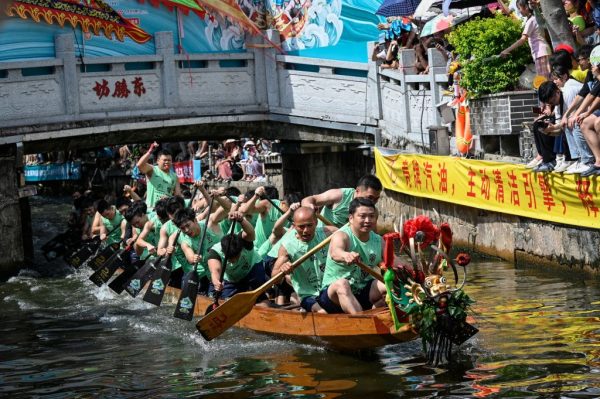
The river-filled regions of Guangdong have maintained the tradition of Dragon Boat Festival races for more than a thousand years. A local proverb says:
“On the eighth day of the fourth lunar month, the dragon boat is dug up from the riverbed.”
This saying refers to an important traditional custom known as “raising the dragon” (qǐ lóng), which marks the preparation of dragon boats for the annual Dragon Boat Festival races.
Raising the dragon
Dragon boat racing has long been a major cultural event in the water towns of Guangdong, particularly in Guangzhou, Foshan, and Dongguan, where dragon boat traditions remain deeply rooted.
To protect dragon boats from the region’s humid climate, insects, and wood deterioration, villagers traditionally bury the boats deep in the mud at the bottom of rivers. This minimizes the wood’s exposure to air and helps preserve the vessel for future use.
Success
You are now signed up for our newsletter
Success
Check your email to complete sign up
The “raising the dragon” ceremony is an essential prelude to Dragon Boat Festival races. Each year on the eighth day of the fourth lunar month, villagers gather at an auspicious time and travel to rivers or ponds to excavate the dragon boats that have been resting underwater.
After the boats are recovered, they are cleaned in a ritual known as “washing the dragon,” then dried, repaired, and decorated. Villagers subsequently begin intensive training for the upcoming races and hold blessing ceremonies to pray for a successful competition.
Once the Dragon Boat Festival races conclude, another ceremony called “returning the dragon” (rù lóng) takes place. The dragon boats are buried once again beneath the riverbed, where they remain until the following year’s “raising the dragon” ceremony.
This annual cycle gave rise to the Guangdong proverb:
“On the eighth day of the fourth lunar month, the dragon boat is dug up from the riverbed.”
The Yanbu Old Dragon
The annual “raising the dragon” ceremony has become a major event in Foshan. Among the most famous dragon boats is the Yanbu Old Dragon, located in Dali Town, Nanhai District, Foshan.
At more than 500 years old, it is considered the oldest surviving dragon boat in China.
According to reports, the vessel’s history can be traced back to the seventh year of the Xuande Emperor’s reign during the Ming Dynasty (1432). Today, the boat is approximately 594 years old.
Constructed from durable Merbau hardwood, the vessel measures 36.8 meters (120.7 feet) in length, excluding the dragon head and tail. It contains 68 seats and weighs approximately 4 metric tons.
Dragon Boat Rice
In addition to the “raising the dragon” tradition, Guangdong people also celebrate the Dragon Boat Festival by eating Dragon Boat Rice, sometimes called Dragon Boat Meal.
This custom reflects the practical wisdom of the region’s water-town communities.
A popular saying goes:
“After eating Dragon Boat Rice, favorable winds and smooth waters will follow.”
Before races, villagers gather to share the meal and good fortune, symbolizing wishes for health, safety, favorable weather, and abundant harvests throughout the year.
Originally, Dragon Boat Rice developed as a hearty meal for rowers, who required significant energy for long hours of paddling.
To keep participants full and energized, the dish traditionally includes filling ingredients such as:
- Glutinous rice
- Regular rice
- Preserved pork
- Dried shrimp
- Squid
- Shredded egg
- Mushrooms
- Diced radish
The ingredients make it somewhat similar to traditional rice dumplings (zongzi).
Because dragon boat racers spend extended periods on the water and are susceptible to cold and damp conditions, garlic, chili peppers, and other warming ingredients are often added to help ward off chill and moisture.
As Dragon Boat Festival celebrations have grown larger over time, the simple Dragon Boat Rice meal has evolved into elaborate Dragon Boat Banquets, becoming a festive gathering enjoyed by entire villages.
By Chu Xin, Vision Times