Japan’s Prime Minister Sanae Takaichi ignited a political firestorm after becoming the first sitting Japanese leader in decades to directly link a Taiwan contingency with potential Japanese military action. Her remarks broke with Tokyo’s long-maintained strategic ambiguity and immediately triggered retaliation from Beijing — while prompting an unusually swift show of support from Washington.
As Chinese state media escalated attacks — with former Global Times editor Hu Xijin branding Takaichi a “malicious witch” — U.S. Ambassador to Japan Rahm Emanuel moved quickly to restate America’s alliance commitments. Posting on social media on Nov. 18, he underscored that the United States “fully stands by its obligations to defend Japan, including the Senkaku Islands (Diaoyu). No number of Chinese Coast Guard vessels will change that.”
His statement came just days after Chinese Coast Guard ships entered waters around the Japanese-administered islands and were driven out by Japan’s Coast Guard. Although the U.S. has never formally recognized Japanese sovereignty over the Senkakus, Washington has consistently affirmed since 2014 that they fall under Article 5 of the U.S.–Japan Security Treaty.
Emanuel’s message, delivered swiftly after the latest Chinese incursions, underlined Washington’s strategic logic: reassure its key ally, signal red lines to Beijing, and maintain deterrence in a region where China’s maritime activity has intensified.
While initial U.S. reactions to Takaichi’s remarks were muted, China’s rapid escalation — including travel warnings and stepped-up maritime actions — pushed Washington to clarify its position.
Japan weighs major shifts in its security policy
Success
You are now signed up for our newsletter
Success
Check your email to complete sign up
Takaichi’s government is also exploring adjustments to Japan’s “Three Non-Nuclear Principles,” which prohibit the possession, production, or introduction of nuclear weapons. Any relaxation would be politically explosive. Still, analysts say the United States has shown little resistance to Tokyo’s recent strategic shifts, suggesting Washington may be open to a more assertive Japanese posture as regional tensions rise.
The prime minister has placed the U.S.–Japan alliance at the center of her national-security agenda and moved to deepen cooperation across the Indo-Pacific. While controversial at home and abroad, her Taiwan comments were widely interpreted as a signal of Japan’s willingness to align more closely with democratic partners in managing China’s rise.
China’s response went well beyond maritime maneuvers. Beijing issued warnings discouraging travel and study in Japan, adding economic and social pressure to the diplomatic dispute.
Japan’s embassy in China, citing shifts in “political and social conditions,” issued an advisory urging Japanese citizens to avoid crowds, remain alert to suspicious behavior, and travel in groups — an unusually explicit caution that underscored Tokyo’s concern.
Takaichi breaks with decades of strategic ambiguity
Takaichi’s remarks in a Diet budget committee session marked a notable departure from Japan’s traditional approach to the Taiwan Strait. She stated that a Chinese blockade or use of force against Taiwan could constitute a “survival-threatening situation,” allowing Japan to exercise its limited right of collective self-defense.
A Kyodo News poll showed 48.8 percent of respondents support her position — a significant shift in public sentiment.
Her stance goes further than that of her political mentor, the late Shinzo Abe, who famously said “a Taiwan contingency is a Japan contingency” only after leaving office.
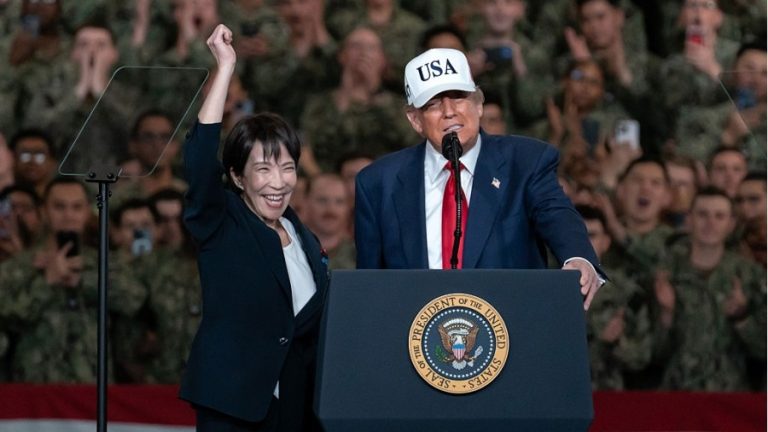
During an October visit to Asia, President Donald Trump assured Takaichi that “the United States is your strongest ally,” adding that Washington would stand with Japan whenever “a need or concern” arose. At the same time, Trump maintained cordial ties with Xi Jinping during their meeting in Korea — a dual posture that analysts say could allow him to act as a mediator if tensions escalate.
Bloomberg has reported that Trump could intervene diplomatically if China applies harsher economic pressure, particularly on critical mineral exports.
The current clash echoes earlier periods of sharp downturns in Sino-Japanese relations, including the 2012 crisis over Tokyo’s nationalization of the Senkaku Islands, which sparked large-scale anti-Japan protests across China.
A new phase in Japan’s Taiwan strategy
Takaichi, Japan’s first female prime minister and a conservative stalwart inspired by Margaret Thatcher, has long advocated strengthening Japan’s military and cybersecurity posture. Her foreign-policy agenda closely follows Abe’s strategic blueprint, with even greater emphasis on Taiwan’s stability as essential to Japan’s security.
Her hard-line stance has drawn praise from U.S. conservative circles and is seen as aligning Japan more firmly with democratic partners confronting China’s challenge in the Indo-Pacific.
For Tokyo, Washington, and Beijing alike, her remarks mark the start of a new chapter in the region’s shifting security landscape.