Japanese Prime Minister Sanae Takaichi’s recent remarks about a “Taiwan emergency” have made her the first sitting leader in decades to openly link a Taiwan Strait crisis with potential Japanese military involvement. This historic declaration breaks with Japan’s long-standing strategic ambiguity and immediately triggered retaliatory measures from Beijing and firm support from Washington.
As China–Japan tensions escalated sharply, the United States reacted quickly, signaling unwavering support for its key ally. When former Global Times editor Hu Xijin attacked Takaichi as a “vicious witch,” U.S. Ambassador to Japan Rahm Emanuel Glass issued a striking statement on social media on Nov. 18:
“If anyone has doubts, the United States fully upholds its defense commitments to Japan, including the Senkaku Islands (Diaoyu Islands). No amount of China Coast Guard activity will change that.”
The timing was crucial. On Nov. 16, after Chinese Coast Guard vessels sailed through waters around the Japan-controlled East China Sea islands and were driven away by the Japan Coast Guard, Washington immediately reaffirmed its defense pledge. This rapid response demonstrated the closeness of the U.S.–Japan alliance.
While the U.S. has never formally recognized Japanese sovereignty over the disputed islands, since 2014 Washington has consistently stated that the U.S.–Japan Mutual Security Treaty covers them—providing a key pillar of regional deterrence.
Deeper US strategic thinking
Success
You are now signed up for our newsletter
Success
Check your email to complete sign up
Emanuel’s statement reflects deeper U.S. strategic thinking in East Asia. With China’s growing activity in the East and South China Seas, Washington needs to reassure allies of its reliability while signaling clear red lines to Beijing. The approach maintains deterrence without excessive provocation.
Although the White House initially responded cautiously to Takaichi’s comments—offering no explicit endorsement—China’s escalating countermeasures have led the United States to speak more clearly in support of Japan.
Even more significant, Takaichi is seeking to revise Japan’s “Three Non-Nuclear Principles,” the policy of not possessing, producing, or permitting the entry of nuclear weapons. Any attempt to change this would be highly controversial. Current signs suggest the U.S. is allowing Japan some room to “cross the red line.” Its lack of strong opposition to her Taiwan remarks or nuclear-policy adjustments implies Washington is willing to deepen alliance cooperation.
Diplomatically, the Takaichi government frames the U.S.–Japan alliance as the core of national security and is expanding multilateral cooperation in the Indo-Pacific. Although her statements sparked backlash, they also signal Japan’s willingness to align with democratic partners in confronting China. Some U.S. political voices openly praise her stance, seeing Japan taking a more proactive regional role.
China’s Retaliatory Actions
China’s response to Takaichi’s remarks has been multi-layered. Beyond increased Coast Guard activity around the Senkaku/Diaoyu Islands, Beijing has applied economic and social pressure—warning Chinese citizens to avoid travel or study in Japan.
Japan responded with similar caution. The Japanese Embassy in China issued safety guidelines for Japanese nationals, advising strategies such as traveling in groups and avoiding crowded areas, reflecting deep concern over the situation.
Chief Cabinet Secretary Minoru Kihara explained that these advisories were based on “comprehensive assessments of political, security, and social conditions” in relevant regions.
Takaichi’s remarks in Japan’s House of Representatives broke with the country’s long-established tradition of strategic ambiguity regarding Taiwan. She said that if a Taiwan emergency involved China’s use of force, it could constitute a “situation threatening Japan’s survival,” allowing Japan to exercise collective self-defense. She is the first sitting prime minister in decades to directly connect a Taiwan crisis with possible Japanese military involvement.
A Kyodo News poll shows 48.8 percent of respondents agree with her.
Her political mentor, former Prime Minister Shinzo Abe, had once said “A Taiwan emergency is a Japan emergency,” but he made that comment only after leaving office and without elaborating on specific scenarios.
Trump: ‘America is your strongest ally’
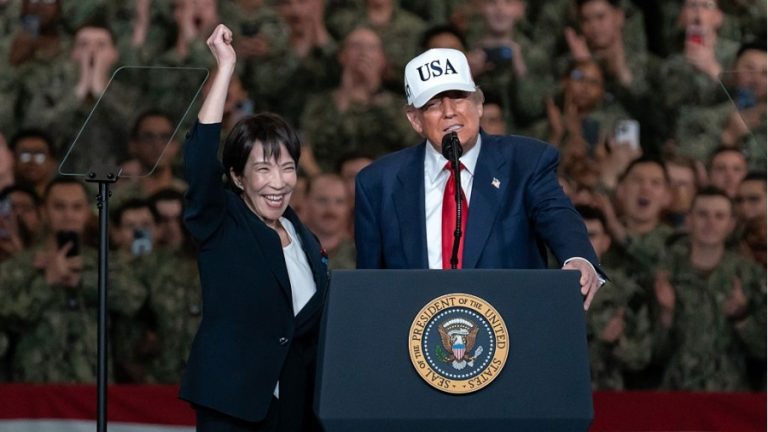
U.S. President Donald Trump’s role is drawing attention. During his Asian tour in late October, he told Takaichi: “Whatever problems, concerns, needs, or requests you have—whatever I can do for Japan—we will be there for you. America is your strongest ally.”
He also referred to Xi Jinping as an “old friend” during their meeting, positioning himself uniquely as someone who maintains good personal relations with both leaders—giving him potential leverage as a mediator.
Analysts say Trump’s preference for personal diplomacy and deal-making makes intervention possible if China–Japan tensions continue rising. Bloomberg reported that if China applies harsher-than-expected economic pressure—especially concerning critical minerals—Trump may step in.
Historically, China–Japan relations have dipped many times, with the last major low point in 2012 when Japan nationalized the Diaoyu Islands, triggering mass anti-Japan protests across China.
Background to the Takaichi incident
The current diplomatic crisis began on Nov. 7, when Takaichi stated during parliamentary questioning that if China invades Taiwan—a “Taiwan emergency”—it could qualify as a situation permitting Japan’s collective self-defense. This was the first time a sitting Japanese prime minister explicitly confirmed “A Taiwan emergency is a Japan emergency.”
When asked under what conditions a blockade of the Taiwan Strait would qualify as such, she replied: “If Taiwan is attacked with military force—such as a naval blockade supported by other methods—this could constitute the use of force.”
After her remarks, Chinese Consul General in Osaka Xue Jian escalated tensions by posting: “We have no choice but to mercilessly sever that filthy neck.”
Japan’s Ministry of Foreign Affairs summoned China’s ambassador Wu Jianghao to lodge a strong protest.
Takaichi’s foreign policy: Continuing Abe’s line
Takaichi became prime minister in October 2025, Japan’s first female leader in constitutional history. With a political career spanning over 30 years, she is known as a hardline conservative—frequently compared to Margaret Thatcher and nicknamed “Japan’s Iron Lady.” She advocates strengthening defense, upgrading intelligence and cybersecurity, enhancing economic security, and supporting constitutional revision for a more assertive security posture.
In foreign policy, she clearly continues the strategic direction of Shinzo Abe, emphasizing the link between Taiwan Strait stability and Japan’s national security. She has long warned about China’s military expansion. U.S. conservatives generally see her favorably, expecting her to solidify the U.S.–Japan alliance and take an active role in the Indo-Pacific.
The Takaichi government centers national security on the U.S.–Japan alliance and is expanding multilateral cooperation across the Indo-Pacific. Despite the controversy, her remarks are seen as a signal that Japan intends to work with democratic nations in responding to China’s growing challenge.
By Yang Tianzi