By Jing Chen
Over the past year, a once-politically frozen issue at the United Nations (UN) has undergone a dramatic shift: the interpretation of UN General Assembly Resolution 2758, a document Beijing has used for half a century to justify Taiwan’s exclusion from the international system.
Governments, diplomats, and legal scholars across the United States, Europe, and Asia have begun re-examining the text after decades of deference to Beijing’s claims. The result has been destabilizing for China’s narrative—and unexpectedly favorable for Taiwan.
The reason for this global reassessment is not geopolitical fashion. It is the realization that Beijing’s interpretation of the resolution is inconsistent with the document itself, which contains no language defining Taiwan as part of the People’s Republic of China.
As more governments scrutinize the text, the legal and historical record has begun to reassert itself.
Success
You are now signed up for our newsletter
Success
Check your email to complete sign up
The Republic of China (ROC) was the first signatory of the UN Charter in 1945 and remains listed in the Charter as a founding member state. The document identifies the ROC—not the PRC—as one of the original five permanent members of the Security Council.
The Charter has never been amended to replace the ROC with the PRC. And under the UN’s own legal framework, no General Assembly resolution can amend the Charter or expel a member state.
That historical and legal reality has prompted fresh examination of what actually occurred in 1971.
What resolution 2758 actually says
The text of Resolution 2758 is brief. It recognizes the representatives of the People’s Republic of China as the legitimate representatives of “China” and removes the representatives of “Chiang Kai-shek.” It does not define Taiwan as part of the PRC, address Taiwan’s sovereignty, expel the Republic of China, or alter the UN Charter. This distinction—between representation and sovereignty—has become increasingly central to diplomatic debate.
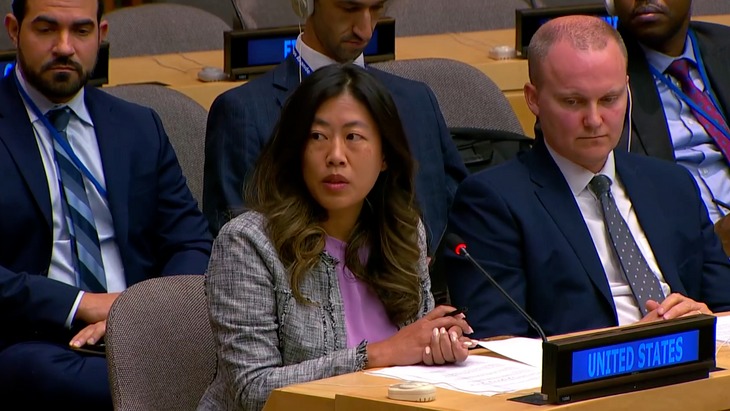
The UN Secretary-General’s spokesperson has publicly clarified that 2758 did not change the Charter, and the U.S. Department of State has issued multiple statements rejecting Beijing’s interpretation. Delegations from Europe, Japan, and other regions have echoed similar positions at the General Assembly.
As a result, many governments now view Beijing’s use of 2758 to exclude Taiwan from the WHO, ICAO, INTERPOL, and other bodies as incompatible with international law.
The international law question: Taiwan is not a province of the PRC
Under widely accepted principles of international law, a state’s identity does not disappear because its governing authority relocates, regime change does not erase statehood, and sovereignty does not transfer automatically without legal succession. Applied to the ROC and PRC, the ROC’s relocation to Taiwan in 1949 did not terminate the state, and the PRC, founded in 1949, is a new state, not the automatic successor to the ROC.
If Beijing denies the ROC exists, it cannot simultaneously claim to have inherited ROC territory, and the UN Charter continues to list the ROC as a founding member. The legal conclusion emerging internationally is striking: Beijing has no basis under international law to assert sovereignty over Taiwan.
For decades, Beijing leveraged Resolution 2758 to pressure UN agencies, block Taiwan from participating under its own name, and persuade governments to avoid references to Taiwan as a political entity. But as China escalated its efforts—intervening in WHO operations, restricting ICAO access, and attempting to censor “Taiwan” from UN materials—its narrative started to draw scrutiny.
This intensified pressure triggered a chain reaction. UN officials revisited the resolution, the U.S. publicly rejected Beijing’s reading, and delegates began referencing Taiwan openly during debates. Europe and Asia started reevaluating legal assumptions, resulting in an international reassessment of Taiwan’s status.
Across Washington, Tokyo, Brussels, and allied capitals, governments increasingly see Taiwan as a critical component of the Indo-Pacific strategic landscape. Japanese officials emphasize that “Taiwan’s security is Japan’s security,” the EU has incorporated Taiwan into its Indo-Pacific strategy, and the U.S. has repeatedly stated that Taiwan’s status remains undetermined and is subject to peaceful resolution.
Several countries have strengthened diplomatic engagement with Taipei, driven not by sentiment, but by a recognition that Beijing’s long-standing interpretation of 2758 is inconsistent with the Charter and international legal norms.
Global diplomatic context: A shifting order
As the United States reasserts leadership in global institutions, China’s diplomatic influence has weakened. NATO has labeled China a “systemic challenge,” the EU is assessing Taiwan-related contingencies, and regional states such as the Philippines have increasingly pushed back against Chinese coercion.
Against this backdrop, discussion of Taiwan’s role at the UN—long considered taboo—is now seen as part of a broader recalibration of the post-Cold War order.
Given the current international climate, several strategies are emerging:
- Requesting a legal review of Resolution 2758’s scope
- Formally asserting that the ROC, as a Charter-listed founding member, retains rights to representation
- Challenging Beijing’s misuse of the resolution in UN agencies
- Reframing Taiwan’s participation as a Charter-based right rather than a political concession
The central argument is straightforward: The ROC’s status under the UN Charter has never been legally revoked.
A historic opening
For the first time in five decades, governments around the world are openly revisiting the question of how Taiwan was removed from the UN system—and whether that removal had any legal basis.
With global skepticism toward Beijing at unprecedented levels, Taiwan stands at what may be the most significant diplomatic crossroads since 1971.
The international debate over Resolution 2758 is no longer academic.
It is shaping the future of Taiwan’s global presence—and redefining how the world understands the international order itself.