By Youde Wong
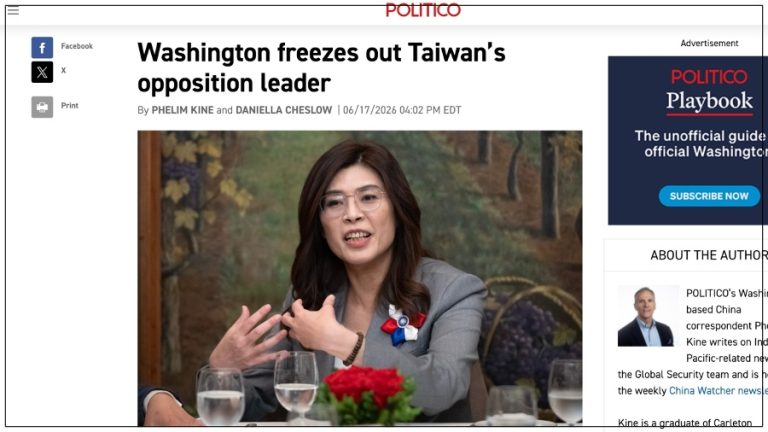
The Kuomintang (KMT) has been thrown into a full-blown internal crisis after a Central Standing Committee (CSC) member who is also a mainland Chinese spouse posted a series of pro-unification videos on TikTok. What began as a disciplinary matter quickly spiraled into a much deeper confrontation over the party’s China stance, political identity, and the boundaries of “red-leaning” rhetoric ahead of the critical 2026 elections.
At the center of the controversy is CSC member Ho Ying-lu. Her videos—some showing her wearing a shirt printed with Mao Zedong’s portrait and calling for Taiwan to “return to the embrace of the motherland”—spread widely online and triggered a swift backlash.
In one clip, Ho says she intends to wear the Mao shirt frequently to promote what she calls the “goodwill” and “sincerity” of the “motherland,” adding that early unification is her “mission and responsibility.” In another, she dismisses Taiwan as a “tiny place” and claims she has nothing to fear because she has a “powerful motherland” behind her, before attacking former president Ma Ying-jeou as “the most useless person.”
To many inside and outside the KMT, the videos echoed Beijing’s political line and directly contradicted the party’s traditional Republic of China (ROC) framework.
Success
You are now signed up for our newsletter
Success
Check your email to complete sign up
Kuomintang’s disciplinary committee
Facing intense criticism, the KMT’s disciplinary committee held an emergency session on Nov. 18. It concluded that Ho’s videos had misled the public, damaged the party’s reputation, and crossed into promoting Chinese Communist Party ideology. The committee voted to suspend her from all party duties — an especially notable move, as it was the first major disciplinary action under newly elected chair Cheng Li-wen.
But the momentum shifted less than 24 hours later.
Ho appealed, arguing that she had not been given a proper chance to defend herself. At the next day’s CSC meeting, several members raised concerns about procedural fairness and questioned whether the committee had acted too hastily. The CSC voted to send the case back for re-examination and, crucially, paused enforcement of the suspension.
The reversal allowed Ho to remain a full CSC member and immediately fueled speculation about factional pressure and behind-the-scenes political bargaining.
The case provoked strong reactions across KMT ranks. Taoyuan City Councilor Zhan Jiang-cun criticized Ho’s remarks as a betrayal of ROC identity and urged party officials not to “perform for the Little Pinks,” referring to pro-Beijing nationalist trolls.
He stressed that popularity among mainland Chinese netizens does not translate into Taiwanese public support, and said KMT officials must demonstrate loyalty to the ROC—not the CCP. Suspension, he argued, should be the minimum consequence. Anyone determined to push unification messaging, he added, might as well join the tiny, pro-unification China Unification Promotion Party.
Zhan’s comments reflected broader anxieties among KMT local officials who fear that any perception of “red leaning” could severely harm the party’s competitiveness in upcoming elections.
Ho, for her part, insisted she had violated no laws and said she felt “chilled” by the party’s response. She argued that her videos were being judged through a political lens, not a legal one, and vowed to continue contesting the case.
A parallel power structure and questions of influence
The sudden reversal raised immediate questions: who had enough influence to halt a punishment that had already been approved?
Former KMT member and Taoyuan City Councilor Yu Beichen argued that such a dramatic turnaround could only have occurred under substantial political pressure. He pointed to Ho’s organizational background—particularly her role in founding the KMT’s only new-immigrant party division, a group he described as powerful enough to operate like “a party within a party.”
This network, Yu said, helped propel Ho into the CSC and remains a source of significant leverage inside the KMT. Ho, he argued, represents “the most authentically red faction” within the party and enjoys enough support that even the chair must proceed cautiously. A harsh punishment, he suggested, could disrupt channels of communication and influence that certain factions consider strategically important—potentially explaining why the case was suddenly reconsidered.
Amid rumors that Chair Cheng Li-wen had personally intervened on Ho’s behalf, the KMT issued a statement on Nov. 21 emphasizing that the decision to re-examine the case came from the CSC itself and was based solely on procedural fairness. The party denied that Cheng had withdrawn or overridden the disciplinary ruling.
Cheng later told reporters that the initial disciplinary move was prompted by Ho’s comments, which challenged the party’s ROC-based identity—something many within the KMT viewed as unacceptable. But she stressed that appeals are part of normal procedure and that the final outcome will reflect the disciplinary committee’s collective judgment after hearing Ho’s explanation.
She urged the public not to overinterpret the procedural return.
The Ho Ying-lu case as a political mirror
The uproar surrounding Ho is not an isolated controversy. It lays bare the KMT’s difficult balancing act as it navigates cross-strait politics.
Alongside Ho’s Mao-shirt videos and pro-unification rhetoric, recent actions by senior party figures have heightened scrutiny.
KMT Chair Cheng Li-wen was reported to have attended a memorial event connected to individuals involved in CCP espionage cases.
Just days earlier, on Nov. 14, Vice Chair Chang Jung-kung visited China and publicly called for both sides of the strait to strengthen their sense of belonging to “one Chinese nation.”
These developments come at a time when Taiwanese voters place growing emphasis on sovereignty and democratic self-protection. Although Ho remains in her party post for now, the storm she triggered shows no sign of fading.
The KMT’s disciplinary committee is expected to reconvene soon.
How it balances “a member’s procedural rights” with the need to “defend the party’s national stance” will send an important signal about where the KMT is headed.
For now, the Ho case acts as a political mirror.
A heavy penalty risks provoking backlash from pro-unification groups and mainland Chinese-spouse networks inside the party.
A lenient outcome, however, risks reinforcing public perceptions that the KMT is drifting closer to Beijing, something that could deal serious damage to the party’s standing heading into the 2026 elections.