By Yang Tianzi
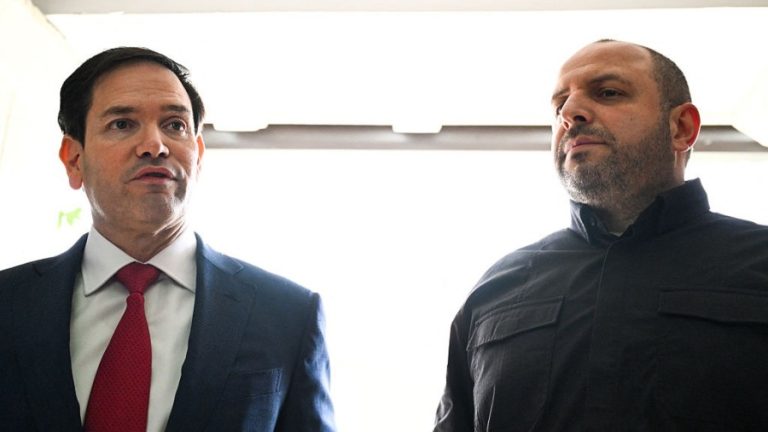
A high-stakes round of negotiations in Florida has drawn global attention as the Russia–Ukraine war approaches its fourth year. Following the meeting, U.S. Secretary of State Marco Rubio described the discussions with Ukraine on a possible peace agreement as “productive,” while emphasizing that “a lot more work needs to be done.”His comments reflected both the Trump administration’s push for a diplomatic breakthrough and the substantial obstacles that remain.
Talks near Trump’s inner circle
The meeting was held in Hallandale Beach, just north of Miami—notably far from Washington and close to Donald Trump’s personal political orbit. The location itself underscored who is steering the negotiation efforts.
Rubio was joined by Trump-appointed Russia–Ukraine envoy Steve Witkoff and senior adviser Jared Kushner, signaling that the initiative is being driven directly by Trump’s priorities, rather than traditional diplomatic channels.
Ukraine’s delegation was led by Rustem Umerov, the newly appointed chief negotiator and secretary of the National Security and Defense Council. His appointment followed a major political shock in Kyiv: President Volodymyr Zelensky’s chief of staff, Andriy Yermak, resigned after anti-corruption authorities searched his residence in connection with an alleged US$100 million kickback scheme tied to the state nuclear energy company.
Success
You are now signed up for our newsletter
Success
Check your email to complete sign up
With Yermak’s sudden departure, Ukraine lost a key figure in its diplomatic apparatus at a critical moment. Umerov entered the talks with dual responsibilities: advancing negotiations while reassuring Washington that Ukraine remains politically stable and worthy of continued support.
After the meeting, Rubio struck an optimistic yet measured tone. He said any agreement must include not only terms that halt the fighting but also provisions that help Ukraine “achieve long-term prosperity.” His remarks reflect the Trump administration’s broader strategy: combining a ceasefire with a durable political and economic framework for Ukraine’s recovery.
Trump signals optimism on reaching a deal
Trump expressed greater confidence than Rubio, saying the chances of reaching an agreement to end the war were “pretty good.” His approach has focused on securing a rapid ceasefire to stabilize global markets and reduce the geopolitical cost of a prolonged conflict.
Ukraine, meanwhile, faces pressure across several fronts: Russian military advances continue in the Donbas region, domestic political disruptions are raising questions about Kyiv’s stability, and diplomatic balancing is growing more challenging as U.S. and European approaches diverge.
These pressures complicate Kyiv’s negotiating position and make a comprehensive settlement far from certain.
The leaked US peace plan and its controversial provisions
The Florida talks coincided with the public circulation of a leaked 28-point U.S. peace proposal. Multiple sources say the draft focuses on five major areas.
Territorial arrangements: Some versions propose long-term leases, frozen lines of control, or delayed referendums—steps that, in effect, allow Russian control over parts of eastern Ukraine and Crimea in the medium term.
This element has sparked concern in Ukraine and across Central and Eastern Europe.
Security and military limits: Ukraine would pause its pursuit of NATO membership for an extended period, replacing it with multinational security guarantees or limited armaments.
Restrictions on force size, missile range, and weapon deployment are intended to reduce perceived pressure on Russia’s borders.
Sanctions and frozen assets: The plan outlines phased sanctions relief in exchange for Russian compliance with ceasefire and withdrawal measures.
A key debate involves the use of frozen Russian assets—whether they should prioritize Ukraine’s reconstruction or be used as leverage.
War-crimes and amnesty considerations: The proposal has drawn criticism for appearing to offer “legal exits” for certain political and military leaders.
Human rights advocates argue this risks diluting accountability for aggression.
Reconstruction and investment: Several sections open the door to large-scale privatization and foreign investment in postwar energy and infrastructure sectors.
Reports suggest that business figures close to Trump, including energy firms and investment funds, may play notable roles.
Facing criticism, the administration is said to be preparing a pared-down 19-point version that removes the most contentious elements.
Zelensky turns to Europe to strengthen his position
After the Florida meeting, Zelensky chose to travel to Paris rather than immediately schedule a visit with Trump.
This was his second visit to France in a month—an indication of how crucial European backing has become as peace talks accelerate.
The Élysée Palace said Zelensky and President Emmanuel Macron would discuss the “conditions for a just and lasting peace.”
European leaders fear that a U.S.-led framework might demand excessive concessions from Ukraine and want a stronger role in shaping the final agreement.
France, the EU’s only nuclear-armed state and its primary military power, has long emphasized strategic autonomy and resisted compromise that undermines Ukrainian sovereignty.
Zelensky’s outreach therefore serves to strengthen his negotiating position as he navigates between U.S. proposals and European principles.
Europe’s own peace proposal, according to reports, offers firmer guarantees on territorial integrity, security, and reconstruction.
This reflects Europe’s recognition that Ukraine’s security is tied directly to the continent’s broader security architecture.
Still, Europe faces constraints: without U.S. support, European defense capacity cannot sustain Ukraine’s high-intensity military needs.
Trump’s “America First” stance has forced European capitals to contemplate the possibility of ending the war without a decisive Ukrainian victory.
Putin’s intentions will shape the outcome of the talks
Trump’s envoy Steve Witkoff is expected to visit Moscow next week—a crucial test for the peace effort.
His mission is to determine whether Putin is satisfied with current territorial gains or intends to push further.
Russian forces continue pressing forward in Donbas and have intensified missile strikes on Ukraine’s energy infrastructure.
Putin appears intent on using battlefield momentum to strengthen his position at the negotiating table.
Witkoff must navigate between avoiding the perception of being too soft on Moscow and delivering an agreement Trump can present as a diplomatic success.
Despite expressions of optimism, deep structural gaps remain: Ukraine and Russia diverge sharply on territorial and security issues; the U.S. and Europe have not fully aligned their approaches; and Ukraine’s political volatility continues to affect the pace of talks.
For now, Rubio’s summary—productive, but requiring much more work—captures the uncertain moment.
In the coming weeks, follow-up U.S.–Ukraine consultations, Witkoff’s trip to Moscow, and Zelensky’s engagements with European leaders will shape the direction of the war.