By Jin Yan
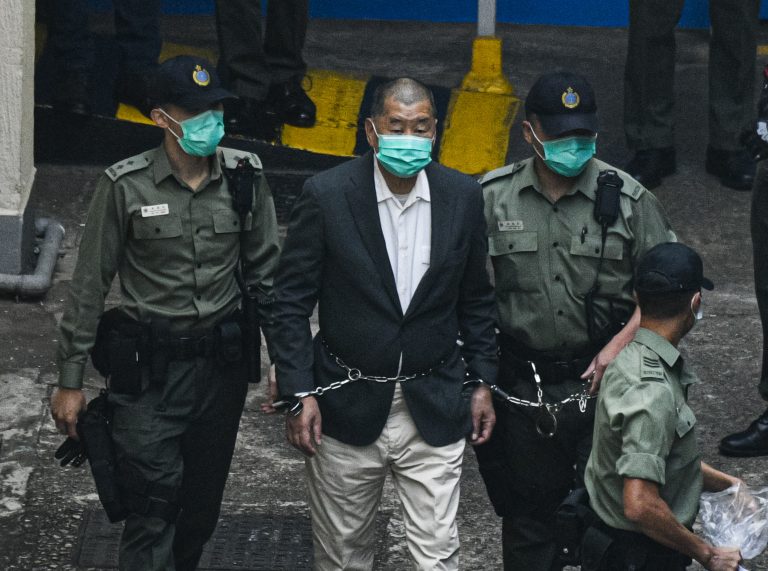
On Dec.15, 2025, the Hong Kong High Court delivered its verdict in the case against Next Digital founder Jimmy Lai for violating the Hong Kong National Security Law and sedition charges, finding him guilty on all three counts. This landmark national security case, which spanned 156 days of trial, came just one day after the Hong Kong Democratic Party announced its dissolution on Dec. 14—less than 48 hours apart—symbolizing the double demise of Hong Kong’s political and press freedoms.
Multiple press freedom organizations and overseas Hong Kong groups view it as a fatal blow to Hong Kong’s press freedom, and call for heightened international attention.
Jimmy Lai convicted; sentencing in 2026
Three national security-designated judges—Esther Toh, Alex Lee, and Susana Maria D’Almada Remedios—unanimously found Jimmy Lai guilty of two counts of “conspiracy to collude with foreign or external forces to endanger national security” and one count of “conspiracy to publish seditious publications.” The 855-page judgment described Lai as the “mastermind,” intending to destabilize CCP governance and continuing activities covertly even after the national security law took effect.
The case is adjourned to Jan. 12 next year for mitigation and sentencing, with Lai facing up to life imprisonment. This landmark national security case verdict followed the Democratic Party’s formal dissolution the previous day, with the two events less than 48 hours apart, symbolizing the double end of Hong Kong’s political and press freedoms. Meanwhile, the recent deadly fire at Wang Fuk Court exposed regulatory corruption and lack of oversight, further highlighting how Hong Kong has degenerated into a mainland-style system, with “one country, two systems” existing in name only.
Success
You are now signed up for our newsletter
Success
Check your email to complete sign up
Jimmy Lai, now 78, has been remanded in custody for over five years (more than 1,800 days), mostly in solitary confinement, with his health deteriorating sharply. He suffers from diabetes, high blood pressure, and heart issues, with weight loss, nail detachment, and tooth decay.
The UN Working Group on Arbitrary Detention ruled in 2021 that his detention was “illegal and arbitrary.” The Committee to Protect Journalists (CPJ) condemned it as a “sham conviction” and “disgraceful persecution,” stressing that Lai’s only “crime” was running a newspaper and defending democracy.
Reporters Without Borders (RSF) called the verdict a “death sentence for press freedom.” The Hong Kong Overseas Media Association labeled it “naked political liquidation,” criticizing the criminalization of speech and the replacement of juries with designated judges, severely damaging judicial credibility. The association urged the Hong Kong and central governments to honor the Basic Law and Sino-British Joint Declaration, revoke improper charges, and called for international human rights accountability.
Overseas Hong Kong groups link the Lai case to the Democratic Party’s dissolution and the Wang Fuk Court fire, seeing them as emblems of Hong Kong’s overall freedom decline. The Wang Fuk Court blaze erupted on November 26, burning for over 43 hours, killing at least 160 (including one firefighter), injuring 79, and leaving 6 missing—Hong Kong’s deadliest fire in nearly 80 years.
Starting from flammable renovation scaffolding materials, it rapidly engulfed seven buildings, exposing bid-rigging corruption, faulty fire alarms, and regulatory failures. Residents complained about hazards as early as 2024, to no avail. The incident reflects the absence of press freedom, where independent media could not oversee, akin to mainland fires during the pandemic in Urumqi or the Sichuan Wenchuan tofu-dreg projects.
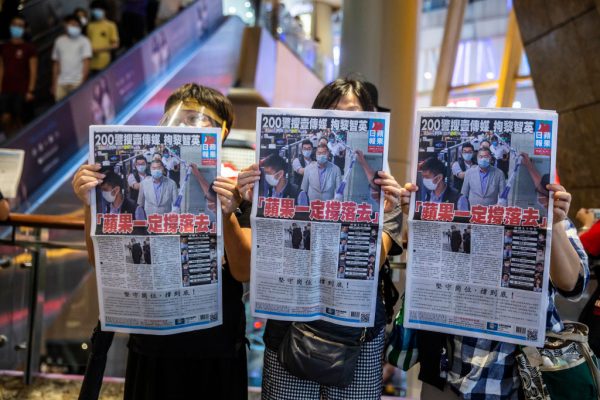
Canada Hong Kong link: Lai case symbolizes end of press freedom; Canada should not do business with CCP
Andy Wong, president of Canada Hong Kong Link, in an interview with Vision Times, criticized the judgment as “utterly absurd,” with flimsy evidence and national security cases “convicted without exception,” turning the judiciary into a political tool. This targets not just Lai personally but declares the end of press freedom, marking the close of the independent media era.
He sees the Lai case and Democratic Party dissolution as coincidental yet symbolic events, jointly announcing the “end” of Hong Kong’s political and press freedoms. As early as the “47-person case” and Lai’s arrest, freedoms were already moribund; now it’s merely the finale. The Democratic Party’s dissolution means the end of moderate pro-democracy participation, with the Legislative Council left with only the single voice of “patriots governing Hong Kong.”
Wong said Hong Kong’s press freedom is “basically lost.” After closures of Apple Daily and Stand News, investigative reporting vanished. The Wang Fuk Court fire stemmed from lack of oversight, with building hazards (like bid-rigging) long ignored. Overseas independent media are filling the void, tracking evidence through public records and sending truths back to Hong Kong, while warning democratic governments: Hong Kong is no different from the mainland, with “one country, two systems” collapsed.
On the Dec. 7 Legislative Council election, Wong described it as a “patriots’ legislature” with no real debate and zero space for opposition. Post-fire, no lawmaker dared speak justice; Hong Kong people need mainland-style rights defense, using limited space for self-protection. He urged remaining Hong Kong residents to stay hopeful and united, making good use of residual space against hazards.
Canada Hong Kong Link has long lobbied the Canadian government to sanction Hong Kong officials and urged caution in trade with Hong Kong and the mainland, warning high risks of being accused of “colluding with foreign forces.” Canada should diversify trade toward the EU, Japan, South Korea, and Southeast Asia, sanction Hong Kong officials, and uphold human rights.
The group will continue lobbying for transparent fire investigations. Wong emphasized that the Lai case, Democratic Party dissolution, and deadly Hong Kong fire are all emblems of freedom’s decline; the international community cannot stand idly by.

Jimmy Lai’s integrity worthy of admiration
Kwan Cheuk-chung, co-chair of the Toronto Association for Democracy in China( TADC), in a Vision Times interview, expressed concern for Lai’s health, calling five years of solitary confinement for a near-80-year-old pure “abuse” against humanity.
He hopes sentencing accounts for time served, imposing five-and-a-half years so Lai is “released after one more day,” or applying “medical parole.” He predicts Beijing avoids Lai dying in prison to evade international condemnation like Liu Xiaobo, possibly showing leniency. He calls on the U.S. to pressure for unconditional release; otherwise, a 10-year sentence would be unbearable.
Here’s a polished version of your sentence:
Kwan lauded Lai’s decision to remain in Hong Kong despite the risks, calling it a “selfless sacrifice” for freedom and a testament to his remarkable integrity.
He was somewhat surprised by the Democratic Party’s dissolution but deeply regretted it. With the government blocking all avenues, dissolution became a desperate act of “self-preservation,” aimed at keeping a lifeline for future contributions. It reflects a severe deterioration of the political environment, leaving no space for opposition.
Kwan compared the Wang Fuk Court fire to mainland disasters, caused by corruption and lack of oversight. Hong Kong is “mainlandized,” with press, rule of law, human rights, and speech freedoms gone; “one country, two systems” extinct. Old buildings rife with hazards, without independent media, tragedies are hard to avoid.
Kwan emphasized that TADC will continue to speak out, advocating for Lai’s release and independent fire investigations, while pressing for international pressure.
Verdict a political performance
The Committee for Freedom in Hong Kong (CFHK) issued a harsh statement on the Dec. 15, branding the verdict a “political performance disguised as justice” and “legal fraud,” not just persecuting Lai but marking the complete destruction of Hong Kong’s reputation as a global rule-of-law center.
CFHK UK and Europe Director Mark Sabah pointed out that Lai, as a British citizen, suffering such treatment reflects the UK government’s weak China policy. He urged Prime Minister Keir Starmer to make Lai’s release an absolute precondition for his January visit to China next year, otherwise he should postpone; immediately impose travel bans and asset freezes on the three involved national security judges, and demand all foreign judges in Hong Kong resign.
CFHK U.S. Director Jonathan Stivers stressed Lai’s only “crime” is upholding beliefs in freedom. He called on the Trump administration, if Beijing does not release Lai, to immediately hold Chinese and Hong Kong officials accountable; accelerate passage of the Hong Kong Economic and Trade Office Certification Act and Hong Kong Judicial Sanctions Act to sever the CCP’s long-arm jurisdiction.
CFHK reiterated that the international community must stand with Lai and all political prisoners against Beijing’s authoritarian control.
The verdict was expected but highlights Hong Kong judiciary’s fall and press freedom collapse. The organization will continue global actions, sanctioning those involved and upholding Hong Kong commitments.