By Yang Tianzi, Vision Times.
As the bells welcoming the New Year of 2026 rang out across Tehran, the Islamic Republic of Iran found itself confronting one of the most severe domestic political crises since the 1979 revolution. In the final week of December 2025, protests ignited by economic despair spread like wildfire from mobile phone markets in central Tehran to major cities nationwide, drawing merchants, students, workers, and other social groups into an unprecedented wave of anti-government demonstrations.
This episode of unrest was not only a direct response to Iran’s economic collapse, but also a signal of potentially profound changes to the country’s political landscape. What began as protests over exchange rates rapidly escalated into political chants of “Down with the dictator.” From merchant strikes to cross-class national mobilization, the demonstrations displayed characteristics and implications unlike any seen before.
Currency freefall ignites public anger
The immediate trigger for the nationwide protests was the catastrophic collapse of Iran’s currency, the rial, at the end of the year. According to detailed reporting by The Washington Post, on Dec. 27 the rial plunged to a historic low of 1.38 million rials per U.S. dollar; just one day later, on Dec. 28, it fell further to 1.44 million rials per dollar. This rapid depreciation dealt a devastating blow to Iran’s retail sector, which relies heavily on imported goods.
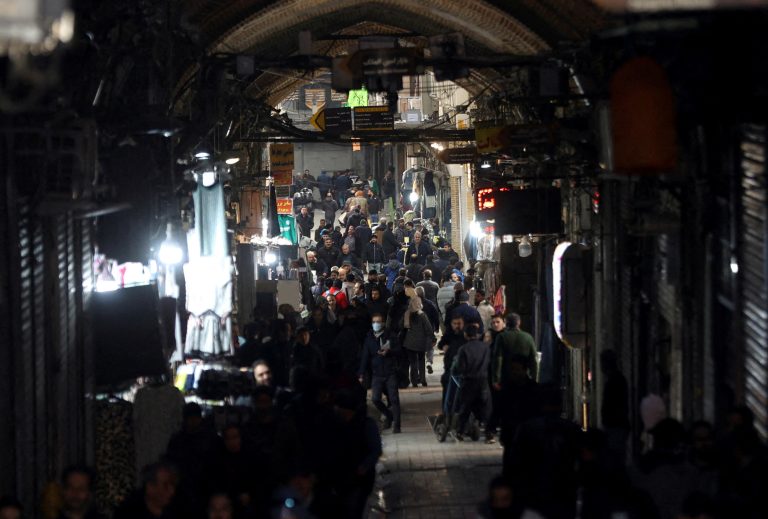
Mobile phone markets in central Tehran became the first flashpoint. Located near previous protest hubs and dominated by merchants selling imported electronics, these markets were hit hard by overnight surges in procurement costs and consumers unable to absorb sharply higher prices. On Dec. 28, desperate shopkeepers launched a collective strike — shutting down stores and taking to the streets.
Success
You are now signed up for our newsletter
Success
Check your email to complete sign up
Tehran resident Yasser witnessed the historic moment firsthand. Visiting the central commercial district on the afternoon of Dec. 29, he observed collective action by clothing merchants:
“They began pulling down their metal shutters, chanting slogans, and marching. The crowd quickly grew to several hundred people, demanding that other shops close as well. Those who refused were cursed, while those who complied were cheered.”
Notably, the early core of the protests showed clear social characteristics: they were driven mainly by young male merchants just starting their businesses, while long-established, well-capitalized shops largely stayed on the sidelines. This revealed the unequal impact of the economic crisis—young entrepreneurs, with weaker risk tolerance, became both the first victims and the vanguard of protest.
Iran’s 2025 economic indicators were alarming. The rial lost nearly 50 percent of its value over the year, while inflation surged to around 50 percent in December alone. This effectively halved the purchasing power of ordinary Iranians within a single year, pushing even basic necessities out of reach. For salaried workers, 50 percent inflation translated into a real income loss of roughly one-third, forcing many families to slash spending and ration even food purchases.
Demonstrations spread nationwide
What began as merchant-led economic protests spread nationwide with astonishing speed. Videos circulating on social media showed large marches forming in central Tehran starting Dec. 29, before rapidly expanding beyond the capital.
The protests soon reached surrounding and more remote areas, including Qeshm Island in the Persian Gulf and western cities such as Sanandaj and Hamedan. By the 30th, the movement had engulfed major cities including Kermanshah, Shiraz, and the historic city of Isfahan. This outward, radiating pattern demonstrated the movement’s deep social roots and strong mobilization capacity.
Initially limited to phone and clothing merchants, the protests took on new political momentum on the evening of Dec. 29 when university students — traditionally a key force in Iranian political movements — formally joined the demonstrations. Their participation added organizational strength and ideological clarity.
Soon after, truck drivers’ unions issued statements supporting the protests, marking the formal convergence of blue-collar workers with the merchant class. This cross-class alliance was historically significant, breaking traditional social boundaries and forming a broader anti-government coalition.
By Dec. 30, support expanded further. Retailers, private clinics, car dealerships, cafés, and restaurants across sectors announced closures via social media in solidarity. This tactic of “strike-by-closure” reduced the risks of street confrontation while exerting tangible economic pressure on the government, reflecting increasingly sophisticated protest strategies.
Political awakening of the Iranian merchant class
In its analysis, The Washington Post described the recent unrest as rare instance since the 1979 Islamic Revolution in which large-scale political protests were initiated by Iran’s traditional merchant class.
Historically, bazaar merchants have been regarded as conservative forces and key supporters of clerical rule. During the 1979 revolution, Tehran’s Grand Bazaar played a pivotal role in toppling the Pahlavi monarchy and later formed a mutually beneficial relationship with the Islamic Republic. When this class now takes to the streets against the government, it sends a dangerous signal: the regime’s traditional social base is fracturing.
Compared with earlier protests, this movement showed a distinct class shift. Economic protests in 2017 and 2019 were largely driven by workers and farmers, focused on subsistence and subsidies. This time, even relatively affluent and economically central business groups were forced into protest, indicating that the crisis had transcended class boundaries and inflicted indiscriminate damage across society.
The rapid politicization of demands was especially striking. Though rooted in exchange rates and inflation, protests quickly evolved into direct political challenges. Videos from Tehran malls on Dec. 29 showed crowds chanting “Down with the dictator,” directly targeting the political system itself. Even more sensitive, some demonstrators praised the former Pahlavi monarchy, an explicit challenge to the Islamic Republic’s legitimacy.
Trita Parsi, executive vice president of the Quincy Institute for Responsible Statecraft, offered a pointed analysis:
“Protests sometimes begin with economic grievances, which is exactly what’s happening now, but they can quickly evolve into something else.”
This transformation from economic to political demands is precisely what most alarms Iranian authorities.
Deeper roots
To understand the deeper causes of the protests, one must examine Iran’s overlapping crises. The economic collapse was not sudden, but the culmination of long-standing structural problems.
According to Al Jazeera, Iran’s economic troubles can be traced back to 2018, when U.S. President Donald Trump withdrew from the Joint Comprehensive Plan of Action (JCPOA) and reimposed sweeping unilateral sanctions — particularly targeting oil exports and the financial system. These sanctions severed Iran’s access to global finance and sharply reduced foreign currency earnings, laying the groundwork for currency collapse.
Conditions worsened further in 2025. In September, European countries began preparations to reinstate UN-level sanctions, citing Iran’s violations of the 2015 nuclear deal. This raised the prospect that Iran would face not only U.S. sanctions but a broader international sanctions regime. Investor and public confidence eroded further, creating a vicious cycle of depreciation expectations, currency dumping, and actual devaluation.
Psychological burdens and the shadow of war
Beyond sanctions, the threat of war weighed heavily on public sentiment. In June 2025, Iran was struck by Israeli airstrikes, followed by a 12-day military confrontation that saw wide devastation of the Iranian forces. Though it stopped short of full-scale war, it inflicted deep psychological trauma and material strain.
Military spending surged, squeezing already depleted government finances. More importantly, persistent war risks imposed heavy risk premiums on Iran-related economic activity, accelerating foreign capital withdrawal and capital flight, further weakening the rial.
For ordinary citizens, the war’s shadow brought dual pressure: economic hardship alongside fear of renewed conflict. This profound uncertainty about the future became a key psychological driver pushing people into the streets.
Crisis of trust, government caution
Perhaps the most devastating blow came from the collapse of government credibility. Parsi noted that “public distrust of the government largely stems from the government’s own statements.”
He pointed out that President Masoud Pezeshkian admitted about a week before the protests that he was “powerless” to solve the economic crisis. While seemingly candid, this admission shattered the public’s last hope that the government could manage the situation. If the country’s top executive declares himself helpless, citizens naturally ask why the system should continue to be supported.
This trust crisis is rooted in Iran’s political structure. Under the theocratic system, real power lies with the Supreme Leader and religious institutions, while elected officials have limited authority. When crises require fundamental policy shifts — such as major changes in foreign relations — this structure makes meaningful reform exceedingly difficult.
The government’s response to the nationwide protests was unusually restrained, contrasting sharply with its past reliance on harsh crackdowns. This reflected both recognition of the situation’s complexity and strategic uncertainty.
State and pro-government media avoided inflammatory labels such as “rioters” or “foreign agents” during the first four days. State television referred to demonstrators simply as “merchants,” while even the hardline Fars News Agency adopted a relatively neutral tone.
This restraint reflected delicate calculations: demonizing merchant protesters risked alienating the middle class, while outright denial of economic grievances would lack credibility.
Concilation from the president, silence from the Supreme Leader
On Dec. 30, Iranian President Masoud Pezeshkian posted on X, stating: “People’s livelihoods are an issue I focus on every day,” and promised “fundamental measures” to reform the monetary and banking system. He said he had instructed the interior minister to engage protest representatives and listen to their “legitimate demands.”
While conciliatory, this approach faced structural limits. In Iran’s system, the president is not the ultimate decision-maker; authority over diplomacy, security, and major reforms lies with the Supreme Leader. Whether presidential promises can translate into policy change remains uncertain.
As of Jan. 1, 2026, Supreme Leader Ali Khamenei — holder of ultimate power in Iran — had issued no public comment. This silence itself was a significant political signal, open to multiple interpretations: observation, delegation to the government, or internal consensus-building.
Yet silence carries risks. In a charged atmosphere, absence of top authority may be interpreted as weakness or internal division, potentially emboldening protesters.
The Iran protests of late 2025 indicate that dissatisfaction has crossed class boundaries, spreading from the underclass to the middle class and business elites. More importantly, it exposed deep structural crises in Iran’s political economy.
The unrest highlighted the fragility of Iran’s oil-dependent economic model under sanctions and the opportunity costs of heavy spending on military and ideological projects. At a deeper level, it raised questions about regime legitimacy as even traditional supporters began to defect.
As a major Middle Eastern power, Iran’s internal crisis could trigger regional ripple effects. Whether through external escalation to deflect pressure or internal reform driven by necessity, the outcome may reshape the region’s geopolitical landscape.