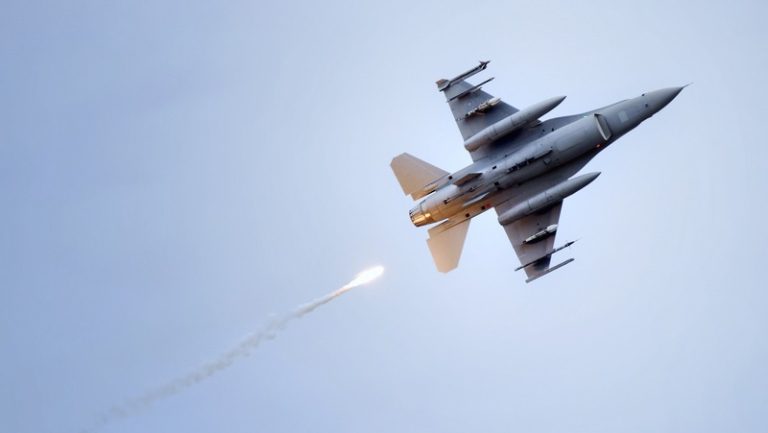
On Jan. 6, a single-seat Air Force F-16V fighter jet, tail number 6700, crashed into the sea off Fengbin Township, Hualien County during a routine night training flight. Captain Hsin Po-yi, the pilot, subsequently went missing, and multiple agencies continue to conduct large-scale search and rescue operations.
Timeline of the crash released
Major General Chiang Yi-cheng, Inspector General of Air Force Command, stated that the aircraft took off from Hualien Air Base at 6:17 p.m. on the 6th, and its radar return disappeared at an altitude of 1,700 feet at 7:29 p.m. According to voice recordings and radar data, at 7:27 p.m. Hsin was flying at about 7,600 feet and reported becoming separated in cloud. In less than a minute, records showed the aircraft dropping from 7,600 feet to 4,000 feet, and in the final 12 seconds the altitude plunged to 1,700 feet. Hsin shouted “preparing to eject” three times before the radar signal disappeared.
The Air Force and Coast Guard expanded the search area the next day. So far, more than 18 aircraft and 13 vessels (including Navy ships and Coast Guard vessels) have been dispatched for the mission.
At a morning press conference, the Air Force said that it had received a radio report from Captain Hsin saying “ejecting,” but no signals from survival equipment or parachute beacons have been detected, so it cannot yet be confirmed whether the pilot actually completed ejection.

Military response and search conditions
Colonel Chou Ming-ching, commander of the Air Force 5th Wing’s 27th Squadron, said failures of the Modular Mission Computer (MMC) occur in stages, and at the time of the incident Hsin’s aircraft no longer displayed a flight path. Captain Hsin reported experiencing “spatial disorientation” and also noted that the aircraft altimeter was decreasing.
Success
You are now signed up for our newsletter
Success
Check your email to complete sign up
Chou said that ejection is the pilot’s final line of defense: “He (Hsin) did everything he was supposed to do, and my wingman and flight lead tried everything they could to bring him back.”
Military experts noted that even if the pilot initiated ejection, high acceleration or the moment of impact could cause loss of consciousness, preventing completion of survival procedures such as separating from the ejection seat, possibly resulting in both the pilot and seat sinking together, which greatly increases search difficulty. In addition, sea temperatures in the crash area are low; without cold-protection gear, a person in the water would quickly lose body heat, leaving only tens of minutes for survival.
Was it caused by mechanical failure?
On online forums, an anonymous user claiming to be a senior flight instructor alleged that the F-16V’s Modular Mission Computer (MMC) frequently malfunctions, possibly causing unstable instrument displays and navigation information and leading to “spatial disorientation.” The post claimed that stability worsened after MMC upgrades and that the aircraft still lacks an automatic ground-collision avoidance system, making extreme situations more dangerous. These claims have not been officially confirmed.
In the evening, the Air Force reported that as of 5 p.m., 14 Air Force aircraft, 2 Navy vessels, 170 Army coastal personnel, 44 light and medium tactical vehicles, 4 National Airborne Service aircraft, and 11 Coast Guard vessels had been deployed. According to reports, Captain Hsin’s family has arrived at Hualien Air Base to await the latest developments, and people across the country are closely following the situation and praying for the search and rescue efforts.