By Cai Siyun, Vision Times
As reports of missing young people and children continue to grow across China, disturbing allegations have resurfaced online. Now, screenshots circulating on Douyin (a popular social media app in China) reportdly show internal chat records from a Changchun “group project” suggesting that a woman was tracked, forcibly taken away in an ambulance, and transferred with the alleged cooperation of a local police station. Netizens suspect the incident may be linked to organ-donor abduction.
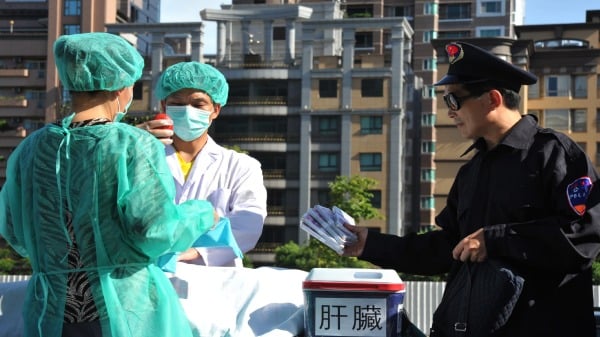
For years now, China has been accused of running a for-profit organ harvesting network, with multiple international human rights groups, researchers, and investigative journalists alleging that prisoners of conscience and other vulnerable individuals have been used as involuntary organ sources.
RELATED: ‘Ironclad Evidence’ Lays Bare China’s State-Run Organ Harvesting Network
Leaked screenshots spark alarm
On Jan. 5, two screenshots appeared on Douyin. One came from a group titled “250701 Project Coordination.” Based on the group name, netizens speculate the incident occurred around July 1, 2025. Photos in the chat show a lightly dressed young woman buying fruit, suggesting it was summertime.
Success
You are now signed up for our newsletter
Success
Check your email to complete sign up
The group reportedly had 11 members. A person identified as “Yang Min” uploaded two photos of the woman at a roadside fruit stand and noted she was buying durian. Another member immediately issued instructions: “Tell xx and the others, once she finishes buying, control her inside the building. Use an ambulance to bring her back directly. Take her straight away; don’t let her go home.”
Minutes later, the same individual forwarded the images to another group, apparently reporting to superiors, adding: “Judging by her build, her physical index rate shouldn’t be high.” He then wrote: “DNA compatibility has passed. Jida now has liver and kidney recipients.”
Another member asked: “Has the local police station been contacted?” The reply was: “Just finished contacting them.”
Scrubbed from social media
When a netizen later asked whether local police (“jc”) cooperated, the whistleblower responded with a checkmark, indicating confirmation. The screenshots were soon deleted, and the whistleblower’s account disappeared, though related search records remain visible on Douyin.
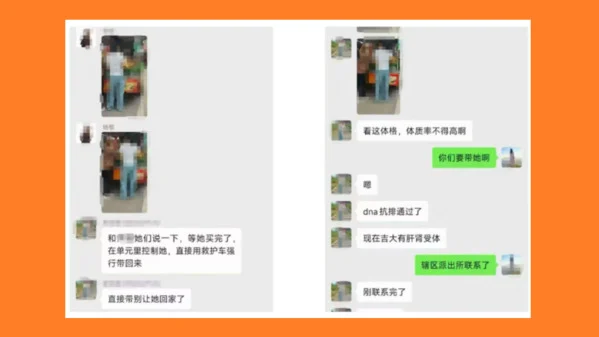
Based on the chats, netizens believe the woman was matched, abducted on the street, loaded into an ambulance, and taken to a hospital for organ removal, with police cooperation. Because the messages mention Jilin University (“Jida”) having liver and kidney recipients, observers suspect the transplant may have involved a hospital affiliated with the university.
RELATED: Helicopters Land Daily at Xiangya Hospital Amid Organ Harvesting Allegations
According to reports by the World Organization to Investigate the Persecution of Falun Gong (WOIPFG), both The First Hospital of Jilin University and The Second Hospital of Jilin University have been listed for investigation over allegations of large-scale forced organ harvesting.
A disturbing pattern of abductions
Observers note that similar incidents involving ambulances have surfaced repeatedly. On Dec. 27, 2025, in Longgang, Wenzhou, a woman was reportedly abducted from her apartment by uniformed individuals and carried into an ambulance. Video footage filmed by neighbors shows her screaming for help as she was dragged away, crying: “Save me, please! I don’t want to die!”
Authorities have issued no official explanation, and the footage was quickly scrubbed domestically, though it continues circulating overseas.
In June 2025, a video posted on X claimed that near Guigang Old West Station in Guangxi, a 16-year-old girl was struck by a vehicle and then forcibly strapped to a stretcher and taken away. Her body was reportedly sent to a morgue the following day. Netizens noted that one of the men involved closely resembled individuals previously seen escorting organ-transplant “green channel” patients.
In May 2025, another video showed a woman in Yuzhou, Henan, handcuffed by individuals dressed as emergency personnel and taken away on a stretcher. She shouted to passersby: “My name is Li Jianqing! I am fully conscious and healthy… What kind of hospital uses handcuffs? Help me! Please!” Bystanders filmed but did not intervene.
Netizens react
Reactions across overseas platforms were swift and anguished:
- “If you can be dragged away even at home, where is safety?”
- “She must have been matched.”
- “Organ harvesting is already an industry.”
- “Why are these cases never solved? It’s not police incompetence — it’s that no one is allowed to investigate.”
- “This is worse than hell.”
Since the Chinese Communist Party (CCP) began persecuting Falun Gong in 1999, a vast organ transplant industry has allegedly emerged through forced organ harvesting, involving public security, courts, the military, and medical institutions. Observers say the victim pool has since expanded beyond Falun Gong practitioners to society at large, especially young people. Other known victims include prisoners of conscience, such as Muslim Uyghurs, Tibetans, and other marginalized groups.
Falun Gong, also known as Falun Dafa, is an ancient spiritual discipline founded by Mr. Li Hongzhi in China in 1992. Despite being peaceful in nature, the Chinese Communist Party (CCP) launched a brutal persecution campaign targeting the faith in 1999. The persecution has continued unabated for over two decades now.
As more cases surface and official silence persists, fears are growing that what were once isolated allegations now point to a systemic pattern — one that leaves many questioning whether anyone in China is truly safe.