
By Meng Hao, Vision Times
The highly-suspicious death of a 13-year-old boy at Qinghuayuan School in China’s Henan Province has sparked nationwide attention. The case coincides with a recent surge in missing-teen incidents and long-standing findings by World Organization to Investigate the Persecution of Falun Gong (WOIPFG) regarding alleged state-sponsored organ harvesting in China, prompting renewed concerns of an illicit organ supply chain operating in the country.
Commentator Wei Yu argues that the incident is not an isolated tragedy but part of a systemic pattern in which ordinary citizens are sacrificed to sustain the lives of senior officials. She warns that Henan may have become a major hub, an “organ supermarket,” and that 2026 could mark a turning point.
RELATED: Leaked Chats Raise Fears of Police-Linked Abductions, Organ Harvesting in China
Case overview
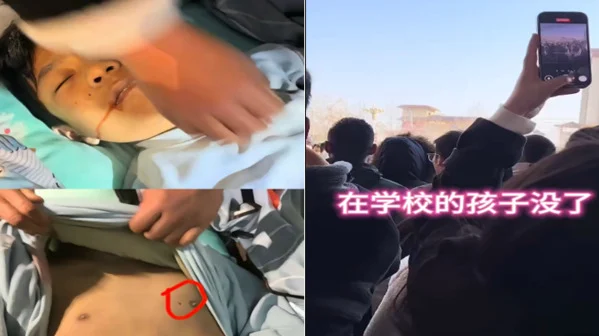
At around 6 a.m. on Jan. 8, Zhu, a seventh-grade student at Qinghuayuan School in Henan’s Xincai County was found dead in his dormitory. Before the family arrived, school staff attempted to move the body using a non-standard vehicle bearing a Red Cross symbol but lacking any medical institution markings (license plate Yu-Q283G5). The transfer was only halted when the boy’s uncle physically stopped the vehicle.
Success
You are now signed up for our newsletter
Success
Check your email to complete sign up
When family members were finally allowed to see the body hours later, they reported pinkish blood at the corner of the mouth, a nail-sized puncture on the left chest, and dark purple bruising around the waist.
- Jan. 9: The Xincai County Education Bureau announced that preliminary findings ruled out criminal causes and said follow-up arrangements were underway.
- Jan. 11: A joint investigation team declared the death the result of cardiac causes, claimed there were no external injuries, ruled out poisoning and foul play, and said the chest puncture resulted from forensic blood sampling for toxicology, while the mouth fluid was described as post-mortem leakage during handling. Authorities urged the public to “respect facts” and avoid rumors.
After the case became public, hundreds of vehicles gathered near the school in protest. Authorities deployed armed police, sealed roads, and restricted access. Related videos and posts were rapidly removed from domestic platforms. Multiple reports later circulated claiming that the boy’s uncle, parents, and grandfather had “disappeared” or died; though these claims remain unconfirmed.
RELATED: Surge in Missing Children Cases in China Fuels Concerns of Organ Harvesting
A cluster of missing children
Following the Xincai case, multiple reports of missing teenagers emerged across Henan, including:
- Jan. 7: Luo Xingye, 15, disappeared on his way to school in Qingfeng County
- Jan. 9: Du Qiuze, 15, went missing after school in Huaibin County (40–60 km from Xincai)
- Jan. 11: Yang Jiahao, 14, disappeared near his school gate in Xichuan County
- Jan. 12: Wang Yichun, 13, (Heilong Town, Zhumadian) and Xu Mengyao, 14, (Dancheng County) vanished while traveling to school
Online commenters speculated that these cases could be “backup candidates,” citing the need for time-sensitive organ matching and rapid replacement if an initial procedure fails. Observers also questioned why the boy was not rushed to a hospital, noting that the county people’s hospital is roughly 200 meters from the school, with the public security bureau about 300 meters away.
RELATED: ‘Ironclad Evidence’ Lays Bare China’s State-Run Organ Harvesting Network
Qinghuayuan reportedly operates as a chain of schools, with online claims of similar deaths elsewhere. Allegations circulated about investment ties to healthcare projects and overseas markets; though none have been independently confirmed.
As anxiety grows, parents have voiced fears over free health checkups and blood-donation drives, suspecting data collection for donor screening. Rumors, such as hiding tracking devices in shoes or turning underground garages into makeshift wards, underscore the climate of fear in China.
‘Schools have become organ chain supermarkets’
Wei Yu contends that the Xincai death and the cluster of disappearances are not isolated incidents, but evidence that alleged organ harvesting has expanded beyond persecuted groups to the general population.
RELATED: China’s Surge in Teen ‘Brain Death’ Cases Renews Fears of Live Organ Harvesting
She argues that schools, once seen as safe havens, are being transformed into covert data-collection and screening nodes, where free physical exams and blood drives function as preliminary filters for potential donors. In her words, “healthy boys have become preferred targets, while officials seek ‘life-extension’ at any cost.”
Wei Yu further links public anxiety to persistent rumors about Chinese President Xi Jinping’s health, citing commentators who speculate about serious internal ailments around 2026. She points to repeated observations of unsteady gait, tremors, and fatigue in public appearances as signs that Xi himself may have undergone an organ transplant to prolong his life.
She also references long-standing allegations of elite “longevity projects,” arguing that practices originating during the suppression of Falun Gong under Jiang Zemin have escalated, from secret detentions to abductions in public spaces and disappearances on school routes.
According to Wei Yu, the rapid official conclusion of “cardiac death,” attempts to move the body, damaged or missing surveillance footage, and the containment of family members mirror patterns previously documented by independent investigators, suggesting a coordinated state cover-up.
She says parents in Henan are increasingly refusing free exams and blood donations, adopting a single bottom line: “Children must come home safe.” If senior-level surgeries were exposed in 2026, she warns, public anger could erupt.
Links to state-sponsored organ harvesting
For more than two decades, WOIPFG has conducted cross-border investigations into allegations that the Chinese Communist Party has orchestrated large-scale organ harvesting since 1999, particularly targeting Falun Gong practitioners. The organization has amassed extensive materials, including recorded calls, testimonies, archived hospital data, and academic publications, arguing that transplant volumes far exceed plausible sources such as executed prisoners.
International human rights lawyer David Matas has described the alleged practice as “an evil unprecedented on this planet.”
WOIPFG reports cite explosive growth in transplant capacity after 1999, the creation of vast detention networks, compulsory blood typing and DNA collection, and the maintenance of “live donor pools.” Investigators argue that multiple backup donors are often prepared for a single transplant due to extremely short ischemia windows—an allegation implying lethal outcomes for unused “reserves.” Cited cases include:
- Demonstration surgeries requiring multiple standby organs transported by state resources;
- Reports of abnormally short warm ischemia times in medical papers—suggesting on-site procurement;
- Recorded admissions by medical staff claiming “fresh,” readily available donors.
Despite official claims since 2015 that all organs come from voluntary civilian donations, reported waiting times shortened to one or two weeks, with emergency transplants comprising over a quarter of procedures — figures critics say are incompatible with China’s low donation rate.
WOIPFG estimates that the number of victims could exceed two million, and recent reports raise concerns about the extension of transplants to infants and young children, with donor sources unexplained.
Red flags
Analysts drawing parallels to prior allegations point to features that match documented patterns:
- A left-chest puncture consistent with perfusion or rapid sampling;
- Pinkish blood suggestive of cardiac involvement;
- A cluster of disappearances aligning with the need for multiple backups;
- School-based screenings as data-collection gateways.
They warn that advances in transplant techniques, such as overcoming ABO incompatibility, expand the pool of potential donors, putting every healthy teenager at risk if allegations are true. For critics, this marks a chilling shift: From targeting specific groups to encompassing society at large, with Henan emerging as a new front line.
Editorial note: This article reflects the views and analysis of the commentators cited. Certain claims remain unverified and should be seen as allegations.