NASA has announced that final preparations are being made to roll out its Artemis 2 mega rocket. With this mission, its crew will orbit the moon as early as Feb. 6.
Artemis II will make history as the Artemis program’s first crewed mission, sending four astronauts on a ten-day trip around the Moon to test the systems that will take humans back to the lunar surface on Artemis III.
“We are moving closer to Artemis 2, with rollout just around the corner,” Lori Glaze, acting associate administrator for NASA’s Exploration Systems Development Mission Directorate, said in a statement on Jan. 9. “We have important steps remaining on our path to launch and crew safety will remain our top priority at every turn, as we near humanity’s return to the Moon.”
NASA has planned for the launch of Artemis 2 to be as early as Feb. 5, 2026, but no later than April 2026, though these dates could be changed.
The Artemis 2 consists of the colossal Space Launch System (SLS) rocket, which stands at 212 feet tall. It will house the Orion spacecraft that will be manned by the crew, adding to the height and making it 322 feet tall.
Success
You are now signed up for our newsletter
Success
Check your email to complete sign up
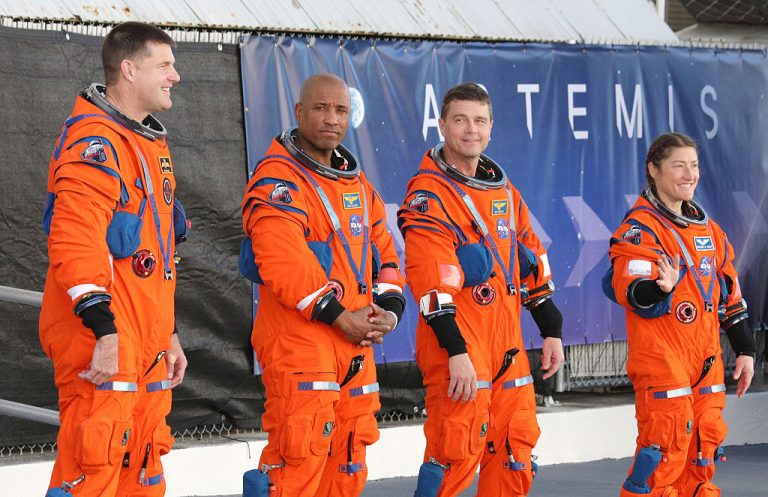
The members of the crew taking part in the mission are:
- NASA commander Reid Wiseman,
- Pilot Victor Glover
- Mission specialist Christina Koch
- Jeremy Hansen of the Canadian Space Agency
They will monitor how the Orion will operate, including with manual flight, steering and landing of the capsule in Earth’s orbit. They will also serve as medical test subjects to research deep space.
READ MORE:
- Trump Orders 2028 Moon Return, Puts Space Policy on War Footing With China
- US Inflation Holds at 2.7% as Fed Faces Rising Policy Pressures
- Family Center at Newburgh Armory Unity Center Supports Local Children and Families

Rolling out the rocket
Though the distance between NASA’s Vehicle Assembly Building and the launch pad is only four miles (six kilometers), moving the rocket requires up to twelve careful hours.
Upon reaching the pad, engineers will hook up critical ground support equipment, including “electrical lines, fuel environment control system ducts, and cryogenic propellant feeds.” These connections allow teams to properly verify that the hardware is fully synchronized with the ground infrastructure before the final countdown.
Once the rollout is complete, NASA will run a wet dress rehearsal — the prelaunch test to fuel the rocket. Teams will showcase how the rocket will be filled with 700,000 gallons of cryogenic propellants. Other procedures will include a launch countdown, practicing removing the rocket propellant and other safety measures.
If all goes well, a flight readiness review will be made to determine if all systems are ready to go before a launch date is confirmed.
While NASA plans to launch as early as possible, the crew’s safety is its top priority, Space.com wrote.
“We want to emphasize that safety is our top priority,” Lakiesha Hawkins, NASA’s acting deputy associate administrator for exploration systems development, said in September last year. “And so, as we work through these operational preparations, as we finish stacking the rocket, we’re continuing to assess to make sure that we do things in a safe way.”

Artemis program
The Artemis program will mark the first time humans have ventured to the Moon in more than 50 years.
The program’s previous initiative, Artemis 1, was an uncrewed test flight, which saw an Orion spacecraft orbit the Moon in November 2022. It returned to Earth four weeks later, but the capsule’s heat shield suffered major burns during reentry through the planet’s atmosphere.
This unfortunate occurrence caused a delay on the initial launch for Artemis 2 to 2026.
In regards to the next phase, the Artemis 3 mission, NASA aims to land astronauts on the lunar south pole in 2028.