By Jingyao Li
China’s military convened an expanded meeting of the Central Military Commission (CMC)—the Chinese Communist Party’s top body overseeing the People’s Liberation Army (PLA)—Discipline Inspection Commission on Jan. 16. Speaking at the meeting, CMC Vice Chairman Zhang Shengmin said the military’s anti-corruption campaign had achieved “notable results” over the past year.
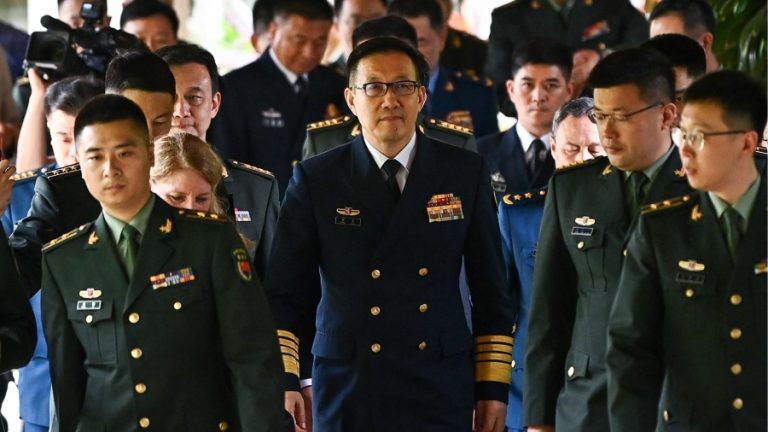
Yet state media footage revealed a striking detail: only two full generals were present. Analysts say the image points to a cascading collapse of Xi Jinping’s military inner circle, with Defense Minister Dong Jun now widely seen as the only remaining top PLA general closely associated with Xi.
Only two full generals at key CMC discipline meeting
Following the Fifth Plenary Session of the Central Commission for Discipline Inspection (CCDI)—the Chinese Communist Party’s top anti-graft body—held from Jan. 12 to 14, the CMC Discipline Inspection Commission convened its expanded meeting in Beijing on Jan. 16. Zhang Shengmin attended and delivered remarks, again stressing the need to “deepen political rectification” and raise standards in the coming year.
An account known as “China Personnel Watch” wrote on X that only two full generals were present: Zhang Shengmin on the rostrum and Han Shengyan, commander of the Central Theater Command, seated below. All other attendees held the rank of lieutenant general.
Success
You are now signed up for our newsletter
Success
Check your email to complete sign up
The account noted that at the same meeting in January 2025, a total of 14 full generals had attended. Those present then included He Weidong and Zhang Shengmin on the rostrum, as well as Xu Xueqiang, Xu Qiling, Wang Xiubin, Chen Hui, Xu Xisheng, Ling Huanxin, Wang Renhua, He Hongjun, Xu Deqing, Guo Puxiao, Li Wei, and Zhang Hongbing.
This year, only Zhang Shengmin remained. Han Shengyan, the second full general present, had been promoted to the rank only in December. Based on this comparison, the account said roughly 93 percent of full generals have effectively been “eliminated” from active command roles.

Missing PLA generals and signs of a deepening military purge
Several of the absent generals have shown signs of political or disciplinary trouble in recent years.
Xu Xueqiang, head of the CMC Equipment Development Department, missed the 2025 Central Economic Work Conference after having attended every year from 2022 to 2024.
Xu Qiling, deputy chief of the Joint Staff Department at the theater-command level, previously missed the Fourth Plenum of the 20th Central Committee of the Chinese Communist Party.
Wang Xiubin, who served as commander of the Southern Theater Command beginning in June 2021, was transferred in July 2024 to the CMC Joint Operations Command Center as executive deputy director. On Oct. 17, 2025, he was expelled from the Party and the military.
Chen Hui, an Air Force officer promoted to full general in December 2024 and appointed political commissar of the Army, was absent from the Dec. 22, 2025 promotion ceremony, according to state media footage.
Xu Xisheng served as political commissar of the Rocket Force, China’s strategic missile branch, while Ling Huanxin was political commissar of the Academy of Military Sciences.
Wang Renhua, secretary of the CMC Political and Legal Affairs Commission, missed the Fourth Plenum. The Central Political and Legal Affairs Commission website no longer lists him as a member, and on Dec. 27, 2025, he was removed as a delegate to the National People’s Congress (NPC), China’s rubber-stamp legislature.
He Hongjun, named executive deputy director of the CMC Political Work Department in July 2024, was expelled from the Party and dismissed in October 2025. He was widely regarded as a trusted Xi loyalist and once seen as a potential successor to Miao Hua.
Xu Deqing previously served as political commissar of the Western Theater Command and was promoted in 2022 to political commissar of the Central Theater Command. Guo Puxiao served as political commissar of the Air Force. Li Wei was transferred in 2024 to become the inaugural political commissar of the Information Support Force. Zhang Hongbing, promoted in 2022 to political commissar of the People’s Armed Police, was stripped of his NPC delegate status in December 2025.
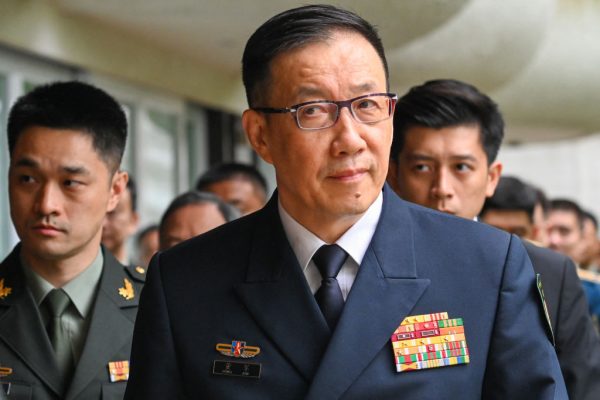
Xi Jinping’s military camp reduced to Dong Jun
In December last year, the PLA promoted Yang Zhibin, commander of the Eastern Theater Command, and Han Shengyan, commander of the Central Theater Command, to full general. At that ceremony, only four full generals—Zhang Youxia, Zhang Shengmin, Liu Zhenli, and Dong Jun—appeared.
At the Jan. 16 discipline meeting, only Zhang Shengmin and Han Shengyan were present.
U.S.-based political commentator Chen Pokong said Yang Zhibin and Han Shengyan are newly promoted generals whose factional alignment remains unclear. “Aside from them, all the other full generals have fallen,” he said. “Among those not yet taken down are Zhang Youxia, Zhang Shengmin, Liu Zhenli, and Dong Jun. But Xi’s own camp has collapsed. The only one left is Dong Jun.”
Chen added that by examining attendance lists and empty seats at meetings of the NPC, the Chinese People’s Political Consultative Conference (CPPCC), the CCDI, and military discipline bodies, it is often possible to identify officials who have already fallen from favor.
Despite holding the post of defense minister, Dong Jun has not been elevated to the Central Military Commission or named a state councilor. Chen Pokong speculated that Dong’s troubles may only be a matter of time. Dong also did not attend the January 16 meeting.
Rumors surrounding Dong have circulated online for months. In December, independent commentator Cai Shenkun claimed that Dong had already been removed as defense minister but allowed to retain the rank of full general. Whether he will face further investigation, Cai said, will depend on political developments ahead. Some speculate that Dong could ultimately lose his rank as well.
Fujian-linked military faction effectively wiped out
Ahead of the Fourth Plenum, China’s Ministry of National Defense announced the downfall of nine full generals—an unprecedented number at such senior ranks. All were widely seen as close associates personally promoted by Xi Jinping, and most were linked to the so-called “Fujian faction,” referring to officials connected to Xi’s earlier career in Fujian province.
The nine included Politburo member and CMC vice chairman He Weidong; CMC member and former Political Work Department director Miao Hua; former executive deputy Political Work Department director He Hongjun; former Joint Operations Command Center executive deputy director Wang Xiubin; former Eastern Theater Command commander Lin Xiangyang; former Army political commissar Qin Shutong; former Navy political commissar Yuan Huazhi; former Rocket Force commander Wang Houbin; and former People’s Armed Police commander Wang Chunning.
He Weidong and Miao Hua both served for extended periods in the former 31st Group Army based in Fujian. After attending China’s annual “Two Sessions” political meetings in March last year, He Weidong disappeared from public view. Although online reports claim he is under investigation, no official announcement has been made.
Political commentator Tang Jingyuan said these developments suggest a serious split within the Chinese Communist Party, with Party elders and segments of the military leadership potentially at odds with Xi Jinping amid an intense internal power struggle.

Xi Jinping’s closest military aides fall one by one
Another striking development, analysts say, is that Xi Jinping’s closest military aides have all run into trouble.
According to former investigative journalist Zhao Lanjian, Qin Shengxiang disappeared on July 28, 2025, and was reportedly taken in for investigation.
Zhong Shaojun served as director of the CMC General Office beginning in 2017, stepped down in March 2024, became political commissar of the National Defense University in June 2024, and left that post in October 2025. Cai Shenkun has previously reported that Zhong has retired from active service.
Commentator Wang Youqun said Zhong’s case may be tied to three issues: the Rocket Force scandal, the Miao Hua and He Weidong cases, and alleged benefit transfers involving Zhong’s family. Because Zhong was a close Xi confidant, Wang said, the matter is particularly sensitive and has been handled quietly.
Fang Yongxiang, who took over as director of the CMC General Office in March 2024, was also linked to Xi’s Fujian network. In March 2025, reports emerged that he had been removed and transferred to serve as deputy political commissar of the Academy of Military Sciences, with some claiming he was under investigation. Of the seven alternate members passed over for elevation to full Central Committee membership, Fang was among them.
A commentary published on the military’s Qiushi-affiliated website stressed that “the people’s army’s code of conduct and political work must be rooted in the interests of the people, and no one may use the military to achieve personal goals.”
Chen Pokong said the wording appeared pointed at Xi himself. “Xi believed that controlling the gun meant he could make the gun command the Party and rule for life,” he said. “Instead, his military power has been hollowed out. Now Zhang Youxia is effectively presiding over the day-to-day work of the Central Military Commission.”
A cascading collapse inside China’s military leadership
On Jan. 17, the CCDI and China’s National Supervisory Commission released anti-corruption data for 2025, showing that 115 provincial- and ministerial-level officials or above were placed under investigation during the year—far more than the number publicly announced as having fallen.
Commentator Li Linyi said that after intense internal military infighting, active-duty full generals have been nearly wiped out, sending shockwaves through the PLA ranks. “The purge has not stopped,” he said. “Officers are anxious, and many are lying low.”
Analyst Li Yanming said that amid the escalating military purge, more than ten full generals who were absent from both the Fourth Plenum and the CMC discipline meeting are now in precarious positions. Whether they will be officially announced as having fallen in 2026 will be a key indicator of elite infighting and broader political trends within the Chinese Communist Party.
Independent commentator Du Zheng wrote in Up Media that the large-scale, cascading collapse of Xi Jinping’s military inner circle—whether driven by corruption charges or accusations of political disloyalty—has, by its sheer scale, delivered a direct blow to Xi’s authority.
Editor’s Note: This article is based on official Chinese military announcements, state media footage, and analysis by overseas Chinese commentators. Claims regarding internal power struggles, disciplinary cases, and factional dynamics within the Chinese military cannot be independently verified and are presented as assessments by the cited sources.