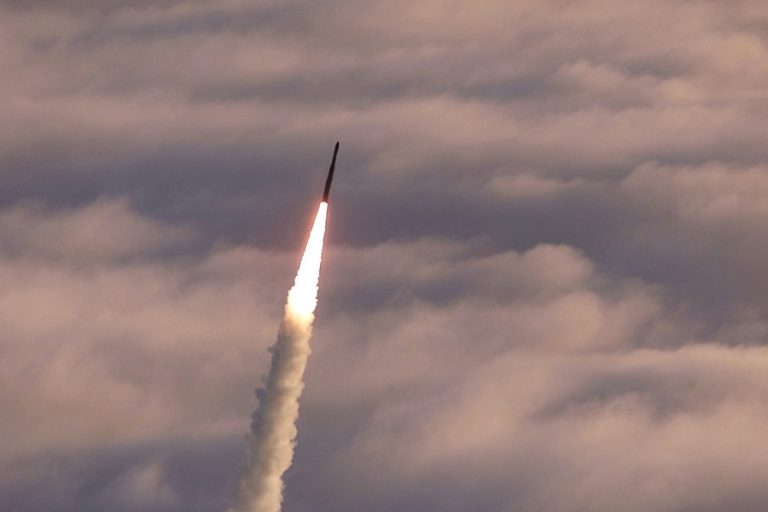
The Chinese People’s Liberation Army (PLA) on Monday, July 7, test-fired a submarine-launched intercontinental ballistic missile (ICBM) capable of carrying a nuclear warhead into the South Pacific.
Most of Communist China’s missile tests are made within the country’s territory, rather than over international waters, resulting in protests from governments throughout the region.
Beijing said the launch was part of a routine annual military training exercise, while the United States, Japan, the Philippines, Australia, and Pacific island nations expressed dissatisfaction and raised objections to the test.
US urges China to participate in nuclear arms control talks
The U.S. State Department said that the United States is advancing efforts to prevent nuclear proliferation with unprecedented determination, but that China continues to rapidly expand its nuclear arsenal while lacking transparency, raising serious concerns among regional and international communities.
The United States has urged China to actively participate in arms control negotiations and establish more transparent notification mechanisms for intercontinental ballistic missile launches and space launches.
Success
You are now signed up for our newsletter
Success
Check your email to complete sign up
U.S. State Department spokesman Tommy Pigott confirmed that the United States detected the Chinese submarine launching an unarmed intercontinental ballistic missile from a submarine, with the missile landing in the South Pacific, according to a statement shared by the U.S. embassy in China.
Japan: Rapid military expansion raises concerns
Japan’s Chief Cabinet Secretary Minoru Kihara said on Tuesday (July 8) that the government is analyzing the specific details of the Chinese missile test and that it is currently unable to determine Beijing’s true intentions.
However, he pointed out that in recent years, Beijing has continued to rapidly expand its nuclear weapons and missile capabilities, including intercontinental ballistic missiles, while maintaining a lack of transparency. He said China’s military developments have become a shared concern for Japan and the international community.
Philippines calls test a ‘reckless display of force’
The Philippine Department of National Defense issued a statement expressing strong concern over the test, describing it as a “reckless display of force,” according to a statement shared on Tuesday.
The statement said that the launch had no peaceful purpose, but was instead a deliberate provocation and act of intimidation directed at countries opposing Beijing’s “illegal expansionism” and “coercive behavior.” It added that the action disregarded the security concerns of Pacific island nations and the region’s fragile ecological environment.
The Philippine Department of National Defense said it would work with partners in the Pacific region to call on China to act responsibly and not turn shared waters into a tool for threatening other countries.
Australia criticizes failure to provide advance notice
Australian Prime Minister Anthony Albanese said the ICBM test undermined regional stability and constituted a clear act of provocation, reported ABC.
He said Australia had expressed its serious concerns to China through diplomatic channels in both Beijing and Canberra.
Albanese also pointed out that, unlike standard practice for missile tests, the Chinese authorities did not notify Australia 48 hours in advance of the launch, increasing tensions in the region.
Australian Defence Minister Richard Marles said that China’s demonstration of longer-range nuclear strike capabilities would further undermine regional stability.
Foreign Minister Penny Wong said the move contradicted the shared vision that “the Pacific should be a sea of peace”and increased the risk of miscalculation in the region.
Solomon Islands: ‘This is not how friends behave’
Matthew Wale, prime minister of the Solomon Islands, said that while China has long been regarded as a friend of his country, testing a ballistic missile over the open Pacific was “not the behavior of a friend” and detrimental to regional stability, according to a report by In-depth Solomons. .
Wale added that he had lodged a strong protest with the Chinese ambassador to the Solomon Islands and had formally submitted a diplomatic note of protest.
He emphasized that whether it is China, the United States, or any other country, no nation should conduct missile tests in the Pacific region. This, he said, is a principle upheld by Pacific island countries.