By Xiao Guang
The sky above the Tibetan plateau stretches so wide it commands reverence. Fierce winds tear white clouds into strange forms. At times they resemble a snow leopard mid-stride. At others, the flowing robes of a lama caught in motion.
As Tibetan property was absorbed into collectivization and those labeled “herd owners” or “wealthy herders” were subjected to struggle, monasteries and monks were not spared. What followed was not incidental damage but a campaign that unfolded with increasing force. The assault on religious institutions proved even more thorough, and more violent.
In May and June of 1958, Li Weihan, then head of the Chinese Communist Party’s United Front Work Department, told a meeting in Qingdao that religion should be understood as something destined to weaken and eventually disappear. The process, he said, should be actively accelerated.
‘On Reforming the Religious System’
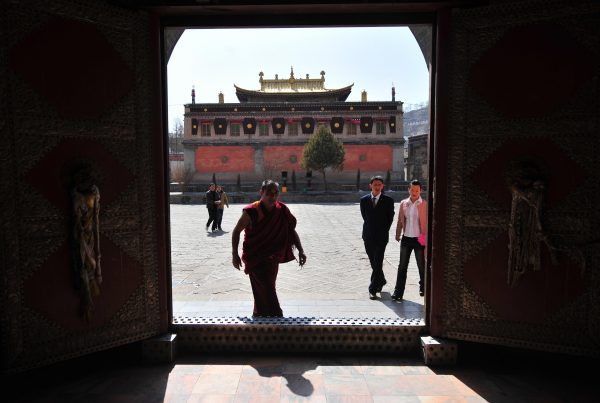
The following month, the Qinghai Provincial Party Committee adopted a resolution titled On Reforming the Religious System. Among its central goals was the “thorough remolding of religious personnel” and the dismantling of most monasteries. In internal CCP documents, the campaign was described as “religious system reform.” Publicly, it was framed as an “anti-feudal movement” or part of the so-called Four Antis campaign. In practice, this translated into the forced secularization of monks, the closure and destruction of monasteries, and the dismantling of Tibetan belief systems. Tibetan Buddhism was the explicit target.
Success
You are now signed up for our newsletter
Success
Check your email to complete sign up
At an internal meeting, Gao Feng, then first secretary of the Qinghai Provincial Party Committee, delivered remarks that were later circulated in internal accounts. “For monks who are seized,” he said, “kill the elderly, kill the living Buddhas and stewards, and kill those who remain stubborn during interrogation.”
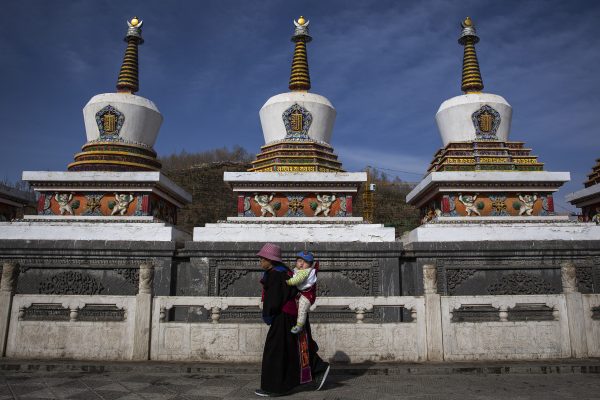
For Tibetans, lamas occupied the highest place of respect. In moments of hardship, people turned first to monasteries, seeking guidance from monks or reincarnate teachers. Each monastery was supported by designated villages or tribes that supplied novices, labor, food, and material resources. Over centuries, monasteries had become far more than sites of religious practice. They were schools, libraries, printing houses, archives, hospitals, banks, shelters, and centers of cultural life.
Among pastoral communities, it was customary for nearly every family to send one son to the monastery. In this sense, Tibetan monasteries functioned much like ancestral halls in Han society. They were collectively sustained and represented shared spiritual and material wealth for an entire region. The Communist approach to such institutions was consistent and uncompromising. Everything was confiscated.
Arjia Rinpoche, former abbot of Kumbum Monastery, later recalled the turning point he witnessed in 1958, when he was just eight years old.
One day, more than 3,000 monks at Kumbum were ordered to assemble. Children were included. Under ordinary circumstances, senior lamas would preside from elevated thrones while monks sat on the floor to receive teachings. That day, the thrones were removed. All reincarnate teachers and monks were made to sit on the ground. Rows of desks and benches replaced the ritual seating. Communist officials occupied the desks, and a large banner hung before them. What remained most vivid in Arjia Rinpoche’s memory was the presence of armed soldiers in green uniforms seated among the officials.
‘You are parasites’
In his autobiography Against the Wind and With the Current, Arjia Rinpoche recorded the scene.
Du Hua’an, a deputy head of the Qinghai United Front Work Department, delivered the opening speech. He was not tall, Arjia recalled, but his voice carried. “You reactionaries,” he said, “you exploiting class. You eat the flesh of the people and drink their blood. You are parasites.”
As he spoke, Du paced the platform, stamping his foot with each step. “Kumbum Monastery is a nest of counterrevolutionaries,” he declared. “You are wolves in sheep’s clothing, a feudal disguise. If you are not overthrown, the people will never rule, never stand up.”
When the speech ended, the assembled crowd was ordered to chant slogans: “Tear off the feudal cover,” “Thoroughly criticize religion,” “Smash religious superstition,” “Confess and receive leniency; resist and be punished,” “Avenge grievances, settle old scores.” As soon as the chanting stopped, arrests began.
The first person seized was Kumbum’s former abbot. He was bound, beaten, and then subjected to public denunciation. That was how the struggle session began. By Arjia Rinpoche’s estimate, four to five hundred people were taken away that day. His teachers, secretaries, and stewards were all arrested. He was left alone.
“I was only eight,” he later recalled. “Before that day, someone always took care of my daily life and religious practice. From that moment on, no one did. I came back by myself. I didn’t know where to go. I was probably crying as I followed the others.”
After the struggle sessions, monks at Kumbum were ordered to stop accepting offerings and to join manual labor as part of ideological “remolding.” Arjia Rinpoche’s robes were dyed and cut, reshaped into a Mao-style uniform. Along with several other young monks, he was sent to a local primary school. There, they studied stories such as Dong Cunrui Blows Up the Bunker and Huang Jiguang Blocks the Machine Gun. The stated aim was to raise them as successors to the Communist cause.
By early 1959, as the campaign was officially declared largely complete, more than 2,300 monasteries across Tibetan regions in Gansu, Qinghai, Sichuan, and Yunnan had been damaged or shut down, with some entirely destroyed. Estimates cited in later accounts indicate that more than 170,000 monks and lamas were killed or forcibly secularized.