By Bei Chun, Toronto Correspondent Station
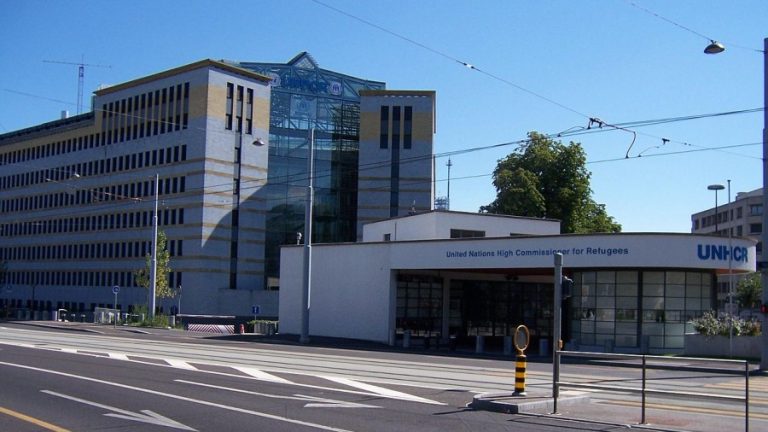
In recent days, advertisements from the United Nations High Commissioner for Refugees (UNHCR) have appeared prominently on China’s social media platform WeChat. UNHCR has also opened a storefront on the app. Reporters from this publication found that the store is selling so-called “peace passports” and a range of high-priced stationery items. The least expensive product—a box of pencils—is priced at nearly USD 30.
As the Chinese Communist Party (CCP) continues what critics describe as increasingly regressive governance, and following the outbreak of the Wuhan virus, a growing number of Chinese citizens have chosen to leave China and seek refugee protection overseas. Against this backdrop, in one of the world’s leading human rights–abusing countries, UNHCR has openly begun selling merchandise. Is this a form of irony directed at the Chinese Communist Party (CCP), or has Xi Jinping already folded the United Nations into his own pocket—effectively hijacking the organization to sing his praises, and even using UN-affiliated bodies to openly generate revenue?
In response to these developments, this publication interviewed Jie Lijian, chairman of the China Democracy Party International Alliance.
Jie said the storefront is not a simple commercial activity, but a political mechanism through which the CCP provides disguised benefits to the United Nations. He described how the CCP uses financial penetration and administrative pressure to gradually take control of the international organization, reducing it, on key human rights issues, to what he called an “empty talk club.”
Sky-high pencil prices: a ‘disguised gift’ to the United Nations
Success
You are now signed up for our newsletter
Success
Check your email to complete sign up
Jie first pointed to the pricing of the pencils sold by the United Nations in China, saying it is strikingly unreasonable. At nearly USD 30, or about 168 yuan, the product is clearly not priced for ordinary consumers. In his view, such a departure from market logic reflects a “disguised gift” provided by the CCP to the United Nations.
Jie said that if the pencils were left unsold in the Chinese market, it would amount to a public embarrassment for the United Nations—something the CCP would not allow to happen. Since ordinary citizens would not purchase such items, the state would step in to fill the gap by mobilizing public resources. By manufacturing the appearance of strong sales, the authorities could showcase China’s “support” for the United Nations. In essence, he said, this is a carefully packaged form of economic backing, similar in nature to the large sums the CCP donates to the United Nations each year.

‘Hollow condemnations’ under financial penetration
Jie further noted that the CCP, along with countries such as Russia, provides substantial funding to the United Nations on an annual basis—and that such funding comes at a price. He said these large financial contributions have left the United Nations, when dealing with issues related to Taiwan, Iran, and other authoritarian regimes, issuing only what he described as “hollow condemnations,” while lacking the ability to impose meaningful sanctions.
He cited the recent experience of an Iranian citizen journalist at a United Nations meeting, saying that people do not need empty rhetoric, but concrete sanctions. The current reality, he argued, is that under sustained lobbying and pressure from major donor states, the UN’s human rights mechanisms have gradually lost their edge. This, he said, is the inevitable outcome of being captured by money.
‘Forced allocations’ under administrative orders
As for how such high-priced items are ultimately “sold,” Jie described what he called a distinctive operating model within the CCP system. He said the government typically does not draw directly from the state treasury to make such purchases, but instead relies on more concealed methods carried out through administrative orders.
According to Jie, authorities apply various forms of pressure to forcibly assign purchasing quotas to private companies, government contractors, and related individuals. For these entities, the transaction is not merely a business decision, but a “political task” that must be completed. Faced with official directives and political pressure, they “dare not refuse,” and are compelled to pay in order to cooperate with what he described as a staged performance — thereby indirectly transferring benefits to the United Nations.

From UNHCR’s WeChat marketing to the Carney government’s ‘strategic collusion’
What is emerging is a picture of a refuge in collapse. As countless Chinese refugees risk their lives trekking through jungles along irregular migration routes in search of a slim chance of protection from the United Nations, UNHCR’s promotional advertisements appear conspicuously on WeChat — a platform subject to the CCP’s strictest surveillance and widely used as a tool for indoctrination and social control. The contrast is not only deeply ironic, but also raises serious questions about whether this international human rights body has been deeply penetrated by the CCP’s digital authoritarian system, placing its independence and security under unprecedented strain.
Even more unsettling, Jie said, is that Canada — an important member of the Western democratic world — under the Carney government has recently entered into what has been described as a “strategic cooperation” agreement with China’s Ministry of Public Security. In his view, this marks a moment when the CCP’s long-arm jurisdiction no longer operates in the shadows, but instead advances openly under the banner of “law enforcement cooperation.” When the United Nations’ protective umbrella begins to leak, and when democratic governments such as Canada choose to shake hands with what he called “executioners,” the consequences for Chinese political exiles overseas are devastating. Safe havens around the world, he warned, are disappearing, as the CCP’s network of transnational repression quietly tightens under the cover of so-called international cooperation.