By Li Muzi
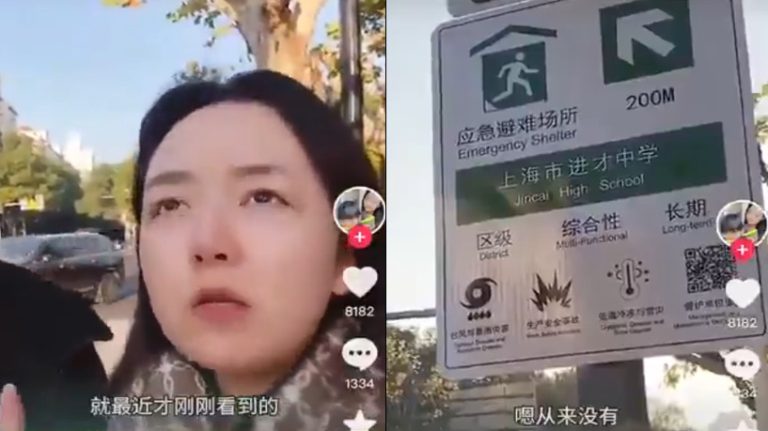
On Jan. 27, an overseas self-media account known as Laobeijing Teahouse released a video asserting that emergency shelter signs had abruptly appeared along Shanghai streets, describing the situation as uncertain and unsettling. The video shows a large roadside sign displaying “Shanghai Jincai High School” at its center, topped by an icon labeled “Emergency Shelter.” The sign indicates that the shelter is located 200 meters away.
In the video, a Shanghai woman addresses viewers directly, asking whether others have also noticed a growing number of such signs across the city.
“We’ve lived here for many years and never saw these before,” she said. A man beside her responded bluntly, “Yeah, never.”
The woman emphasized that the sign appeared newly installed. She questioned whether schools across Shanghai had now been designated as emergency shelters and what specific scenarios they were intended for. The man replied simply, “It’s where you run if something happens.”
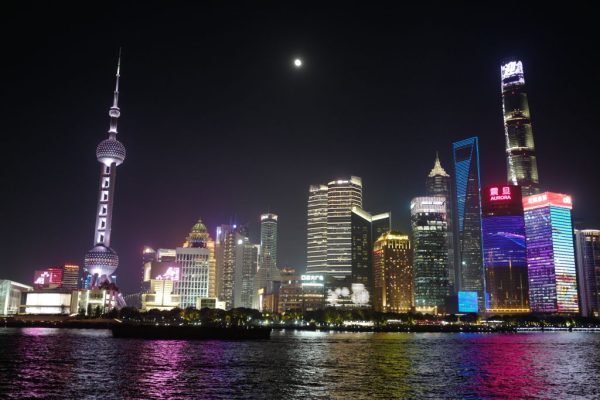
Shanghai emergency management authorities respond
Success
You are now signed up for our newsletter
Success
Check your email to complete sign up
On Jan. 28, the Shanghai Emergency Management Bureau convened a press conference to announce revisions to and the implementation of the city’s Overall Emergency Response Plan for Public Emergencies.
According to The Paper, a mainland Chinese media outlet, the bureau formally introduced the revised plan during a news briefing that morning. A member of the bureau’s expert advisory panel stated that urban emergency management relies not only on government agencies but also on the active participation of residents and enterprises.
The expert said the revised plan serves three core purposes: promoting participation, clarifying responsibilities, and standardizing behavior. Its stated objective is to enable enterprises and residents to engage more effectively in emergency prevention and response, while clearly understanding their roles within Shanghai’s emergency management system.
He further stressed that enterprises and ordinary citizens should focus on three areas: understanding Shanghai’s emergency response mechanisms and basic procedures; understanding the emergency obligations and baseline responsibilities citizens are expected to fulfill during both prevention and response phases; and understanding the official channels and platforms for communicating with government authorities in routine circumstances as well as during emergencies.
That same day, the Jinan Municipal Government Information Office in Shandong Province held a separate press briefing featuring its Emergency Management Bureau.
According to Jinan Daily, Jinan currently maintains 630 designated emergency shelter sites, covering a total area exceeding 24 million square meters. The city reports an average shelter capacity of 2.5 square meters per person.
Political context: CCP power struggles and military purge
The sudden visibility of emergency shelter signage has drawn intensified scrutiny against the backdrop of broader political turbulence within the Chinese Communist Party (CCP), China’s ruling party.
On Jan. 24, a major internal shake-up reportedly took place when Zhang Youxia, vice chairman of the Central Military Commission (CMC)—the CCP’s highest military decision-making body overseeing the People’s Liberation Army (PLA)—and his close associate Liu Zhenli were officially announced to be under investigation.
In the days that followed, reports and speculation about internal power struggles and unusual military movements within the CCP and the PLA spread rapidly. Some analysts characterized the developments as the beginning of a countdown toward systemic instability within the Chinese political system.
Shanghai, China’s largest city and a critical economic hub, and Beijing, the CCP’s political nerve center, have come under close observation amid these unfolding events.

Analysts warn of unprecedented instability under Xi Jinping
Independent political commentator Du Wen wrote on the X platform that the situation amounts to what he described as the most ruthless and comprehensive purge in the history of the CCP and international communist movements. He portrayed the developments as evidence of structural breakdown within the Chinese military under Chinese leader Xi Jinping and warned that internal retaliation could follow.
Du urged Beijing residents to reduce unnecessary outings, specifically warning against travel near Chang’an Avenue, the ceremonial artery adjacent to key Party and military institutions. He cautioned that large-scale troop unrest could erupt at any moment. His remarks reflect his personal assessment and have not been independently verified.
Democracy activist and writer Sheng Xue, speaking in a recent interview with Vision Times, said the Zhang Youxia case should not be interpreted merely as an anti-corruption campaign or a routine factional struggle.
In her view, the incident signals a state of “systemic loss of control” within the CCP’s internal power structure—a condition she suggested has echoes of past political convulsions, including periods of chaos comparable to the Cultural Revolution.
“When the military no longer fully obeys orders, regime stability enters a condition in which collapse can occur at any moment,” Sheng said. She warned that Xi Jinping’s ongoing purge strategy could backfire and suggested that behind-the-scenes bargaining among rival factions may play a decisive role in shaping China’s political trajectory in the period ahead.
Editor’s Note:
This article is based on publicly circulated videos, reports from mainland Chinese media outlets, and commentary by analysts and public figures. The claims, interpretations, and political assessments cited reflect the views of the sources quoted and have not been independently verified.