By Chen Jing
When science no longer reassures
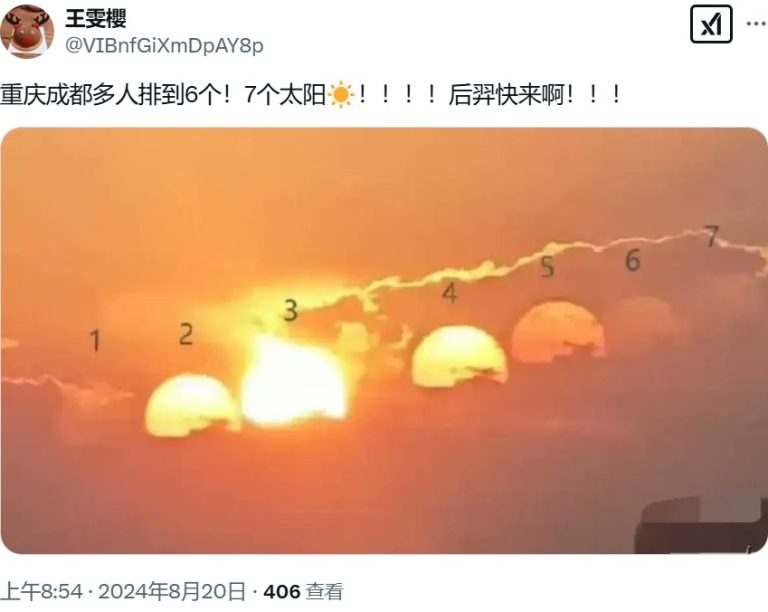
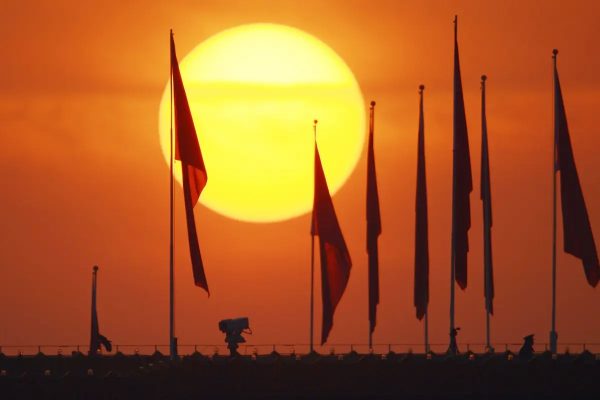
In recent years, reports of “multiple suns appearing together” have emerged from different parts of China. Observers describe several sun-like images visible at the same time, their light overlapping and difficult to distinguish. From the perspective of modern science, this phenomenon is well known: so-called “sun dogs,” an optical effect caused by sunlight refracting through ice crystals high in the atmosphere. These are usually seen in polar or high-latitude regions, or under stable, cold weather conditions.
But when something described as rare begins to appear frequently—especially in lower-latitude areas without unusual weather—scientific explanations lose their calming effect. People begin asking other questions. Why is this happening now? Why so often in recent years? And why at a moment when many inside China sense that the political system is approaching a period of serious instability?
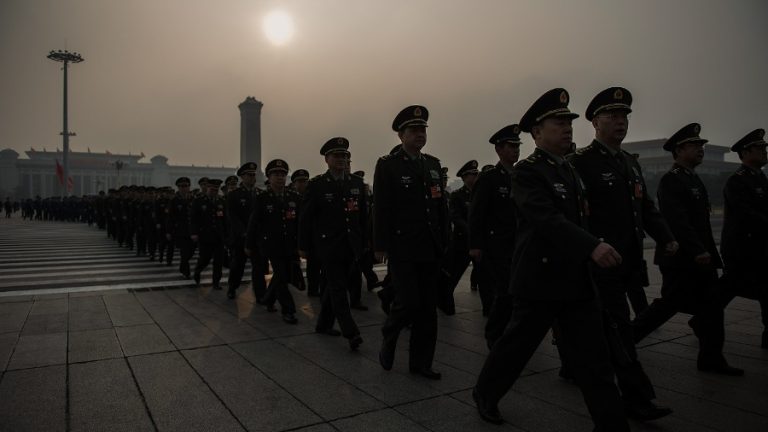
At first, these sightings were little more than casual conversation. That changed after official announcements confirmed the downfall of Zhang Youxia and Liu Zhenli, both senior commanders in the People’s Liberation Army (PLA), China’s armed forces. The atmosphere shifted. What had seemed like a visual curiosity was suddenly read as something more ominous: a symbolic overlap between unusual natural images and dramatic political events.
A traditional saying captures this instinctive reaction: when abnormal signs multiply, something beneath the surface is already wrong. If the sun in the sky appears divided, can political authority on the ground still be unified?
Heaven, order, and legitimacy in Chinese political thought
Success
You are now signed up for our newsletter
Success
Check your email to complete sign up
To understand why “multiple suns” carry political meaning in China, it is necessary to look at traditional Chinese ideas about power and legitimacy. In classical thought, “Heaven” did not mean a distant religious realm or a neutral natural system. It represented order, moral authority, and the ultimate source of political legitimacy.
Within this framework, the sun symbolized the ruler—the single center from which authority and moral order radiated.
One sun meant unity and clear hierarchy. More than one sun implied disorder: authority split into competing centers, legitimacy blurred, and power no longer clearly defined. For centuries, official histories recorded unusual celestial images alongside moments of political crisis. Works such as Records of the Grand Historian (a foundational history of early China), the Book of Han (covering the Western Han dynasty), and the Book of the Later Han repeatedly link reports of “multiple suns,” “stars visible at noon,” or “a dimmed sun” to periods of intense power struggle and regime breakdown.
These records were not claiming that the sky caused political collapse. Instead, they used natural imagery as a way of describing political reality. When human institutions fell into chaos, historians described the heavens as chaotic too.
What history says happens when authority splits
Across Chinese history, references to multiple suns appear at remarkably consistent moments: just before centralized authority breaks down.
At the end of the Warring States period—an era of prolonged conflict before China’s first unification—Records of the Grand Historian notes that “the sun rose twice in one day, appearing together for several days.” At the time, the Zhou king, the nominal ruler of the old order, had little real power. Rival states and ministers openly competed for dominance. Soon afterward, the feudal system collapsed entirely. The message embedded in the imagery was clear: when there is no true center of authority, the sky itself seems to show more than one sun.
During the late Western Han dynasty, the Book of Han records that “multiple suns appeared in the sky, their lights in confusion.” This occurred around the time of Wang Mang, a court regent who seized the throne and attempted to found a new dynasty. Although the Han court still existed in form, real power was split among Wang Mang, imperial relatives, influential clans, and regional strongmen. Authority existed, but no one could clearly define where it truly lay.
A prophetic summary from the same era stated it bluntly: “The sun represents the ruler; when suns appear together, the ruler’s way is in chaos.”
On the eve of the Three Kingdoms period, when China fractured into competing states, the Book of the Later Han records that “two suns appeared at noon, terrifying the populace.” Emperor Xian, the last Han emperor, still occupied the throne, but he was controlled by Cao Cao, a powerful warlord. Elsewhere, figures such as Yuan Shao and Sun Quan ruled large territories independently. There was one emperor in name, but several centers of command in reality. Decades of war followed, and imperial authority disappeared altogether.
A similar pattern appeared in the late Western Jin dynasty. The Book of Jin describes “overlapping suns” during the War of the Eight Princes, a destructive struggle among members of the imperial family. Central authority disintegrated, the state collapsed, and China entered a prolonged period of invasion and internal chaos.
From these episodes emerged a clear historical judgment: “Multiple suns do not signal the arrival of a new ruler. They mark the breaking apart of the old one.”
In other words, such signs do not announce a stable replacement. They describe a system that has already lost the ability to hold power together.

Zhang Youxia and Liu Zhenli as a modern parallel
Seen in this historical context, the downfall of Zhang Youxia and Liu Zhenli cannot be dismissed as a routine anti-corruption campaign. It fits a much older pattern.
Zhang Youxia was a vice chairman of the Central Military Commission (CMC), the Chinese Communist Party body that directly commands the PLA. Liu Zhenli was chief of the Joint Staff Department, responsible for military operations and planning. Together, they sat at the very center of China’s military power structure.
Their sudden removal signals violent shifts within that center. When figures long treated as indispensable are recast as threats and eliminated, it suggests not confidence but fear. This is not the smooth tightening of control. It is evidence that authority no longer feels secure enough to tolerate strong pillars.
This is why the moment feels unstable. Power is not being calmly reorganized; it is being broken apart under pressure.
Fragmentation and competing centers of power
Traditional interpretations of “multiple suns” align closely with this situation. Any political system can sustain only one effective center of command. When senior military leadership is repeatedly purged, the ability to set clear direction weakens. Competing loyalties, internal rivalries, and silent resistance begin to grow.
The scientific explanation of sun dogs offers an unintended metaphor. What looks like multiple suns are not real suns at all—only reflections created by distortion. In political terms, this resembles a system filled with displays of loyalty that mask rivalry and distrust, where official signals are increasingly unreliable.
The old order has not fully collapsed, but no new, stable structure has emerged. Authority still exists on paper, yet its real influence is scattered and uncertain.

Disorder reflected, not created
The anxiety triggered by the coincidence of repeated “multiple suns” sightings and the downfall of Zhang Youxia and Liu Zhenli comes from a deeply rooted intuition: symbols reflect underlying conditions.
The removal of these two commanders exposes cracks at the top of China’s power pyramid. It matches the oldest interpretation of multiple suns: authority disperses before it disappears.
What follows may echo familiar historical cycles. Public unity may conceal deep internal fractures. Under sustained pressure, different parts of the system—from the military to party institutions and regional authorities—may quietly shift toward self-preservation rather than collective coherence.
In Chinese historical memory, periods marked by “multiple suns” are never stable. They describe systems where command is contested, legitimacy is unclear, and the gap between formal authority and lived reality widens. As ancient observers warned, “Heaven shows signs to reveal fortune and misfortune; the wise take heed.”
The repeated appearance of this image suggests that what once seemed like a single, unchallengeable center of power has already entered a phase of irreversible internal breakdown.
History’s lesson is consistent: order often begins to unravel precisely when it appears strongest.
Editor’s Note:
This article draws on publicly circulated images and videos, historical records, and commentary rooted in traditional Chinese political culture. Interpretations involving symbolism reflect the author’s analytical framework and are not independently verifiable claims. The views expressed are solely those of the author.