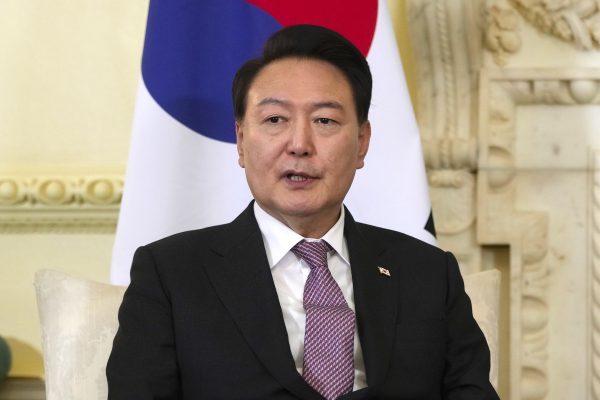
Yoon Suk Yeol, the former president who stunned the world by declaring emergency martial law in December 2024, now faces a death sentence in a case that has split South Korean society in two. The Seoul Central District Court will deliver its first-instance verdict on Feb. 19, 2026, in a globally televised ruling. It will be only the second time in South Korean history that a former head of state has faced a capital prosecution, after the military dictator Chun Doo-hwan in 1996. The outcome will shape the future of Korean democracy, its alliance with Washington, and the boundaries of presidential power.
Six hours that shook Korean democracy
The crisis traces back to the night of Dec. 3, 2024, a date now seared into South Korean political memory. With no war underway and no national emergency to invoke, President Yoon suddenly declared “emergency martial law.” Fully armed soldiers and police fanned out across Seoul within minutes, surrounding the National Assembly and deploying forces near major media outlets. The scenes evoked South Korea’s authoritarian past, when military rulers routinely seized power at gunpoint.
But Korean democracy held. Members of the National Assembly broke through military cordons, convened an emergency session, and voted overwhelmingly to overturn the martial law decree. The entire episode lasted just six hours, yet the constitutional shock wave it produced has not subsided.
Under South Korea’s constitution, any declaration of martial law must first pass through the State Council, the cabinet-level deliberative body that serves as a critical check on presidential emergency powers. Investigators found that Yoon bypassed this requirement entirely, notifying only a handful of loyalists before acting unilaterally. The Seoul Central District Court later issued a blunt rebuke: “Martial law, as an exercise of national emergency powers, should be invoked only under the most extreme and exceptional circumstances. The defendant openly violated the constitutionally mandated State Council procedures.”
From obstruction of justice to the charge of leading an insurrection
Since leaving office, Yoon has been hit with eight separate criminal cases. Two have already produced significant legal consequences.
Success
You are now signed up for our newsletter
Success
Check your email to complete sign up
The first is a relatively narrow obstruction-of-justice case. In January 2025, an independent counsel team attempted to execute an arrest warrant at the presidential residence, only to be physically blocked by a large security detail that Yoon had pre-positioned. On Jan. 16, 2026, the court convicted him and handed down a five-year prison sentence. The language of the ruling was unsparing: “As president, the defendant bore a greater obligation than any citizen to uphold the rule of law. His contempt for procedural requirements warrants severe condemnation.” The verdict sent an unmistakable signal that the judiciary would show no deference to a former head of state, and set a harsh tone for the far graver insurrection trial to follow.
That trial centers on the charge of masterminding an insurrection, the most serious crime in South Korea’s legal code. During an eleven-hour closing argument on Jan. 13, 2026, prosecutors laid out their case in uncompromising terms: “The declaration of martial law betrayed the constitutional duty to protect civil liberties and safeguard the constitutional order. It fundamentally endangered national security and the survival of the people. In its purpose, its methods, and its execution, this act was anti-state in nature.” To prevent any future leader from attempting the same, prosecutors argued, only the harshest possible sentence would suffice. They demanded death.
Yoon’s defense: a self-styled Galileo fighting communism from prison
Yoon’s legal team responded with a dramatic gambit, comparing their client to Galileo and Giordano Bruno, figures persecuted for truths the establishment refused to accept. Their argument: “The opinion of the majority does not always reveal the truth.” The defense sought to recast Yoon as a tragic patriot, a leader who acted to save his country from pro-communist infiltration and now faces political retribution disguised as justice.
This framing resonated powerfully with South Korea’s conservative base. From his roughly ten-square-meter solitary cell in the Seoul Detention Center, Yoon has refused to stay quiet. On December 3, 2025, the first anniversary of his martial law decree, he issued a combative open letter titled “A Message to the People,” attempting to redefine the entire episode on his own terms.
In the statement, Yoon described the “December 3 Emergency Martial Law” as “a righteous battle against subversive forces that paralyzed state governance and sought to destroy the free constitutional order.” He aimed his fire squarely at the main opposition Democratic Party of Korea, branding it the true destroyer of constitutional governance. He accused the party of impeaching government appointees over thirty times, slashing defense and economic budgets, and making more than 1,200 illegal personnel appointments.
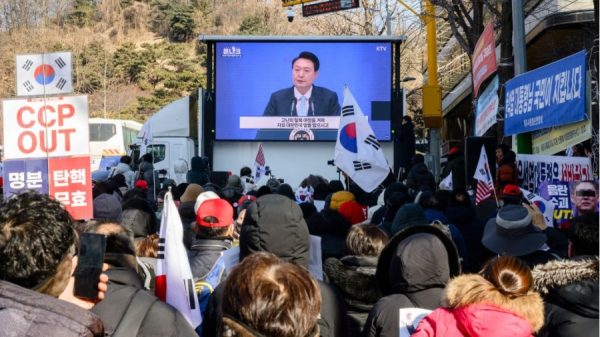
The most incendiary passage in Yoon’s prison letter alleged that “South Korea has become a spy paradise for pro-communist, treasonous forces.” He attacked his political opponents for blocking the expansion of the country’s espionage laws, which he said had allowed “pro-CCP and pro-Pyongyang treason to run rampant.” This accusation struck at one of the rawest nerves in Korean public life, tapping into a deep and growing fear of Chinese influence operations and foreign infiltration.
Why Yoon’s anti-communist message found fertile ground in Korean society
Yoon’s combative rhetoric landed in a society already primed to receive it. A 2024 Pew Research Center survey found that 97 percent of South Koreans hold a negative or very negative view of China, the highest rate of any country surveyed worldwide. Much of this hostility dates to 2016, when Beijing imposed sweeping economic retaliation after Seoul agreed to host the U.S. THAAD missile defense system, a move China viewed as a direct threat. The episode left a lasting imprint on Korean public opinion.
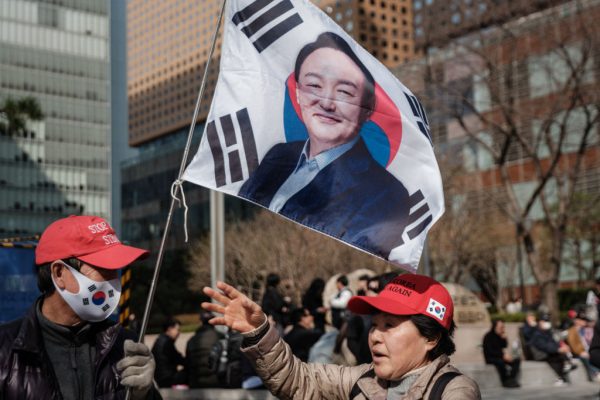
On the streets of Seoul, from the tourist district of Myeongdong to the heavily Chinese-immigrant neighborhood of Daerim-dong, banners demanding “Free Yoon Suk Yeol” and “Destroy the Communist Party” have become a common sight. On September 28, 2025, multiple conservative groups rallied near Seoul Station, waving South Korean and American flags and chanting anti-communist slogans, explicitly linking Yoon’s imprisonment to the geopolitical threat they believe South Korea faces from China and North Korea. When current President Lee Jae-myung criticized such rallies as “filled with profanity and hate speech that exceeds the bounds of free expression,” conservatives seized on his words as proof of government weakness.
The espionage law debate that Yoon spotlighted from prison is poised to become a defining political fault line. South Korea’s existing National Security Act was designed primarily to prosecute espionage on behalf of North Korea. Its provisions for punishing intelligence activities linked to other foreign powers, particularly China, remain comparatively weak.
Conservatives argue that in an era of intensifying U.S.-China strategic competition and escalating intelligence warfare, expanding the law’s scope is essential to closing what they call a “national security black hole.” Progressives and civil liberties groups counter that broadening the statute risks repeating the authoritarian-era abuse of the National Security Act, which was routinely weaponized to silence dissidents and crush political opposition. How South Korea resolves this tension will serve as a litmus test for the maturity of its democracy.
What Yoon’s fall means for the US-led alliance in the Indo-Pacific
The domestic upheaval carries significant international consequences. During his presidency, Yoon pursued an explicitly pro-Washington, pro-Tokyo foreign policy, distancing Seoul from Beijing and Pyongyang while aggressively deepening trilateral U.S.-Japan-South Korea security cooperation. With Yoon behind bars, the future of that diplomatic trajectory is uncertain. Washington has publicly emphasized respect for South Korean judicial independence. Behind closed doors, however, American officials worry that prolonged political instability in Seoul could weaken the alliance architecture across the Indo-Pacific.
The Yoon case has cleaved South Korean society into two nearly irreconcilable worldviews.
Those who support the prosecution see the trial as proof that Korean democracy has matured. Deploying the military to surround the National Assembly and muzzle the press during peacetime, they argue, crosses an inviolable line. Tolerating such an act would hand every future leader a dangerous precedent: that when political pressure mounts, force is an option. Holding a former president in an ordinary jail cell, subject to ordinary criminal law, is precisely what “equality before the law” demands.
Those who oppose the prosecution see a political vendetta dressed in judicial robes. They point to South Korea’s grim pattern: virtually every former president has faced criminal investigation after leaving office, creating a cycle in which each change of government triggers a prosecutorial reckoning against the predecessor. In a society this polarized, they warn, a death sentence will inevitably be read as a political signal, overshadowing any purely legal reasoning behind it.
As the ruling date approaches, South Korea confronts several pivotal questions. Will the court adopt the prosecution’s demand for the death penalty? How will the judiciary define “masterminding an insurrection,” and what precedent will that definition set? And however the court rules, what will the verdict mean for the future of South Korean justice, its democratic institutions, and its role in the global order?