The controversy surrounding the nationality and candidacy eligibility of Taiwan People’s Party legislator-at-large Lee Chen-hsiu continued on Feb. 13, drawing renewed public attention.
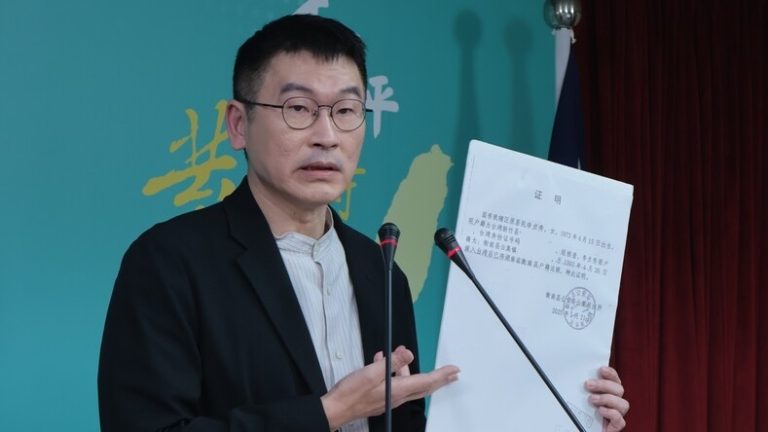
Lee went in person to the Mainland Affairs Council (MAC) to hold a press conference, presenting a deregistration certificate that she said proves she canceled her Chinese household registration in 1993. She stressed that she no longer holds Chinese nationality.
The MAC responded that there are doubts about the format of the document and that it only partially recognizes the timing of her submission. The agency reiterated that it cannot assist her in completing procedures to renounce Chinese nationality.
MAC Deputy Minister and spokesperson Liang Wen-chieh said the certificate submitted by Lee differs in format from deregistration certificates typically provided by mainland spouses. He also said she only completed submission of proof of loss of her original Chinese household registration in March 2025. That timeline, he added, means that when she registered as a legislator-at-large candidate in 2023, she may have simultaneously held household registrations in both Taiwan and mainland China.
Under relevant provisions of the Act Governing Relations Between the People of the Taiwan Area and the Mainland Area, individuals originally from the mainland must complete household deregistration and submit proof before meeting eligibility requirements for candidacy. The MAC emphasized that legislators must bear a single allegiance to the state and said that at this stage it is still unable to confirm whether Lee has completely lost Chinese nationality.

Success
You are now signed up for our newsletter
Success
Check your email to complete sign up
Dispute over wording of certificate
Lee married into Taiwan on April 26, 1993, and obtained residency status in 1999. In 1999, however, the cross-strait act did not yet require a single household registration system. From the time she married into Taiwan in 1993 until she obtained residency in 1999, mainland household deregistration was not yet required under Taiwan law.
Liang said the certificate provided by Lee reads: “After marrying into Taiwan on April 26, 1993, she has already canceled her household registration in Hengnan County, Hunan Province. This is hereby certified.” He noted that this wording differs from certificates submitted by other mainland spouses.
According to Liang, certificates from other mainland spouses specify that the individual “on a certain year, month, and day of the Western calendar, came to cancel registration,” which corresponds to the issuance date of the certificate. They do not retroactively state the date of mainland household deregistration, as in the certificate provided by Lee. He said the wording is significantly different.
At the press conference, Lee appeared emotional and at one point choked up. She said that as early as 1999 she had registered in Taiwan to obtain household registration and had canceled her Chinese household registration. She submitted a photocopy of the deregistration certificate in an effort to clarify the facts.
Lee also publicly authorized the MAC to assist her in handling the “procedure to renounce Chinese nationality” required by the government, saying she hoped to calm public doubts.

Renunciation must be handled personally
Responding to Lee’s authorization, Liang said that regardless of the country involved, spouses must personally handle the renunciation of their original nationality.
“If you want to renounce U.S. nationality, the Ministry of Foreign Affairs will not handle it for you. If you want to renounce mainland nationality, the MAC can only ask you to handle it yourself,” Liang said. He added that the documents submitted by Lee will be returned to her. Because renouncing foreign nationality is the responsibility of the individual concerned, government agencies cannot complete the procedure on their behalf.
Liang said Lee’s mainland deregistration certificate was only submitted to the National Immigration Agency in March 2025. That means, he said, her Taiwan status was only considered complete in March 2025. When she was nominated at the end of 2023 as a legislator-at-large candidate of the Taiwan People’s Party, she therefore had “dual household registrations,” which did not meet candidacy eligibility requirements under the cross-strait act.
In response to concerns that the case could affect the rights and interests of other spouses originally from the mainland, the MAC said it does not wish this incident to implicate the majority of mainland spouse families and will adopt a handling approach that does not disturb the majority.
At present, the Executive Yuan and the Ministry of the Interior have repeatedly sent letters requesting that Lee submit formal written proof of renunciation of Chinese nationality. No legally effective document had been received by the deadline, making her legislative qualifications a focal point of scrutiny.
Relevant government departments said they will consult with election authorities to study and repair institutional loopholes to prevent similar situations from occurring again.