By Dongfang
As the post-WWII international order fractures under pressure from Washington’s “America First” tariffs and Beijing’s aggressive bid for global influence, middle powers from Europe to East Asia are racing to build new coalitions. Canadian Prime Minister Mark Carney has emerged as the most vocal champion of this middle-power coalition strategy, warning at Davos: “If we’re not at the table, we’re on the menu.”

Two superpowers, and everyone else picking sides
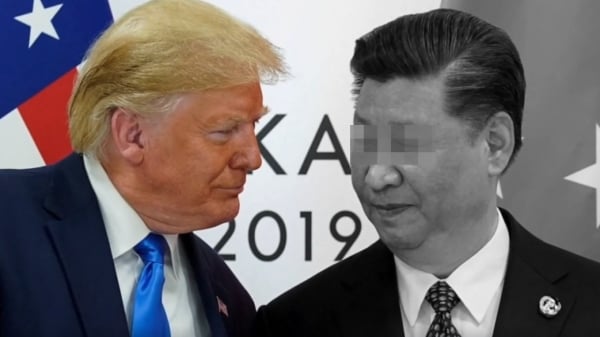
Today’s world is defined by the contest between the United States and China. Xi Jinping, China’s leader, has declared a “great change unseen in a century,” insisting that “time and momentum are on our side.” Wolf-warrior diplomacy, military saber-rattling, and the Belt and Road Initiative all project Beijing’s ambition to overturn the existing global order.
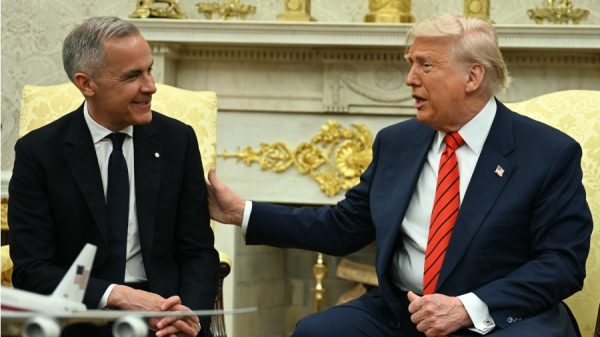
Other nations, especially middle powers, face a stark choice: pick a side or band together for survival. At this inflection point, Canadian Prime Minister Mark Carney has stepped forward as the most active advocate for a coalition of middle powers, including most of Europe, Japan, South Korea, Australia, India, Brazil, and Turkey. At the World Economic Forum in Davos, Carney put it bluntly: middle powers must act collectively, because “if we’re not at the table, we’re on the menu.”
The post-WWII order is crumbling, and no one is ready for what comes next
The international system built after 1945 is no longer sustainable. The emerging order remains shapeless, leaving many nations disoriented. The United States has abandoned its role as global policeman. At the same time, the Trump administration openly wields American economic and military power to demand that allies serve U.S. interests. China, meanwhile, has seized the vacuum to cast itself as the responsible adult in the room. Few countries buy it. Most view Beijing as an authoritarian regime that bends global trade rules to its own advantage and will use any means necessary to get what it wants.
Success
You are now signed up for our newsletter
Success
Check your email to complete sign up
How middle powers are hedging their bets
Middle powers have two broad strategies for self-protection. The first is to build domestic self-sufficiency, reducing dependence on the superpowers. The second is to form issue-specific coalitions: supply chains, trade routes, security cooperation.
Many are already moving. Military spending is rising across the board. France is developing homegrown alternatives to American dominance in technology and software. On the trade front, the logic is inescapable. The United States long served as the engine of global demand, but Trump’s tariffs and push to reshore manufacturing have disrupted that role. China cannot replace it. The Chinese economy is drowning in overcapacity and needs to dump its surplus production on foreign markets.
Canada has distanced itself from Washington on China trade policy, fast-tracked stalled oil, gas, and mining projects, and is expanding its export terminals to reduce reliance on the American market. The European Union is pursuing free trade agreements with India, South America, and Mercosur nations, and pushing to finalize its deal with Australia. German Chancellor Friedrich Merz recently visited India, Saudi Arabia, Qatar, and the United Arab Emirates, with a trip to China scheduled before the end of the month. French President Emmanuel Macron and British Prime Minister Keir Starmer have both visited Beijing recently.
Arms buildups and new military alliances are accelerating
Every one of these countries remains wary of tilting too far toward Beijing. Dependence on the Chinese Communist Party, they know, carries even greater risks. Many middle powers, Germany chief among them, are ramping up defense spending. The European Commission last year created a financing mechanism to help member states boost military budgets, and Canada has joined the initiative.
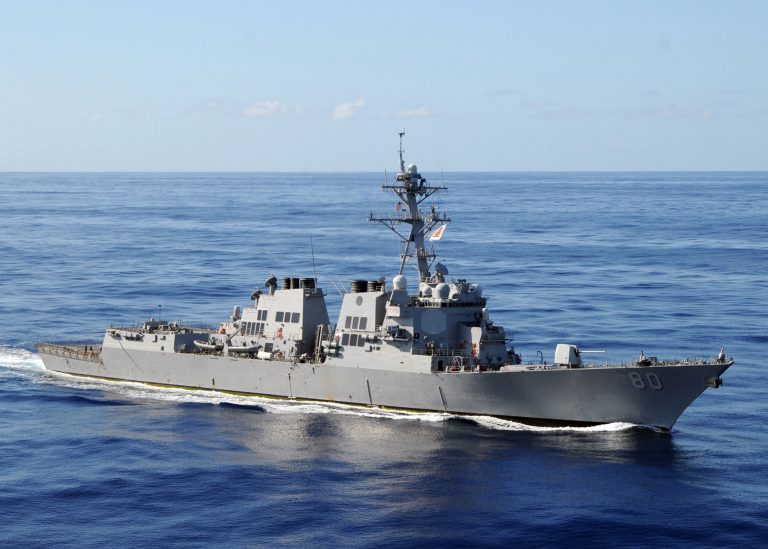
European nations are also deepening military ties with East Asian partners, including Japan, South Korea, Singapore, Australia, and New Zealand, all of which share anxieties about both Russia and China. Britain, Italy, and Japan are jointly developing a sixth-generation fighter jet. South Korea has become a major arms supplier to several European countries: Poland is buying Korean tanks, the Baltic states are purchasing Korean artillery, and Norway is acquiring Korean long-range missiles. Britain and Australia are building nuclear-powered submarines in cooperation with the United States, and South Korea is pursuing its own nuclear submarine program.
Full strategic independence from the U.S., though, remains out of reach for Europe. European self-defense capabilities are limited. The continent can produce its own artillery, tanks, submarines, and warships, but it depends heavily on the United States for fighter aircraft, military satellites, and nuclear deterrence.
Why a middle-power bloc may never coalesce
The Chinese have a saying: long periods of unity give way to division, and division eventually yields to unity. In today’s context, this does not mean territorial conquest or fragmentation. It means the rise and fall of interest blocs and alliances. The world may well be entering an era of competing trust clusters, in which like-minded nations huddle together for warmth.
The problem is that middle powers struggle to find common ground, especially when their values diverge sharply. Arab states, for instance, are unlikely partners for European democracies or Canada. Unless middle powers can look beyond short-term self-interest, their coalitions risk becoming flashpoints rather than stabilizers. India, after Russia’s invasion of Ukraine, refused to join international sanctions on Russian oil and continued purchasing it. Turkey and Israel, each jockeying for greater geopolitical weight, may end up in direct conflict with each other.
Even when alignment is possible, execution remains agonizing. Consider the European Union: 27 member states, shared standards, collective trade negotiations, yet the EU’s bureaucracy is so bloated and slow that it can barely make decisions, let alone implement them. Beyond the summit communiqués and slogans, almost nothing moves.
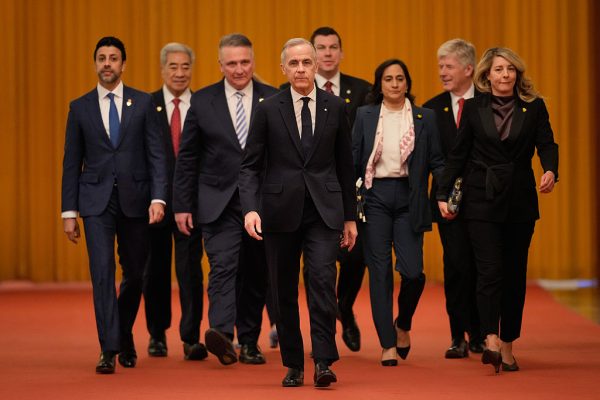
The post-WWII system took 70 years to build. Replacing it will be just as hard
The current international order rests on trade and security relationships that Western nations spent seven decades constructing alongside the United States. Decoupling from that architecture is enormously difficult. Middle powers are a diverse, fractious group, each running its own calculations, often with conflicting interests and values. Mismanaging this transition could generate more global instability, not less. For now, middle powers have no choice but to feel their way across the river, one stone at a time.