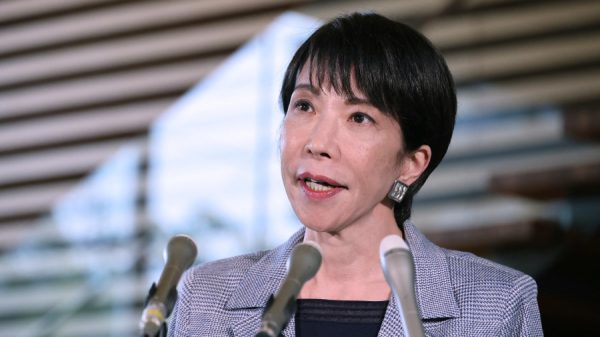
On Feb. 18, Japan’s political scene reached a pivotal moment. During a special Diet session convened after the House of Representatives election, Liberal Democratic Party (LDP) President Sanae Takaichi won overwhelming support in the prime ministerial vote, officially securing a second term as Japan’s 105th Prime Minister. She will form a coalition government with Nippon Ishin no Kai, creating the “Second Takaichi Cabinet,” with all current ministers retained, signaling both political stability and policy continuity.
Takaichi’s overwhelming victory lays governing foundation
The leadership change follows the House of Representatives election held on Feb. 8. The LDP achieved a historic victory in the campaign, winning 316 seats—including additional endorsed independent candidates—far exceeding the majority threshold needed to govern alone. Coalition partner Nippon Ishin no Kai contributed 36 seats, giving the governing coalition a total of 352 out of 465 House seats, securing an absolute two-thirds majority.
This seat distribution has significant constitutional implications. Under Japan’s constitution, if the House of Councillors rejects a bill passed by the House of Representatives, the House of Representatives can pass the bill again with a two-thirds majority, at which point it becomes law. This grants the Takaichi Cabinet strong authority to advance key legislation, even in the face of upper-house opposition.
By contrast, the main opposition bloc, the Constitutional Reform Union (Chuudo Kaikaku Rengo), suffered a major setback, winning only 49 seats, making it difficult to pose a substantive challenge. The stark seat disparity provides a solid governing foundation for Takaichi while raising concerns about power balance.

Cabinet personnel decisions
Addressing public attention on cabinet appointments, Takaichi chose a “steady course,” retaining all current ministers. This decision was based on two considerations: first, to manage urgent time pressures, as the special Diet session’s priority is to pass the 2026 budget by the end of March, and changing ministers could slow deliberations; second, to reflect voter trust, since all current ministers were elected in the general election, demonstrating public support for the governing team.
Success
You are now signed up for our newsletter
Success
Check your email to complete sign up
Before the prime ministerial election, Takaichi addressed the LDP’s bicameral meeting, stating that the party’s campaign promise to “make Japan stronger and more prosperous” had earned the trust of the people. She emphasized that the party would discuss internally how to advance policies in the “fastest and most effective” way and urged all members to implement campaign commitments in unison, reflecting a pragmatic and efficient governing approach.
Despite the overwhelming seat advantage, the ruling coalition has adopted a cautious political stance. LDP Secretary-General Shunichi Suzuki told NHK that while the coalition controls more than two-thirds of the House of Representatives and has received significant public support, “complacency due to seat count is unacceptable.” He said the government would humbly listen to opposition proposals and noted that the coalition has yet to secure a majority in the House of Councillors, requiring extra caution.
Role of Nippon Ishin no Kai in the coalition
Nippon Ishin no Kai plays an important role in the coalition. Co-leader Fumitake Fujita said that the Takaichi administration has entered a “second stage” post-election, with greater responsibility in joint governance. Policies advocated by Ishin, such as reducing the number of parliamentary seats and promoting both welfare and growth, have been incorporated into the coalition agreement and will be discussed in the Diet according to schedule. Ishin’s participation provides reform momentum, especially in administrative efficiency and structural reforms.
Key focus: passing the 2026 budget
The Takaichi Cabinet’s immediate priority is deliberation and passage of the 2026 budget. Suzuki emphasized that the budget affects both the economy and public welfare, and the government hopes to communicate fully with opposition parties to complete deliberations by the end of March. Responding to criticism of “dissolving the Diet before rushing the budget,” Suzuki stated that dissolution was to confirm public opinion, and with voter endorsement, the budget should be advanced quickly to ensure economic stability and citizens’ livelihoods.
Among specific policies, the most closely watched is Takaichi’s campaign pledge to reduce the food and beverage consumption tax to zero for two years. Suzuki said a national conference will be convened to gather broad public input. As this involves major fiscal adjustments, careful evaluation of feasibility and impact is required.
Takaichi also plans to promote a “responsible proactive fiscal” framework, seeking to balance stimulating economic growth with maintaining fiscal discipline—a particularly challenging task for Japan amid an aging population and large public debt.
Opposition responses
With the coalition’s dominant position, opposition parties have adopted different strategies. National Democratic Party leader Yuichiro Tamaki took a pragmatic approach, emphasizing the party’s principle of “solving issues rather than confronting blindly.” He said his party will cooperate on policies where possible but remain firm in oversight and necessary corrections. Tamaki expressed openness to participating in discussions in the proposed consumption tax national conference.
Constitutional Reform Union leader Junya Ogawa emphasized oversight responsibilities. He acknowledged the pressure felt in the Diet due to the LDP’s two-thirds majority, noting a noticeably different atmosphere. Ogawa stressed that “votes may decide decisions, but debates are not won by votes,” and the opposition will use policy substance as its tool to fulfill its oversight role.
Ogawa added that as a party that fared poorly in the election, Constitutional Reform Union must first stabilize internally to act externally, reorganizing the party while conveying policy positions to the public to gain long-term support.

Takaichi plans US visit in March
On the foreign policy front, Takaichi is planning a March visit to the United States to meet with President Trump, aiming to strengthen the Japan-U.S. alliance. This will be her first major diplomatic trip following her reelection and is significant for safeguarding Japan’s national interests amid a complex international situation.
Takaichi has long advocated for a “strong Japan,” taking an active stance in security and foreign relations. Her talks with Trump are expected to cover Indo-Pacific security, economic and trade cooperation, and other key issues, influencing the future trajectory of Japan-U.S. relations.
The special Diet session will last 150 days, until July 17. Takaichi is scheduled to deliver her policy speech and other major government addresses on Feb. 20, outlining her domestic and foreign policy agenda, while formal debate with opposition parties will commence.
The formation of the Second Takaichi Cabinet marks a new stage in Japanese politics. While the coalition enjoys an absolute House majority, cooperation with the opposition is still needed in the House of Councillors, requiring the government to balance strong parliamentary leverage with openness to differing views.
Whether Takaichi can successfully deliver on her promise of a “stronger, more prosperous Japan” will depend on balancing policy efficiency with the quality of democratic consultation. Key issues such as consumption tax reform, proactive fiscal policy, and administrative reform require careful planning and broad consensus. The 150-day Diet session will serve as a critical test of the Takaichi administration’s governing capability and democratic standards.
By Yang Tianzi