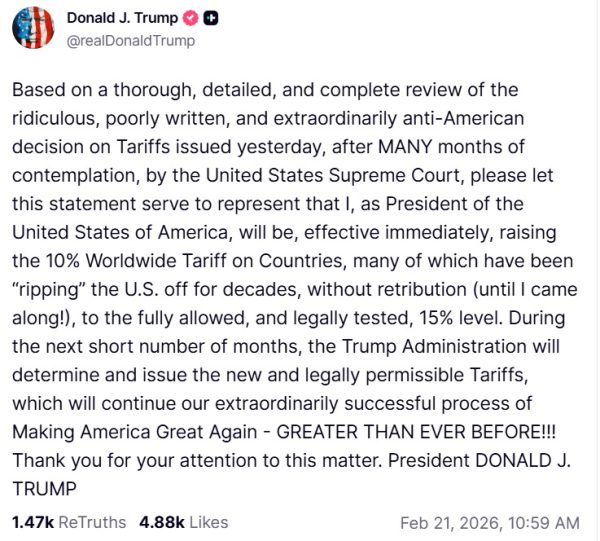
After the U.S. Supreme Court ruled 6–3 that President Trump lacked the authority to impose large-scale “Liberation Day” tariffs under the International Emergency Economic Powers Act (IEEPA), Trump did not back down. Instead, he quickly shifted legal strategy, raising global tariffs from 10 percent to 15 percent in order to maintain his trade pressure strategy.
Following the ruling, French President Emmanuel Macron and California Governor Gavin Newsom issued remarks mocking the decision. However, from a policy perspective, the White House’s actions indicate that its tariff toolbox is far from exhausted.
Supreme Court rules overreach; trade agenda setback
The Supreme Court determined that the president exceeded constitutional authority by invoking IEEPA to impose broad tariffs without congressional authorization. The ruling stated that tariffs fall squarely within Congress’s core taxing power, and that the executive branch may not treat emergency powers as a basis for routine economic policy.
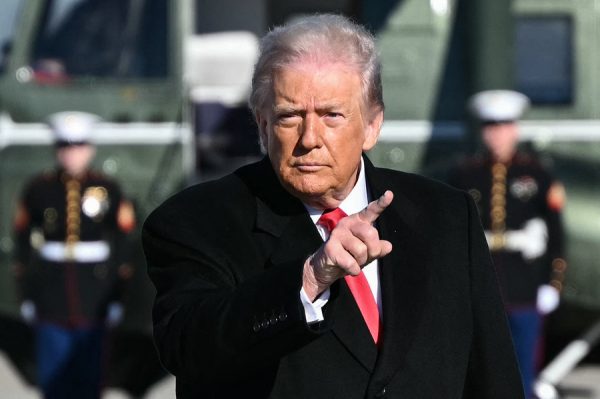
At an emergency press conference, Trump described the decision as “absurd and extremely anti-American,” criticizing certain conservative justices as “disappointing.” He specifically named Chief Justice John Roberts and expressed dissatisfaction that two justices he appointed—Amy Coney Barrett and Neil Gorsuch—voted in favor of the ruling.
At the same time, Trump said he would “act in accordance with the law,” pursuing tariff policy through other statutory provisions rather than openly challenging the validity of the ruling.
Success
You are now signed up for our newsletter
Success
Check your email to complete sign up
Shift to section 122 of the Trade Act of 1974; tariffs immediately raised
Within hours of the ruling, Trump signed an executive order invoking Section 122 of the Trade Act of 1974 to impose a 10 percent global tariff on all imports. The provision allows the president to levy tariffs for up to 150 days under specific short-term emergency conditions.
On Saturday, he further increased the rate to the legal maximum of 15 percent. On Truth Social, Trump said the rate would “take effect immediately,” and emphasized that a “lawful and sustainable new tariff framework” would be announced in the coming months.
According to reports, Section 122 has not been used on this scale since its creation during President Richard Nixon’s administration. It was originally designed to address urgent economic issues such as dollar devaluation and balance-of-payments imbalances. Trump’s move has turned this seldom-used provision into a central tool of current trade policy.
In addition, the White House retains several potential legal avenues, including Section 301 of the Trade Act of 1974 (addressing unfair trade practices), Section 232 of the Trade Expansion Act of 1962 (national security grounds), and Section 338 of the Tariff Act of 1930. During his first term, Trump used Section 301 to impose tariffs on Chinese goods and Section 232 to restrict steel and aluminum imports.
Speaking at the Paris Agricultural Show, Emmanuel Macron stated that “having a Supreme Court and checks and balances is not a bad thing,” signaling approval of the ruling.
Gavin Newsom was more direct. His office posted AI-generated images on social media mocking Trump and demanded that the federal government return money “taken from Americans’ pockets” through tariffs.
Illinois Governor JB Pritzker went further, sending the White House an $8.6 billion “invoice” demanding refunds, warning that further action would follow if repayment is not made.
However, the pace of executive action suggests the White House does not view the ruling as final. Trump stated publicly, “They’re celebrating in the streets, but they won’t be celebrating for long.” At the policy level, he has already used new legal pathways to fill the void left by IEEPA.
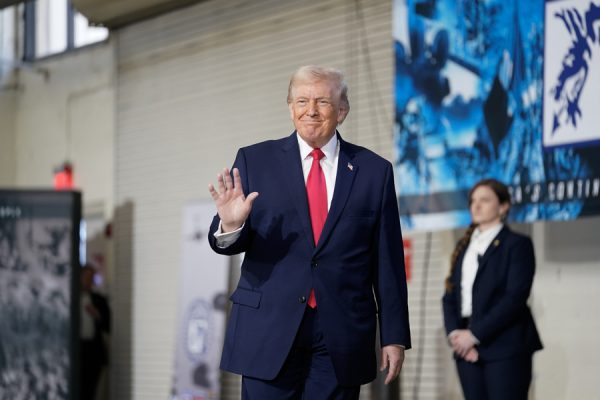
Markets and fiscal uncertainty; refunds could reach hundreds of billions
CNBC reported that U.S. stocks initially rose following the ruling, as investors anticipated easing trade tensions and lower inflation pressures. However, volatility later returned.
Estimates suggest that if previously invalidated tariffs must be refunded, the U.S. government could face more than $175 billion in repayment obligations. The refund mechanism and timeline remain unclear, and the White House has not provided further details regarding implementation of the new tariffs.
Notably, Trump is set to deliver his State of the Union address to Congress soon, with tariffs and economic issues expected to dominate the agenda. With the new rate raised to 15%, the contest over the boundaries of executive and congressional authority has shifted from the judicial arena to the policy and political spheres.
From the current situation, Macron and Newsom’s mockery may be premature. While the Supreme Court restricted the original pathway, it did not eliminate the president’s ability to deploy other trade tools. Trump’s response suggests he has chosen to reorganize his strategy within the legal framework, rather than abandon tariffs as a core negotiating leverage.
By Lu Ke