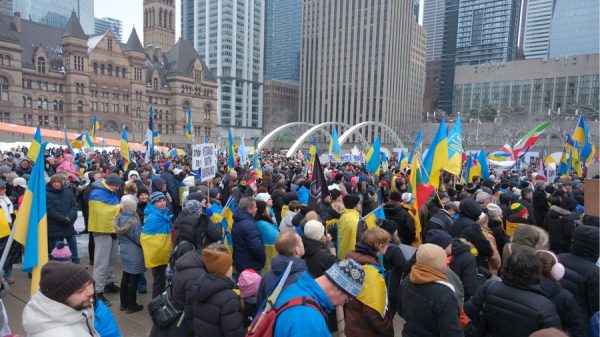
On the afternoon of Feb. 22, nearly a thousand people braved biting cold and drifting snow to gather at Toronto’s Nathan Phillips Square to mark the fourth anniversary of Russia’s invasion of Ukraine and to call for peace. This was one of 60 related gatherings across Canada, spanning cities from Victoria to St. John’s, including candlelight vigils, rallies, and discussions. Four years into the war, over one million people have died and millions more have been displaced.
Kate Bokhonko, a Canadian mother of Ukrainian descent, attended with her 8-year-old daughter, holding a portrait of a classmate killed in the war. “He was my classmate. He should have lived a normal life and had two children. He should have left Ukraine years ago, but he chose to fight on the front lines… a few months ago, he died in battle.”
Bokhonko’s family remains in Ukraine, with her parents and grandparents facing nightly missile and drone attacks. She receives daily photos and videos from them documenting their survival in darkness. “The war is not over; people are dying every day.” Her daughter held a sign reading, “800 Ukrainian children have died in this war.”
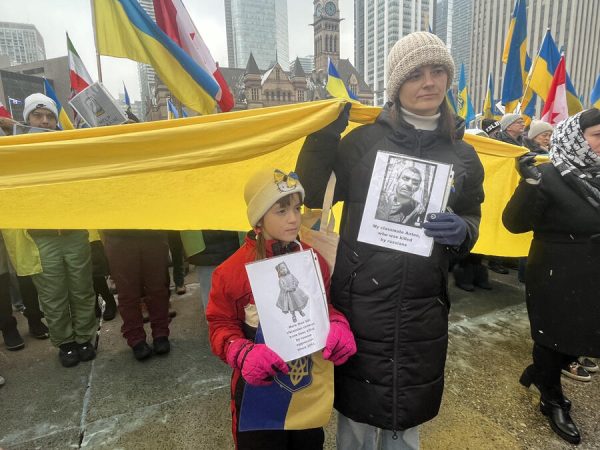
At the rally, Ukrainian flags fluttered in the wind as participants chanted, “Slava Ukraini!” (Glory to Ukraine!). Organized by the Toronto branch of the Ukrainian Canadian Congress (UCC), the rally was one of over 60 anniversary events nationwide held to honor the resilience of the Ukrainian people, and reaffirm Canada’s steadfast support for Ukraine’s sovereignty and territorial integrity.
From high school students to mothers’ voices
The Russia-Ukraine war has entered its fifth year with no immediate end in sight. Russia currently controls 19.4 percent of Ukraine’s territory, adding only 0.79 percent in the past year. U.S.-backed peace talks have stalled. According to the Center for Strategic and International Studies, from February 2022 to December 2025, total casualties for both sides could reach 1.8 million—approximately 1.2 million Russian casualties (up to 325,000 deaths, the largest single conflict of a major power since WWII) and 500,000–600,000 Ukrainian military casualties (up to 140,000 deaths, with 55,000 confirmed by President Zelensky).
Success
You are now signed up for our newsletter
Success
Check your email to complete sign up
UN statistics show the war has caused at least 14,999 civilian deaths in Ukraine, over 40,600 injuries, and at least 763 children have been killed. In 2025 alone, civilian deaths reached 2,514 with 12,142 injured—the highest since the invasion—up 31 percen from 2024. Approximately 5.9 million Ukrainian civilians have fled abroad, with 3.7 million internally displaced.
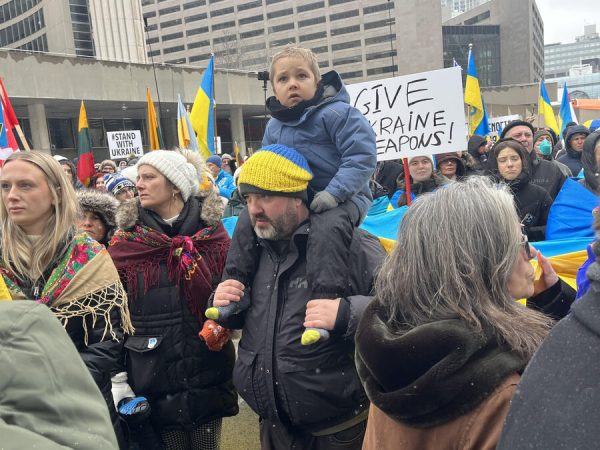
Vision Times interviewed Alexander Belej, a Grade 12 student of Ukrainian descent, at the Toronto rally. Draped in a Ukrainian flag, he said he never misses such demonstrations: “I’m here to show support, to show that I care about this war, and to do what I can to help end it.” Representing the Ukrainian scouts organization, he held a display listing several scouts who had died in combat: “They went to the front lines and sacrificed. We must continue to fight and persevere, hoping to win this war and not lose hope.” Belej and peers held the display prominently at the rally.
His mother, Oksana Buhel, also spoke with Vision Times. “My family and I come every year. My husband is Maltese, and my friends behind me are Lithuanian. Attending is very important; we must uphold world peace and rules, based on values. Things are going increasingly off track, so we must stand up.” Oksana emphasized that although individual power is limited, sitting at home changes nothing: “Ukrainian civilians are being hit by missiles… it’s horrifying.”
Political leaders show support for Ukraine
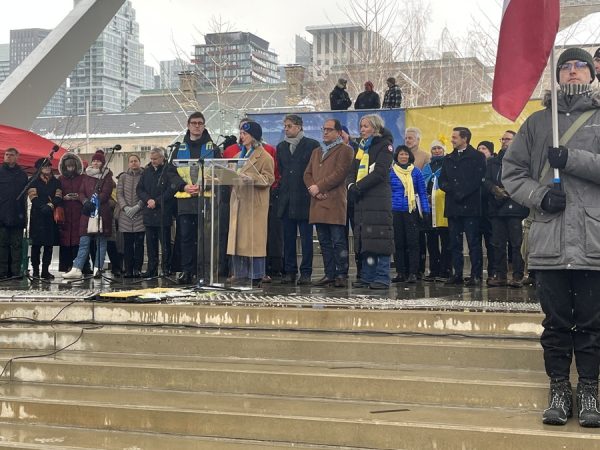
Toronto Mayor Olivia Chow, wearing a blue coat and yellow scarf, emphasized from the stage that Toronto is home to one of the world’s largest Ukrainian communities and a long-time center of Ukrainian culture. She recalled the hardships endured by Ukrainians over four years, including Russian attacks on civilian infrastructure, leaving families without power in winter. She highlighted the 20,000 Ukrainian children kidnapped by Russia, stripped of identity, language, and future, calling it “an inhumane crime the world must never forget.” “Bring them home!” she urged. Toronto pledged to donate five additional generators to its sister city, Kyiv, to help families stay warm, adding to 17 vehicles and 8 generators already sent. She also promised ongoing support for refugees in housing, food, and education.
Ontario Premier Doug Ford noted that Ontario hosts 350,000 Ukrainian-Canadians and has welcomed over 150,000 refugees, pledging continued support for housing, employment, and education. He strongly condemned Putin as “a tyrant and barbarian”: “We must never let him get away with it.” He proudly stated he is already on the “do not go to Russia” list, and said, “I never wanted to go anyway.” His remarks drew loud applause.
Federal Conservative Party leader Pierre Poilievre also spoke, recalling Putin’s “cowardly and monstrous” actions four years ago, underestimating Ukrainians’ courage: barbers took up rifles, farmers climbed onto tanks, and teenagers went to the front lines. He praised former Prime Minister Harper’s decisive leadership, which turned the G8 into the G7. Poilievre urged Canada to lift resource export restrictions to Europe, reduce reliance on Russia, and redirect “dollars that fund dictators” to Canadians. He stressed defending Ukraine aligns with Canadian values and interests: “The Conservatives and all Canadians will stand with Ukraine until victory, independence, and freedom.”
Vision China also interviewed Jaden Braves, founder and CEO of Young Politicians of Canada and UN Canada Sustainable Development Chair. He emphasized the war as a collective fight for Western democratic values: “This isn’t a battle a single country can fight alone—it represents all who believe in Western freedoms. As Canadians, we must defend the Eastern flank of democracy, committed to democratic values, anti-corruption laws, and strong Western defenses.” Braves noted hundreds at the rally condemned the use of human shields and aggression by neighboring states, calling for close Ukrainian-Western cooperation.
Chinese-Canadians speak out: ‘As long as tyranny lives, suffering continues’
Chinese participants were also prominent. Mr. Shao, attending three years in a row, criticized the Chinese Communist Party for supporting Russia with oil, technology, and military aid: “Without CCP support, this war couldn’t last so long. We don’t want war; we call for peace.” Another participant, Xiang Qinfang, suggested Xi Jinping may have struck deals with Putin, causing Ukrainian displacement, urging global unity to end the war and restore homes. Xu, a member of the Canadian Civil Rights Movement, told Vision China: “All the world’s problems trace back to the CCP. As long as tyranny lives, suffering continues!”
The Toronto rally was just one of 60 nationwide. UCC held simultaneous events at Ottawa’s Parliament Hill, London’s Victoria Park, Kitchener City Hall, and more, while the World Ukrainian Congress (UWC) organized nearly 1,000 solidarity events in over 750 cities across 80 countries. Four years of war have seen Russia attack by land, sea, and air, causing over a million deaths and displacing millions. Ukraine’s resistance has recaptured some territory but at great cost: cities reduced to rubble, winter blackouts, and kidnapped children.
Since 2022, Canada has been a leading supporter of Ukraine, ranking first per capita in financial aid, providing over CAD 12.5 billion in assistance, CAD 6.5 billion in military support (tanks, missiles, air defense, training 44,000 soldiers and F-16 pilots), freezing CAD 5 billion in Russian assets, welcoming 300,000 refugees, and imposing strict sanctions. The government led by Prime Minister Karni pledged an additional CAD 2 billion in military aid at the G7.
By Xiao Ran