As Russia’s full-scale invasion of Ukraine enters its fifth year, the course and consequences of the war have once again become a focal point of international attention. Ukrainian President Volodymyr Zelenskiy said Tuesday, Feb 24 that Russian President Vladimir Putin has failed to achieve his war objectives. The Kremlin has rarely acknowledged as much.
Zelenskiy released a video address on social media that revisited scenes from the early days of the war, when Ukrainian civilians resisted Russian troops. He said Ukraine is prepared to “do everything possible” to secure a strong and lasting peace.
Since Russia invaded Ukraine on Feb. 24, 2022, hundreds of thousands on both sides have been killed. The conflict has become the deadliest war fought on European soil since World War II. Vast areas of Ukraine have been severely damaged, and the task of future reconstruction will be immense.
With U.S. mediation last year, Moscow and Kyiv resumed negotiations, but no substantive breakthrough has been achieved. Kremlin spokesperson Dmitry Peskov said Tuesday that Russia has not yet fulfilled all its military objectives and that its “special military operation” will continue.

Analysis: Putin struggles to conceal strategic miscalculations as Russia nears a dangerous edge
According to a report by the British outlet The i Paper, Lawrence Freedman, emeritus professor of war studies at King’s College London, noted that although U.S. President Donald Trump previously sparked controversy by suggesting Ukraine might trade large swaths of territory for peace, even such an outcome would not undo the profound damage caused by Putin’s series of strategic misjudgments over Ukraine.
Success
You are now signed up for our newsletter
Success
Check your email to complete sign up
Freedman argues that for more than a decade, Putin has repeatedly miscalculated on Ukraine. These errors stem from a narrative that Ukraine is an artificial state that rightfully belongs to Russia, based on the historic and cultural ties between the two countries. This view shaped Kremlin policy and ultimately led to war.
He noted that although Ukraine has paid a tremendous price in resisting the invasion, its sovereignty has endured, and its determination to join the European Union has only strengthened, precisely the outcome Putin sought to prevent 13 years ago.
Four years of war have not achieved Russia’s stated objectives; instead, they have weakened the country’s overall strength. Freedman sees not a single misstep, but a chain of strategic errors. Putin had multiple opportunities to limit losses and adjust course, yet failed to act.
Putin has consistently denied the legitimacy of the Ukrainian government and set war aims that include full control of four Ukrainian provinces, including Crimea, while reducing the remainder of Ukraine to a compliant state under a “demilitarized” and “denazified” government. This stance continues to shape his negotiating posture. His rigid adherence to these goals has made it difficult for those, including Trump, who seek to advance peace efforts.
How the war escalated step by step
Freedman recalled that Putin’s fixation on Ukraine became more evident after he began his second presidential term in 2012. At the time, Ukrainian President Viktor Yanukovych was seen as pro-Russian. He had set aside NATO membership, extended the lease for Russia’s Black Sea Fleet in Crimea, and passed legislation elevating the status of the Russian language.
However, in 2013 Yanukovych prepared to sign an association agreement with the European Union, triggering a strong reaction from Putin. Russia imposed harsh economic pressure on Ukraine, forcing it to abandon the deal. This move sparked mass protests and ultimately led to Yanukovych fleeing the country in February 2014.
Faced with a new government in Kyiv, Putin did not attempt cooperation but instead advanced Ukraine’s fragmentation. Had Russia stopped after annexing Crimea, it might have faced a more moderate international response. Instead, support for separatists in eastern Ukraine and direct Russian military involvement escalated the crisis. Through the 2014 and 2015 Minsk Agreements, Putin sought constitutional changes in Ukraine that would preserve Moscow’s leverage over Kyiv’s policies.
The Minsk Agreements were never fully implemented. As Kyiv resisted Russian dominance, Putin reassessed the situation during the COVID-19 pandemic and ultimately decided to regain control over Ukraine through military force, aiming to install a puppet regime in Kyiv. However, the plan for a swift campaign faltered after underestimating Ukrainian resistance.
Even after Russian forces withdrew from the outskirts of Kyiv and Kharkiv, Putin did not acknowledge failure. Instead, he declared the annexation of four Ukrainian provinces that Russia does not fully control. Freedman argues that this strategic dilemma remains unresolved.
The costs of war and its long-term consequences
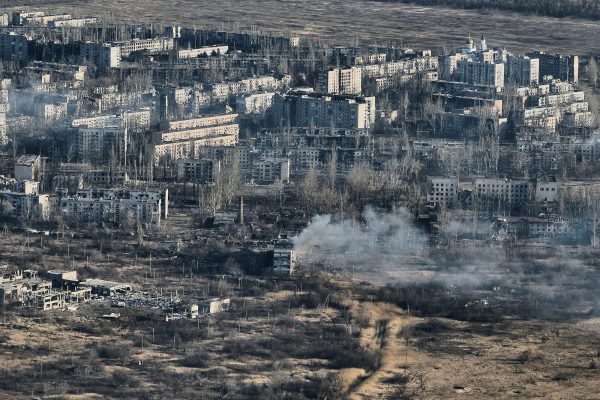
Freedman pointed out that even if Russia retains parts of the occupied territories, those areas have been severely devastated by war. Population loss, economic stagnation, destroyed infrastructure, and widespread unexploded ordnance will create long-term burdens in maintaining security and borders. Meanwhile, Ukraine continues to move closer to Western institutions.
He added that heavy casualties, social trauma, economic distortions, declining living standards, ruptured ties with the West, loss of Europe’s natural gas market, increased dependence on China, and reliance on support from North Korea and Iran have all magnified the consequences of these strategic miscalculations.
Freedman emphasized that in a democratic system, such large-scale strategic failures would have long been subjected to public scrutiny and accountability. In an authoritarian system, however, concentrated power allows a costly war with dim prospects to continue without political consequences for decision-makers.
Zelenskiy urges Trump to ‘stand on our side’
On Monday, Zelenskiy gave an exclusive interview in Kyiv to CNN, publicly urging Trump to “stand on our side.”
He said the United States is “too powerful and too important” to disengage from the conflict and expressed hope that Trump would clearly support Ukraine in Tuesday’s State of the Union address.
“They must stand with a democracy that is fighting against one man,” he said. “Because that man is war. Putin is war. Everything revolves around him. His entire country is in prison.”
He added that if the United States truly wants to stop Putin, it has the power to do so. Asked whether he believes Trump has applied enough pressure on Putin, Zelenskiy responded: “No.”
‘We cannot give him everything he wants’
Zelenskiy acknowledged that after years of war, Ukrainian society is exhausted. However, he stressed that making concessions to Putin “is absolutely not an option.”
“We cannot give him everything he wants. Because he wants to occupy us. If we give him what he wants, we will lose everything.”
He said security guarantees remain central to negotiations. “I want a very concrete answer: If Putin comes again, what will our partners be prepared to do?”
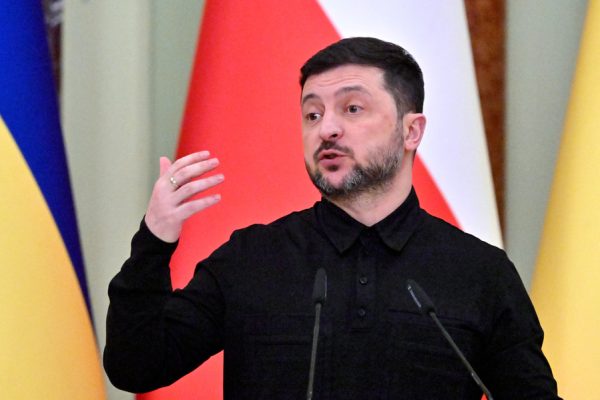
On peace steps and territorial issues
Zelenskiy said there are differences over the sequencing of steps toward peace. Trump hopes to finalize a comprehensive peace agreement alongside security guarantees in a single move, marked by a symbolic ceremony to end the war. Zelenskiy insists that security guarantees must first be approved by the U.S. Congress and completed through legal procedures.
Regarding the front lines, he said Ukraine is willing to freeze fighting along current positions but will not withdraw from areas it still controls in eastern Donetsk region. Russia is demanding that Ukraine relinquish about 20 percent of its territory, including key industrial and transportation hubs.
“We are not children. We cannot place our country on a plate and hand it to them,” he said.
Zelenskiy also addressed questions about Ukrainian elections and his personal future. Elected in 2019, his term was scheduled to end in May 2024. However, under martial law, Ukrainian law prohibits holding elections during wartime, so he continues to fulfill his presidential duties.
By Gao Yun