A set of internal security guidelines for China’s 2026 “Two Sessions,” the annual meetings of the regime’s rubber-stamp legislature and its political advisory body, has leaked online, exposing a surveillance and interception system designed to achieve “zero petitioners reaching Beijing.” The document details AI-powered facial recognition, real-time phone tracking, drone patrols, blockchain-recorded suppression agreements, and a financial punishment system that docks local governments 100,000 yuan for every petitioner who slips through. The meetings are scheduled for March 4 and 5, and the security lockdown extends 10 days before and after.
On Feb. 26, a user named “Yang Caiying” posted on X a set of notes reportedly circulating in petitioner communities. The notes describe the CCP’s security apparatus for the upcoming “Two Sessions” as a “digital twin plus individual accountability” system that builds on an existing six-step interception chain: clearing backlogs, assigning individual monitors, severing travel routes, intercepting and returning petitioners, closing case files, and punishing officials who fail.
The 2026 system adds three layers of technological enforcement and two new accountability mechanisms on top of this foundation.
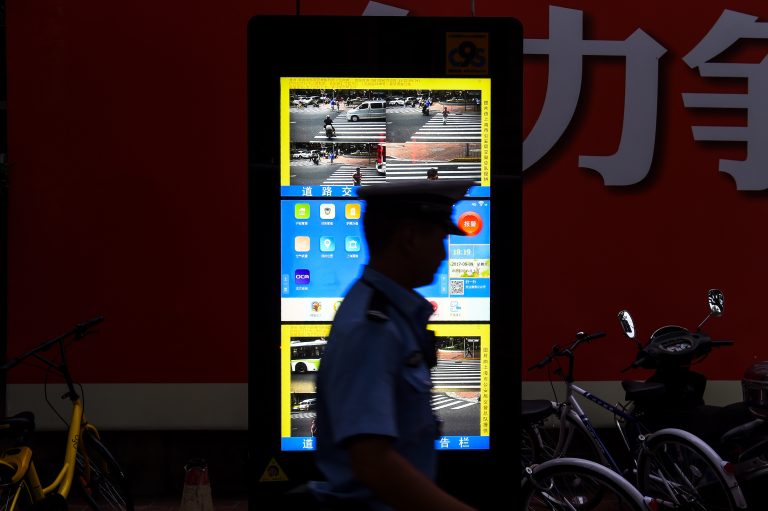
Drones and elevated surveillance cameras now cover every highway service area and long-distance bus station surrounding Beijing. The document describes 18 mobile sentry units equipped with high-altitude camera platforms that use AI facial recognition to scan travelers carrying backpacks and passengers on long-distance buses. The system claims a recognition accuracy rate of 95 percent or higher.
An electronic fence system monitors the mobile phone signals of individuals flagged as “red-level” targets. Under the upgraded “roaming alert” version 2.0, the moment a flagged person’s phone signal appears anywhere inside Beijing’s administrative boundary, the system pushes their GPS coordinates, cell tower ID, and phone number to a forward command post within 10 seconds.
Success
You are now signed up for our newsletter
Success
Check your email to complete sign up
The regime is using blockchain to make suppression agreements permanent and legally binding
One of the most striking elements in the leaked guidelines is the use of blockchain technology to lock petitioners into agreements to stop seeking redress. Under the system, when a petitioner signs what the regime calls a “cease litigation and cease petitioning agreement,” the document text, the signer’s fingerprints, facial scan, and an audio recording are simultaneously written to a “judicial blockchain.” The purpose is to prevent petitioners from later renewing their complaints. If a petitioner who has signed such an agreement attempts to travel to Beijing again, the blockchain record serves as automatic grounds for administrative detention on charges of “refusing to fulfill the agreement.”
This converts a coerced promise to stop complaining into an irrevocable digital contract enforced by imprisonment. The system assumes that these agreements are voluntary and legitimate. In practice, petitioners across China have reported for years that local officials force them to sign such documents under threats of detention, loss of welfare benefits, or retaliation against family members.
Local officials face career destruction if a single petitioner reaches Beijing
The document spells out a punitive scoring system for local Party bosses. County-level Party secretaries and county heads each start with a base score of 100 points. Every petitioner from their jurisdiction who is registered at Beijing’s national complaints office costs them 10 points. When the score hits zero, the official faces “organizational adjustment,” a Party euphemism for demotion or removal.
The three lowest-scoring prefectural-level cities face an additional penalty: their political and legal affairs committee secretaries, the officials who oversee the local security apparatus, are barred from promotion for the entire year.
The financial penalties are equally blunt. Provincial-level budgets automatically deduct 100,000 yuan (roughly $14,000) from the equalization transfer payments owed to any county that produces a registered petitioner in Beijing. The funds are redirected to cover the costs of Beijing’s “reception and service center,” the facility where intercepted petitioners are processed before being sent home.
The system’s sole stated objective: zero locally registered visitors appearing in the National Petitions Bureau’s database during the 20-day window surrounding the meetings.
Petitioners outside the National Complaints Office denounced China’s leaders on camera
While the regime was finalizing its digital blockade, the people it targets were making themselves heard. On Feb. 23, the seventh day of the Lunar New Year, a large crowd of petitioners gathered outside the National Petitions Bureau in Beijing, lining up to register their complaints the following day. Video posted on X by the account “Yesterday” captured several veteran petitioners delivering impromptu speeches to the crowd.
One woman addressed Xi Jinping directly: “Chairman Xi, can you find it in your heart to show some compassion? You can see what’s happening to foreigners, but you can’t see what’s happening to Chinese people? This generation of leaders is blind and deaf. They’ve ruined this country. They’ve destroyed how many people’s youth. We want human rights. Today we’re going to find a different way to seek justice.”
She turned to face the assembled petitioners and shouted: “Where is the peace and prosperity they talk about? Is this peace and prosperity? How are they governing this country? Their governance has destroyed the country. This isn’t governance.”
Another woman, wearing a face mask, sang to the crowd: “People from across the country flood into Beijing to report corrupt officials, to report murderers, through scorching heat and bitter cold. Register and swipe your card, year after year. The corrupt officials and criminals are never arrested, but the people who try to petition get kidnapped and thrown in prison.”
Petitioners have been killing themselves outside the National Complaints Office
The desperation visible in those videos follows a grim pattern. Citizens with no legal recourse have been taking their lives at the doorstep of the institution that is supposed to hear their grievances.
In October 2025, Yang Caiying posted video showing two petitioners jumping together into the Yongding River near the Petitions Bureau, the latest in a string of such incidents. “More than ten petitioners have been forced to jump into the Yongding River this year alone,” Yang wrote. On October 23, 2025, a petitioner reportedly hanged themselves in front of the Bureau. On October 16, a female petitioner jumped into the Yongding River. On March 5, 2025, the day after the “Two Sessions” opened, a petitioner drowned in the Taorantai section of the Yongding River after, in the words of those who witnessed it, being “pushed to the point of no return.”
A veteran petitioner called the entire system a deliberate fraud
Niu Yuchang, a longtime petitioner, told Voice of America that China’s petitioning system has been, from the beginning, a deliberate or semi-deliberate fraud. The probability of having a grievance resolved through the system is “pathetically low,” Niu said.
Based on years of firsthand experience, Niu concluded that the ever-growing number of petitioners and the deepening anger among them are products of China’s political and judicial systems. The petitioning system does not solve problems. It buries conflicts, deflects accountability, and exhausts citizens financially and physically, while corrupt officials hide behind a network of mutual protection and continue to act with impunity.
By Li Muzi