The views expressed in this article are the author’s own and do not necessarily reflect the editorial position of Vision Times.
China buys 80 to 90 percent of Iran’s seaborne oil exports— roughly 1.38 million barrels per day in 2025, shipped on a shadow fleet of over 1,500 tanker runs per year through falsified GPS coordinates, disabled tracking systems, and shell companies registered across Southeast Asia, according to Moderndiplomacy. Iranian crude arrives at Chinese ports relabeled as Malaysian or Indonesian, is processed at small independent refineries in Shandong Province known as “teapots,” and saves Beijing $8 to $10 per barrel against benchmark pricing. This arrangement has saved China billions of dollars annually and provided Tehran with its primary revenue stream — money the US Treasury Department says finances the Revolutionary Guard Corps and its global network of proxy forces.
China cannot replace what it stands to lose. The property market — which once accounted for a quarter of the entire economy — is in its fifth year of collapse. New home sales have fallen by more than half. An estimated 85 percent of household real estate gains since 2021 have been wiped out. The country has recorded ten consecutive quarters of deflation, a streak without precedent in modern Chinese economic history.
And the losses are accelerating. When the US captured Maduro in January, China lost nearly 400,000 barrels per day of discounted Venezuelan crude. Chinese refiners compensated by buying more Iranian oil. A US strike would cut Beijing’s last remaining source of cheap oil, and the shock would ripple through every factory, shipyard, and export terminal in the country. The cheap energy that has underwritten Chinese manufacturing for years would vanish, and there is no alternative supplier offering the same volume at the same discount.

Chinese arms and promises in Iran
Beijing has spent years building the appearance of an unbreakable partnership with Tehran. Under a 25-year cooperation agreement, it has invested billions in the Iranian economy, provided diplomatic cover at the United Nations and the Shanghai Cooperation Organisation, and positioned itself as the partner that would stand by Iran when the pressure came.
Success
You are now signed up for our newsletter
Success
Check your email to complete sign up
In the weeks before the current crisis, it looked like China was delivering on that promise. Sixteen Chinese military cargo planes landed in Tehran over a 56-hour period in late January, reportedly delivering HQ-9B long-range air defense systems and YLC-8B radar units designed to detect stealth aircraft. On February 8, a Chinese military attaché presented a scale model of China’s J-20 stealth fighter to the commander of the Iranian air force. China, Russia, and Iran conducted joint naval exercises in the Strait of Hormuz under the banner “Maritime Security Belt 2026.” A Chinese research vessel has been shadowing the USS Abraham Lincoln carrier strike group in the Arabian Sea since late December.
China made similar gestures before the Twelve-Day War in June 2025, and yet Israeli jets operated freely over Iranian territory for twelve consecutive days and American B-2 bombers struck Iran’s nuclear sites undeterred. China offered public statements and nothing else. Russia did the same. The cargo flights, the naval drills, the strategic pacts — none of it translated into the one thing that would have mattered: military intervention to defend an ally under attack.
Chinese analysts know this. A widely circulated post on the Chinese platform Sohu warned that “Iran is infiltrated like a sieve” by Israeli intelligence and that selling advanced weapons to Tehran was equivalent to “giving blueprints to Israel.” Modern air combat, the post noted, is “a system fight rather than a one-on-one duel of fighter jets,” and Iran lacks the integrated network to use advanced platforms effectively. Beijing is sending weapons it knows will be tested against American systems, and every prospective arms buyer in the Global South will be watching the results.
Related: Why a US Strike on Iran Appears Likely
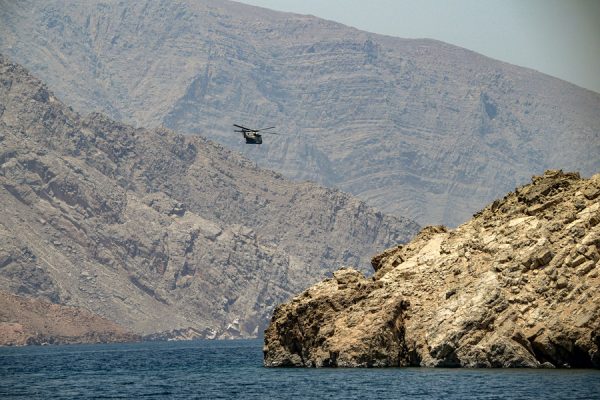
China’s energy dependence on the Strait of Hormuz
The vulnerability is not theoretical. China imports more than 5 million barrels per day through the Strait of Hormuz. Nearly 95 percent of Iran’s own oil exports are loaded at Kharg Island and shipped through the same waterway. If Iran retaliates against a US strike by attempting to close the strait — a scenario Tehran’s parliament has already authorized and its Revolutionary Guard has rehearsed with live-fire drills — the country most immediately harmed is not the United States. Washington is effectively energy self-sufficient and exports oil. China is the world’s largest crude importer, and nearly half of what it imports sails through a narrow passage between Iran and Oman that is about to become a conflict zone.
A CSIS analysis of the current buildup notes that a broader Hormuz disruption could throttle up to 18 million barrels per day of global oil transit. Even a partial closure would send insurance rates for tankers through the strait surging, reroute shipping around the Cape of Good Hope, and add weeks to delivery times for crude headed to Chinese ports. Beijing has no naval capacity to keep the strait open, the US Navy controls it, and the country that might close it is the same country the US is preparing to strike.
The cost to the CCP’s global strategy
For the governments and military establishments that the CCP has been courting with promises of strategic partnership — from Central Asia to Southeast Asia to Africa — the lesson from Iran is straightforward. Beijing will sell you weapons, buy your resources at a discount, sign cooperation agreements, conduct symbolic exercises, and dispatch surveillance ships. When the United States decides to use force, China will issue statements from the Foreign Ministry opposing “the use of force or the threat of force” and call for diplomatic solutions that are “conducive to peace and stability in the Middle East.”
The CCP’s strategy for building an anti-American coalition — what Israeli intelligence analysts call the CRINK axis of China, Russia, Iran, and North Korea — depends on the perception that membership offers protection. Venezuela tested that proposition in January and Maduro is now in US custody. Iran is testing it now, with two American carrier strike groups within range, twelve F-22s stationed in Israel for the first time in history, and a force that defense analysts have described as structured for a sustained multiday air campaign.
The CCP’s position heading into Trump’s visit to Beijing at the end of March is weaker than it has been in years. Its most important sanctions-evasion partner is about to be struck by the country imposing the sanctions. Its energy supply chain runs through a strait it cannot secure. The weapons it has shipped to Iran are about to be field-tested against American stealth aircraft and cruise missiles, in full view of every prospective buyer in the Global South. And the one response that would actually change the strategic equation — direct military confrontation with the United States — is the one option Beijing will not take, because the Chinese military is not built to fight the US Navy in the Persian Gulf and the CCP leadership knows it.
China’s Foreign Ministry will condemn the strikes. Its state media will call it American imperialism. The trilateral strategic pact with Russia and Iran will produce another round of joint statements. None of it will stop a single cruise missile. The CCP has spent years constructing an alternative to the American-led order — a network of sanctioned states, shadow fleets, and strategic partnerships held together by the promise that there is safety in numbers. In January, Washington removed Venezuela from that network in a single night. If the strikes on Iran proceed, Beijing will be left to explain to every government it has courted — from Islamabad to Luanda to Phnom Penh — why the world’s second-largest economy could not protect even one of its most important partners from the country it claims to rival.
By Andrew Jensen