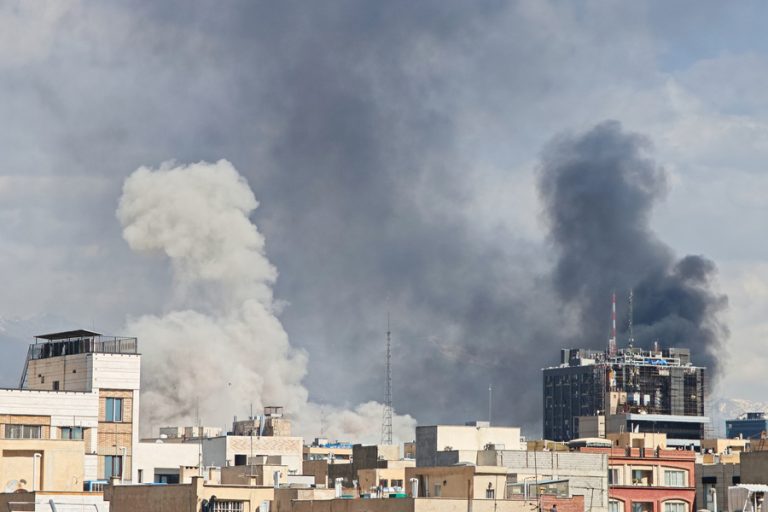
On Monday, March 2 U.S. President Donald Trump said he does not rule out sending U.S. ground forces to Iran if necessary and hinted at launching a new wave of “large-scale” attacks. At the same time, the Israeli military announced late Monday local time that it had begun a new round of airstrikes on Tehran.
Before the airstrikes, the Israeli military issued evacuation warnings to residents of Tehran, specifically urging people living near the headquarters of the Islamic Republic of Iran Broadcasting (IRIB) to leave the area as soon as possible.
Trump: ground troops not ruled out, ‘large-scale’ operations coming
According to Agence France-Presse, Trump has long opposed deep U.S. involvement in Middle East conflicts, but on Feb. 28 he ordered a large-scale military operation against Iran. So far, the operation has mainly focused on airstrikes, including missile and bomb attacks. However, Trump refused to rule out the possibility of ground operations, which carry much higher potential casualties than airstrikes.
He said he has “no psychological barrier” regarding sending in ground troops. “Every president will say ‘there won’t be ground forces,’ but I won’t say that.”
In an interview with the New York Post, Trump said, “I would say ‘they may not be needed,’ or ‘if necessary.’” He also told CNN that strikes against Iran would escalate further.
Success
You are now signed up for our newsletter
Success
Check your email to complete sign up
“We haven’t even really hit them hard yet. The large-scale attacks haven’t even started,” he said. “The large-scale operations are coming soon.” He did not provide specific details.
U.S. Secretary of State Marco Rubio told reporters that no arrangements have yet been made to deploy ground troops to Iran, but the president retains the option. He emphasized that the government believes the current military objectives can be achieved without using ground forces.

Conflict escalates: US and Israel strike hundreds of targets
So far, the U.S. and Israel have struck hundreds of targets inside Iran, including missile facilities, naval assets, and command-and-control systems.
Iran, in turn, has launched missiles at Israel, nearby U.S. military bases, and targets in Bahrain, Jordan, Kuwait, Qatar, and the United Arab Emirates.
Officials have confirmed six U.S. military personnel killed, and three aircraft were accidentally hit by friendly fire.
Trump told the White House that U.S. military operations could last longer than the previously mentioned one-month timeline. Some analysts question whether even the U.S., with the world’s strongest military, has sufficient ammunition and willpower to sustain a long-term confrontation with a determined opponent.
Trump responded: “Our progress is already far ahead. We originally estimated 4 to 5 weeks, but we have the capacity to fight longer. We will do so.”
U.S. war secretary Pete Hegseth also said the possibility of deploying troops to Iran is not ruled out. When asked if ground forces were already in place, he replied, “No, but we are not going to discuss what we will or won’t do.”
Regarding the duration of the war, Hegseth said: “4 weeks, 2 weeks, 6 weeks — all are possible. It may be earlier, it may be later.”
He also emphasized that this military operation, named “Operation Epic Fury,” differs from America’s past long-term wars in Iraq and Afghanistan. He said the operation is not intended to promote democracy in Iran: “No foolish rules of engagement, no quagmire of nation-building, no exercises in establishing democracy. No politically correct war. We fight to win, without wasting time or lives.”

By Gao Yun