Cuban leaders announced in a press conference that talks with the United States are underway. After the news reached mainland China, it sparked heated discussion among netizens. Some commented bluntly: “Cuba’s ‘sun’ is about to set” and “Where there are protests, there is hope.”
On March 13, Cuban President Miguel Díaz-Canel announced in a video broadcast on national television that Cuba is engaging in talks with the United States. Díaz-Canel said the focus of these talks is “to seek solutions to bilateral differences through dialogue” and that “international factors have prompted this exchange.”
Díaz-Canel expressed hope that the negotiations would allow the two long-time adversaries to “move beyond confrontation,” with the goal of “identifying practical measures that benefit the peoples of both countries, as well as areas of cooperation to address threats and ensure the security and peace of both nations and the region.”
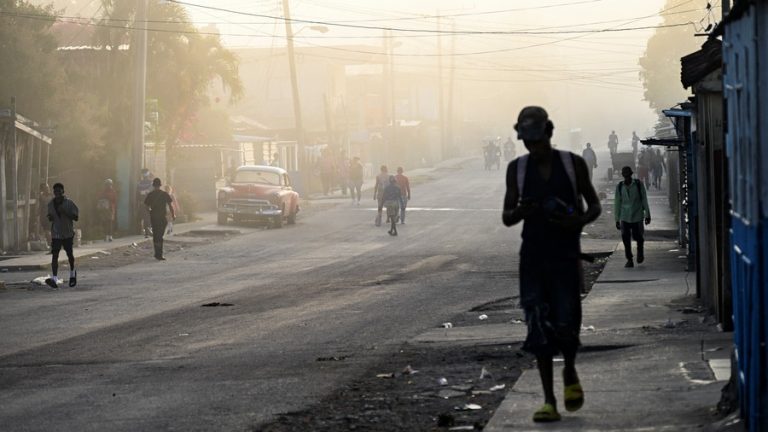
X-platform accounts “Visioner” and “Overseas Reports” shared videos reporting that on the evening of March 13, in Morón, Ciego de Ávila Province, protesting citizens broke into the local Cuban Communist Party office and set it on fire.
“Overseas Reports” stated: “Has the CCP seen this? Before the Chinese people lose patience, quickly lay down your arms and surrender to the people. Dissolve the Communist Party, lift restrictions on parties and the press, hold nationwide elections, return power to the people, release political prisoners, and step down from the stage of history — or there will be no burial for you!”
Success
You are now signed up for our newsletter
Success
Check your email to complete sign up
The Cuban leadership’s public announcement of talks with the U.S. sparked intense online discussion.
Mainland Chinese netizens commented: “Cuba is starting to change” “All the allies are falling one by one” “They must be uneasy now” “Maduro in front, Khamenei behind, cigars are scared” “Zelensky, Trump, Milare, Musk — these people will go down in history” “A step toward democracy, freedom, and civilization.”
Others said: “A series of practical examples have proven that Trump’s approach is the most effective” “Only the two Asian brothers remain” “The Castro era is over” “Director Trump’s strong medicine on stubborn diseases works remarkably” “The trend is unstoppable” “Cuba’s ‘sun’ is about to set” “Where there are protests, there is hope.”
X-platform users also wrote: “I think Cuba’s change is unstoppable, while North Korea may be the last one” “Never expected 2026 to start with the simultaneous collapse of major dictatorships!” “This is Cuba’s only way out. After so many years, it can’t hold on” “The drama never stops, 2026 is shaping up to be exciting!” “The CCP’s old friends are getting fewer and fewer.”
With the upcoming Trump-Xi summit, Cuba’s change could become a key leverage point for Trump to pressure the CCP.
Commentator “New Highland” wrote on X that as U.S. President Trump prepares to visit Beijing for a summit with Xi Jinping from March 31 to April 2, the situation in Cuba is rapidly escalating.
What does Cuba’s “change” mean for U.S.-China competition? This is far from an isolated event; it marks a major turning point in the geopolitical game of the Western Hemisphere and directly becomes a trump card for Trump in pressuring China.
The post noted that first, in terms of the U.S. “backyard” strategy, Cuba represents the symbolic frontline of U.S.-China confrontation in Latin America.
Second, in the global ideological and narrative competition, Cuba, as the last Cold War stronghold, will be portrayed by the U.S. as “another failure of communism,” severely damaging the international legitimacy of China and Russia.
Finally, from a practical and negotiation standpoint, Cuba’s change will have chain effects across multiple areas of U.S.-China competition.
The post concluded that prior to the summit, U.S.-China negotiations in Paris, combined with Cuba’s “goodwill gestures” and public dialogue, are merely signals from a regime fighting for survival—the steps toward change are near, and the next U.S.-China contest in the Western Hemisphere is quietly beginning.
By Li Muzi