In modern China, the legacy of political campaigns launched under Chinese Communist Party rule continues to shape lives long after the events themselves have faded from official memory. For those who lived through them, the consequences were not abstract historical episodes but deeply personal tragedies that fractured families and left enduring scars.
An elderly man from Jining, identified as “a man of conscience,” recounts a lifetime marked by violence, loss, and survival. His story spans the land reform campaigns of the 1950s, the Great Leap Forward famine, the Cultural Revolution, and the aftermath of the 1989 Tiananmen protests, offering a rare, first-hand account of how these movements unfolded at the grassroots level.
A childhood shattered by land reform
He was ten years old in the early 1950s, living with his family in a small village south of Jining along the Grand Canal. His father, labeled a “rich peasant,” farmed a modest plot of land. The family lived simply but steadily, sustained by agriculture and his mother’s weaving.
That stability ended abruptly during the Communist Party’s land reform campaign.
According to his account, local militia members stormed into their home one night, accusing his father of being a “landlord” and “class enemy.” He was dragged from his bed and taken to a tree at the village entrance, where he was publicly humiliated and beaten. Villagers were forced to participate, throwing stones and shouting accusations.
Success
You are now signed up for our newsletter
Success
Check your email to complete sign up
His father’s legs were broken in the beating, leaving him permanently disabled. The family’s land was confiscated, and they were classified among the “five black categories,” a political designation that brought long-term discrimination and social exclusion.
From that point on, survival became a daily struggle. His mother scavenged along the riverbank for shellfish to sell, often going hungry so her children could eat.

Famine and loss during the Great Leap Forward
The situation worsened during the Great Leap Forward between 1958 and 1961.
As the state pushed mass steel production and collectivization, agricultural work was neglected. Crops were left to rot in the fields, and food shortages spread rapidly. In his recollection, villagers resorted to eating tree bark, soil, and rodents to survive.
His younger brother died of starvation during this period. Soon after, his mother, overwhelmed by grief, took her own life by jumping into the canal.
Across the countryside, he recalls seeing corpses along the riverbanks and hearing constant cries of hunger and despair. Officially, the famine was attributed to natural disasters, but in his telling, it was the result of policy decisions that left ordinary people with no means to survive.
Violence during the Cultural Revolution
After becoming an orphan, he was sent to work in a collective farm on the outskirts of Jining. Conditions were harsh, with long hours of labor and minimal food.
During the Cultural Revolution, which began in 1966, violence intensified.
He describes witnessing the death of a retired teacher, identified as Professor Zhang, who had been labeled a “rightist” after questioning farm management practices. During a struggle session, Professor Zhang was forced to drink ink and was later beaten to death by Red Guards.
Other tragedies followed. His uncle, a Buddhist believer, was persecuted and killed after being reported for keeping a small statue at home. A neighbor died in a labor camp after being accused of criticizing government policies. Another woman in the village froze to death after her family was purged.
The destruction extended beyond individuals. Temples were demolished, books burned, and cultural relics destroyed. In his account, the city’s historical landscape was reduced to ruins.
The shadow of 1989
By the late 1970s and 1980s, China had entered a period of economic reform. He married and started a family, hoping to rebuild a sense of normalcy.
That hope was again disrupted in 1989.
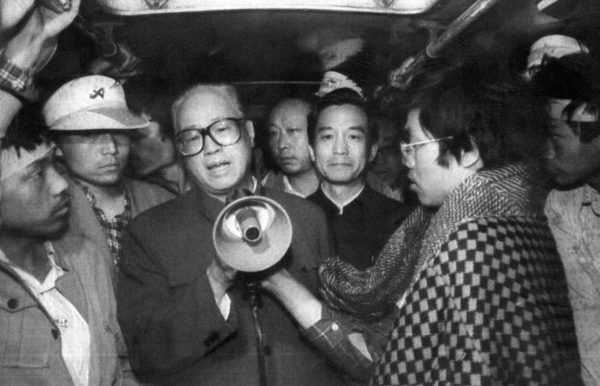
His son, a university student, joined demonstrations calling for democratic reforms. He was arrested and detained for six months. Upon release, he showed signs of severe psychological trauma and physical abuse.
Unable to recover, his son later died by suicide.
For the father, the loss echoed earlier tragedies. He describes a sense of recurring cycles, in which each generation faced new forms of repression under changing political conditions.
A memory that does not fade
Today, Jining has transformed into a modern city, with new buildings and parks along the canal. Yet for him, the past remains ever-present.
He describes walking through familiar streets and feeling as though the voices of the dead still linger, carrying unresolved grievances and suppressed truths.
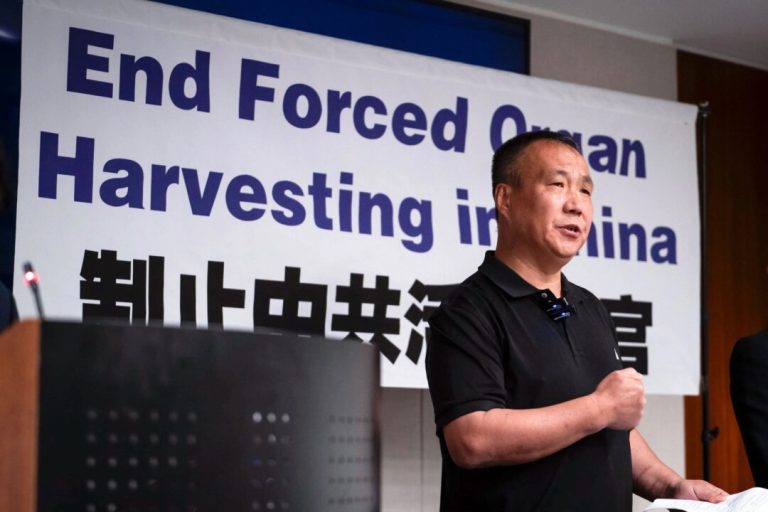
He also expresses concern about ongoing human rights issues in China, including reports of organ harvesting, the disappearance of rights activists, and the suppression of protests in Hong Kong. In his view, the political system has evolved in form but not in nature.
At the end of his account, he states that he has formally quit the Chinese Communist Party, and joined the Tuidang (Quit the CCP) Movement.
“The nightmare has lasted a lifetime,” he says. “It cannot be forgotten, and it cannot be escaped.”
The views expressed are solely those of the author.
By Chen Yuexiu