Taiwan’s Vice President Hsiao Bi-khim said Taiwan will not allow the Chinese Communist Party (CCP) to define its identity, warning that Beijing’s growing use of cognitive warfare, political interference, and coercion tactics pose an expanding challenge to democratic societies in the Indo-Pacific region.
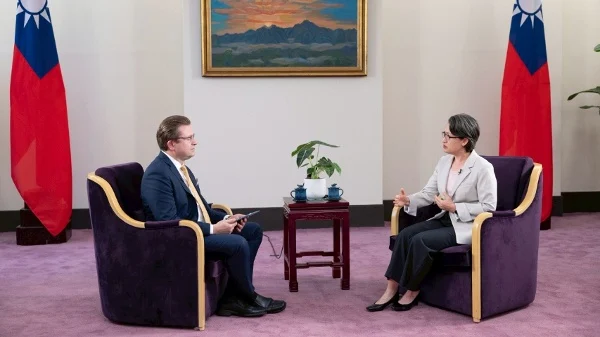
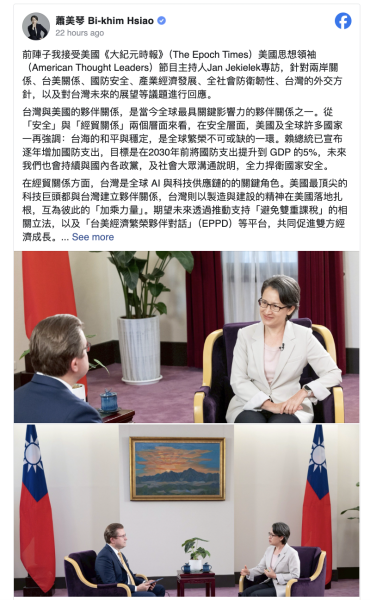
Hsiao made the remarks during a June 22 interview with Jan Jekielek, host of “American Thought Leaders” by The Epoch Times. Taiwan’s Presidential Office said the interview covered cross-strait relations, Taiwan-U.S. ties, national defense, economic development, societal resilience, diplomacy, and Taiwan’s future outlook.
Since its establishment in 1949, Taiwan has operated as a de facto independent polity, with its own democratically-elected government, military, and foreign relations. Beijing, however, claims the self-ruling island as a breakaway province and rightful part of the People’s Republic of China (PRC). As such, the Chinese Communist Party (CCP) has repeatedly stated that it seeks eventual “reunification” as an end goal, even going as far as to say that military force will be used if necessary.
RELATED: China’s ‘Normalized Governance’ Push Near Taiwan Draws Security Concerns
Defending Taiwan’s identity and democracy
When asked about being labeled by Beijing as a “diehard Taiwan independence separatist,” Hsiao said the designation reflects the CCP’s attempt to intimidate and silence Taiwan’s international engagement. She said China sanctioned her partly because of her cooperation with Americans, adding that such pressure would not change Taiwan’s course. “We will absolutely not allow the Chinese Communist Party to define who we are,” Hsiao said.
Success
You are now signed up for our newsletter
Success
Check your email to complete sign up
Hsiao said the purpose of Beijing’s tactics is to threaten, intimidate, and obstruct Taiwan’s work. But like many others who have been sanctioned by the CCP, she said she refuses to let it rattle her.
She added that sanctions will not stop her from doing what must be done, including protecting the country, defending Taiwan, safeguarding its values, and working closely with international partners to preserve shared interests — namely regional peace, stability, and prosperity.
She also noted that more people and companies are being placed on Beijing’s sanctions lists, but said she has no private business interests in China. As a result, many of those sanctioned are able to face the measures with composure.
Fighting against cognitive warfare
Hsiao said Taiwan spends much of its time in a defensive posture because of China’s increasingly aggressive tactics, including cognitive warfare, psychological warfare, political warfare, legal warfare, and interference in Taiwan’s society and politics.
She said the challenge is becoming more serious, especially in the age of artificial intelligence, when disinformation and false narratives can spread more quickly and powerfully. For Taiwan, she said, building its own defensive mechanisms is critical.
Hsiao emphasized that Taiwan’s most important foundation remains its identity and core values. Upholding the rule of law, basic rights, freedom, and democratic institutions, she said, is essential not only for self-defense, but also for making Taiwan a place where like-minded partners in the region want to engage and cooperate.
Asked whether Taiwan cooperates with other intelligence agencies, Hsiao declined to discuss intelligence operations or cooperation with other countries. However, she said many democracies face similar threats from authoritarian regimes and their political manipulation.
She said there are many opportunities for civil society groups, NGOs, governments, and democratic partners to exchange experiences and discuss ways to respond.
Rule of law as the basis
Hsiao also addressed Taiwan’s role as a global technology hub and its strong ranking in economic freedom. She thanked institutions such as the Heritage Foundation for recognizing Taiwan as a stronghold of economic freedom, saying that freedom has allowed Taiwan’s people to build a resilient economy through hard work and innovation.
Taiwan’s economy grew more than 8 percent last year and more than 14 percent in the first quarter of this year, she said, partly due to strong global demand for AI and other critical technologies.
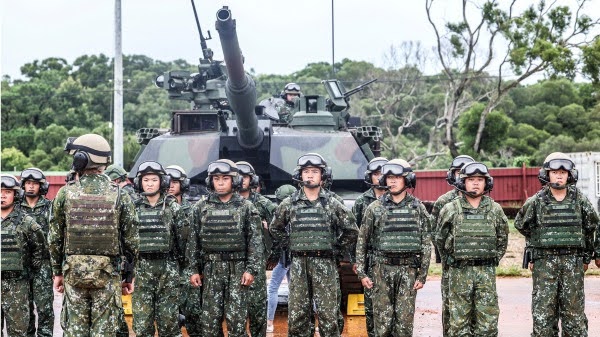
But Hsiao stressed that long-term economic sustainability depends on the rule of law and freedom. She said everything Taiwan does to strengthen itself is aimed at preventing invasion and preserving peace. “We believe that peace comes through strength,” Hsiao said, adding that Taiwan has learned this lesson from painful history.
If military conflict can be prevented, she said, Taiwan’s peace, regional security, and global prosperity can continue — prosperity driven in large part by Taiwan’s role in the global technology supply chain.
Taiwan-US partnership
Hsiao described the Taiwan-U.S. relationship as one of the most consequential partnerships in the world today. Though the two sides do not maintain formal diplomatic relations, she said the partnership remains exceptionally strong, supported by bipartisan backing in the U.S. Congress and strengthened across multiple generations and administrations.
She said the partnership has two major pillars: Security and trade. On security, Hsiao said the relationship helps preserve peace and stability across the Taiwan Strait amid a rapidly changing geopolitical environment and a more aggressive China. She said maintaining the status quo remains the broadest common denominator among regional stakeholders.
For China, she said, Beijing continues to threaten Taiwan and makes no secret of its ambition to annex and control the island. For Taiwan, the status quo also requires facing difficult international realities. Still, she said, it has allowed the Indo-Pacific to maintain decades of peace, stability, growth, and prosperity.
On trade, Hsiao said Taiwan and the United States form a shared economic ecosystem, especially in technology. Taiwan’s companies handle much of the difficult work of manufacturing and production, while U.S. firms benefit from technological innovation. She said Taiwan can support U.S. priorities such as reindustrialization and AI leadership by investing and manufacturing in America, including through major semiconductor investments in Arizona.
Hsiao also called for more policy tools to advance bilateral trade, including legislation to avoid double taxation, and praised ongoing Taiwan-U.S. economic dialogues on supply chain security, energy security, and resilience. She added that Taiwan hopes to continue deepening its partnership with the U.S. so both societies can continue building prosperity through shared values, innovation, and hard work.