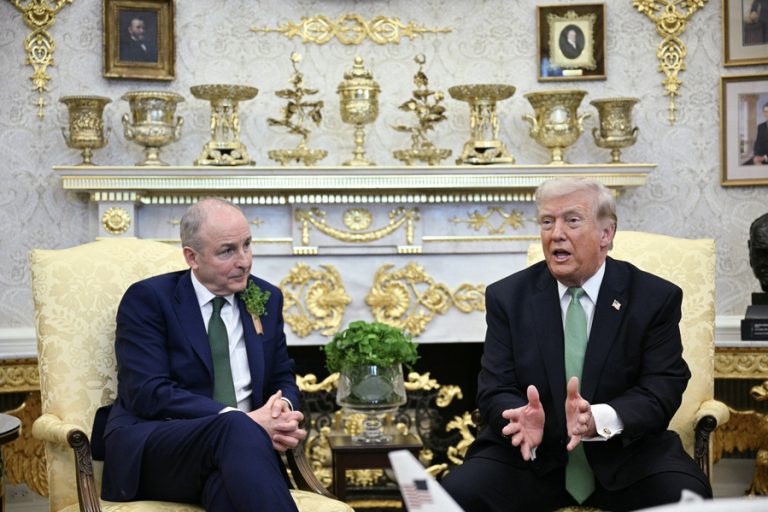
On March 17, U.S. President Donald Trump met with Irish Prime Minister Micheál Martin at the White House, where he took questions from reporters on the war between the United States and Iran, tensions in the Strait of Hormuz, NATO’s position, and his planned visit to China.
Trump said his previously scheduled trip to China this month had been delayed due to the ongoing conflict.
“We are rescheduling the meeting. It looks like it will take place in about five weeks. We are in communication with the Chinese side, and they have no objections,” he said, later adding the meeting could occur in “five to six weeks.”
He said he looks forward to meeting China’s leader Xi Jinping, adding, “He is also looking forward to seeing me, I believe.”
Trump had indicated in recent days that the Beijing trip might be postponed. He has also called on China to help ensure security in the Strait of Hormuz, though Xi has not made any public commitment.

Success
You are now signed up for our newsletter
Success
Check your email to complete sign up
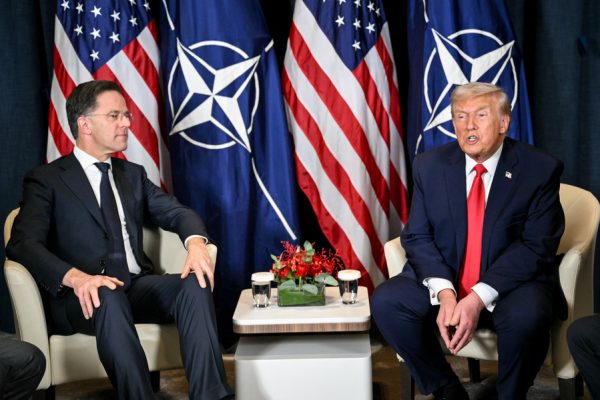
Trump criticizes NATO’s stance on Iran operations
Earlier on Tuesday, Trump wrote on his social media platform Truth Social that most NATO allies had declined to participate in U.S. military operations against what he described as Iran’s “terrorist regime.”
“The United States has been informed by most NATO ‘allies’ that they do not want to be involved,” he wrote. “Almost all countries strongly support our actions and agree that Iran must not be allowed to have nuclear weapons.”
He said he was not surprised, reiterating his long-standing criticism of NATO.
“I have always thought NATO was a one-way street. We spend hundreds of billions of dollars every year protecting these countries. We protect them, and they do nothing for us, especially when we need help.”
Trump also claimed that U.S. strikes had significantly degraded Iran’s military capabilities.
“Their navy is gone, their air force is gone, their air defenses and radar are gone,” he said. “Perhaps most importantly, their leadership at nearly every level has been eliminated and will no longer pose a threat to us, our Middle East allies, or the world.”
He added that, given what he described as major military gains, the United States no longer needs assistance from NATO or other allies.
“We don’t need NATO’s help. We never did. We don’t need help from Japan, Australia, or South Korea either. As president of the United States, the most powerful country in the world, I can say we don’t need anyone’s help.”
Later in the Oval Office, Trump said NATO countries support the U.S. and Israel politically but have been cautious about direct involvement.
“I think NATO made a very foolish mistake,” he said. “Every country agrees with our position, but they don’t want to participate. As the United States, we have to remember that.”
Strait of Hormuz security and war outlook
On the situation in the Strait of Hormuz, a key global oil transit route, Trump said he expects stability to return soon.
“I don’t think it will be long. We are hitting the coasts very hard, essentially the coastal areas and the waters. It won’t take long,” he said, without providing a specific timeline.
He also praised Middle Eastern countries for their support.
“Countries in the Middle East, including Israel, have done a great job. They have been very helpful to us,” he said.
Trump has repeatedly called on allies to help secure the waterway amid ongoing tensions.
Trump dismisses concerns over escalation
Responding to warnings from Iran’s deputy foreign minister that a U.S. ground deployment could lead to “another Vietnam,” Trump said he was unconcerned.
“No, I’m not afraid. I’m not afraid of anything,” he said.
He added that while the United States is not yet ready to end the war, it plans to withdraw “in the near future.”
Trump also said the damage inflicted on Iran would take about a decade to repair.
When asked whether the administration had a postwar plan for Iran, he did not provide details, saying only that the country had been “destroyed in every way.”
Since the conflict began more than two weeks ago, Trump has made repeated statements about the potential timeline for ending the war, emphasizing that decisions will depend on developments on the ground.
By Gao Yun