By Cai Siyun, Vision Times
Large-scale protests and clashes between residents and riot police have broken out in China’s Xinyi City in Guangdong Province after local authorities attempted to build a crematorium near residential areas. Villagers accused the government of misleading residents about the project and bypassing proper procedures, triggering widespread anger and street demonstrations.
Videos circulating on the social media platform X show that from March 17 to 18, large groups of residents gathered in the streets holding banners and chanting slogans. Protesters also surrounded a local Party-community service center to demand answers.
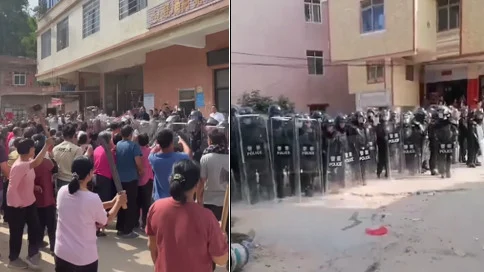
Authorities soon deployed a large number of riot police to suppress the demonstrations. Footage from the scene shows police clashing with villagers, with several residents reportedly beaten. Some individuals were seen with head injuries amid the chaotic confrontations.
According to multiple reports circulating online, the dispute involves two nearby villages, and authorities reportedly mobilized over a thousand police officers from surrounding counties to restore order. The affected villages have since been placed under lockdown, and many related videos have reportedly been removed from Chinese online platforms.
Controversial crematorium project
Success
You are now signed up for our newsletter
Success
Check your email to complete sign up
Local residents claim the government initially told villagers that land would be acquired for road construction. They later discovered the site was intended for a crematorium. According to online reports, the proposed facility would be built at Maliutang, located less than 700 meters from Wangyong Village, about 200 meters from Wusheng Village, and roughly 600 meters from a nearby elementary school.
RELATED: Thousands Defy Firecracker Ban at Guangdong Festival, Forcing Police to Back Down
Residents questioned why the facility was being placed so close to homes and key community resources. One commenter wrote: “There are so many other places available, why build it right next to where people live?” Another added: “It’s near the water source for several villages.”

Others suggested authorities were attempting to control the flow of information. “This news is real. Videos on domestic platforms have been deleted, but local residents have exposed it online. In the current international situation, the CCP is truly afraid that people might rise up in resistance.”
Another comment read: “When human rights are violated, everyone should stand up and fight for their rights.” Another noted: “If the CCP does not fall, the people will never have peace.”
Some residents claimed that officials had warned them not to speak publicly about the incident. “Several people came to my house today and told me not to comment, not to participate, and not to post anything,” wrote a resident under anonymity.
Others observed that related content was quickly disappearing online: “Several videos I saw earlier have already vanished,” wrote on user, while another added, “I heard even chat groups discussing it have been shut down.” Some also claimed that pro-government accounts began flooding social media with unrelated posts to obscure searches for “Guangdong Xinyi.”
Protests across China
Public protests against government policies have become increasingly frequent in recent years. According to Agence France-Presse, multiple demonstrations have taken place in Guizhou Province since late last year. The unrest was triggered by government policies promoting mandatory cremation in areas where traditional burial practices remain common.
In December, villagers in Mushan Village clashed with authorities after officials attempted to forcibly cremate the body of a deceased person who had already been buried. Family members of the deceased said authorities had repeatedly harassed them. “They came to bother my family every day,” one relative said, adding that officials even used drones to monitor them.
Videos circulating online showed dozens of villagers confronting officials and guarding the burial site, although many of those clips were later deleted. A 37-year-old resident surnamed Shen said he joined others in supporting the grieving family. He criticized authorities for disregarding local customs and responding to public dissatisfaction with heavy-handed tactics. He added that the family feared officials might exhume the body for forced cremation.
Similar tensions erupted in November in Shanshuping Town, Guizhou Province, where villagers stopped a funeral vehicle and forced three local officials to kneel before a coffin while wearing mourning bands. Observers say the protests were fueled by anger over a policy requiring all residents to be cremated after death.
Villagers argued the policy not only violated traditional beliefs about burial but also increased financial burdens. After paying cremation fees and purchasing urns, families often still conduct traditional burials because rural areas frequently lack facilities for storing ashes.
Backlash of local policies
Elsewhere, protests have also erupted over land disputes and development projects. On Feb. 1, residents of Daye Village in Lingao County, Hainan Province, clashed with police while protesting forced demolitions, corruption allegations, and disputed village elections.
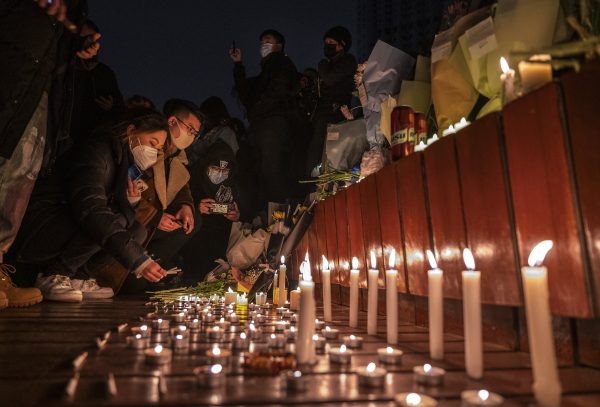
Witnesses said police used pepper spray and batons to disperse protesters. In response, villagers threw dirt and bricks. Videos from the scene showed multiple people injured, with some reportedly taken to hospital. Residents accused local officials of conducting aggressive land seizures under the banner of development, sparking repeated conflicts.
Last October, another large protest broke out in Qiongzhong, Hainan Province, after a state-owned rubber company allegedly cut down farmers’ betel nut plantations. Farmers piled the felled trees outside the company’s office building and demanded explanations. By evening, tensions had escalated. Protesters overturned vehicles, and some shouted, “Down with this bandits’ den!” Police reportedly fired warning shots to disperse the crowd.
Protests across China often reflect growing public frustration over corruption, land disputes, and economic pressures. As China’s economic slowdown continues and unemployment rises, such confrontations between citizens and authorities appear to be occurring with increasing frequency.