At a routine briefing on June 10, 2026, Zhang Han, a spokesperson for China’s Taiwan Affairs Office, was asked to explain one of Beijing’s claimed “seven improvements” that would result from unification with Taiwan. The question focused on how Taiwan’s security would be improved under Chinese rule.
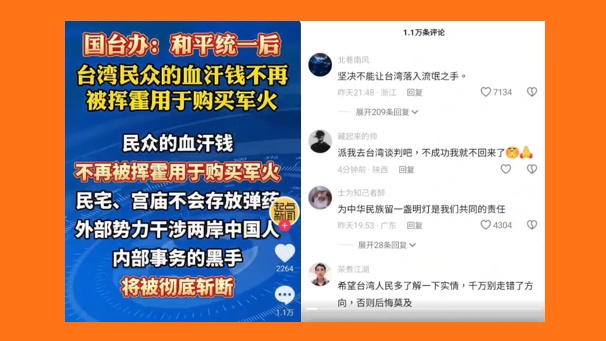
Zhang’s response largely repeated official talking points. She said that after unification, Taiwan’s people would be safer, and that the risk of war associated with “Taiwan independence” would be eliminated at its root. She added that public funds would no longer be “squandered” on weapons, that explosives would not be stored in homes and temples, that Taiwan would no longer serve as a pawn of foreign powers, and that its economy would develop in a stable and sustainable way.
The following day, a clip of the briefing was posted on Douyin and received about 11,000 comments, the majority of which were critical of China’s communist authorities.
Before the post was censored, the most-liked comment read: “We must absolutely never let Taiwan fall into the hands of thugs.” It collected more than 7,000 likes.
The comments below it echoed a similar sentiment. “With weapons in hand, no one dares to act recklessly.”
Success
You are now signed up for our newsletter
Success
Check your email to complete sign up
“Hold firm, Taiwan. With arms in your hands, you don’t have to fear outside coercion.”
“Unifying China is Taiwan’s responsibility” was presented as a slogan, but in context it was widely read as sarcastic commentary on Beijing’s framing of unification.
Many commenters explicitly warned Taiwan against trusting the Party’s promises.
“I hope Taiwan’s people learn more about the real situation. Don’t go in the wrong direction — you’ll regret it,” one wrote.
Another said, “The Chinese people of Taiwan must pass down the civilization of their ancestors, hold firm to happiness, resist outside coercion, and protect the treasure island that is their home.”
A third cluster of comments expressed envy of Taiwan’s freedoms.
“Just got off work. Left at 6 a.m. for a business trip, worked overtime until 8 p.m., and when I saw this news my back stopped aching and my legs stopped hurting. Couldn’t be happier.”
Another mainland citizen wrote: “Send me to Taiwan to persuade them to surrender — if I fail, I just won’t come back.”
Tiananmen footage and pro-democracy videos spread freely on Douyin
On Douyin, China’s domestic version of TikTok, a user posted footage of former China Central Television anchor and documentary filmmaker Chai Jing interviewing Hu Jintao, the CCP general secretary who preceded Xi Jinping, in 2006. Both are politically sensitive figures on China’s internet.
Chai Jing fell from official favor after her groundbreaking 2015 environmental documentary Under the Dome was quickly suppressed. Hu Jintao, meanwhile, became a sensitive figure after he was publicly escorted from the Great Hall of the People during the 20th National Congress in 2022 — footage that spread worldwide before being scrubbed from Chinese platforms.
What followed was a post that compiled, in table and animated format, the dates on which Chinese provinces declared independence during the 1911 Revolution that ended imperial rule.
Then came a video about South Korea’s June 3rd Movement of 1964, a student-led pro-democracy uprising. Many Chinese viewers read it as a reference to June 4th, 1989, when troops killed protesters in and around Tiananmen Square in Beijing after weeks of demonstrations that had drawn hundreds of thousands of people.
Videos followed that focused on the theme of “impeachment,” without naming a specific figure, but with an implied political target easily understood as referring to China’s top leadership, including Xi Jinping.
The most striking content was footage from Tiananmen Square in 1989. In the clip, a student with a red headband and a bicycle, heading toward the square to join the demonstrations, is stopped by a foreign journalist. When the journalist asks where he is going, the student answers: “Going to march, at Tiananmen Square.” The journalist asks why. The student replies: “Why? I think it’s my duty.” Multiple users wrote in the comments that this was the first time they had ever seen anything like it on Douyin.
Historical footage of Zhao Ziyang, the CCP general secretary who was removed from power and placed under house arrest for opposing the crackdown, also appeared. Zhao visiting the students at Tiananmen in the early hours of May 19, 1989 — his last public appearance before his arrest — moved many viewers. Comments spelling out “8964,” the numerical shorthand for June 4 used to evade censorship filters, appeared in numbers rarely seen on any mainland Chinese platform.
A video of Wang Yang, a former Politburo Standing Committee member under Xi Jinping, also circulated, edited to the perspective of a cartoon character.
Wang’s words in the clip: “Pursuing happiness is the right of the people; bringing prosperity to the people is the responsibility of the government. We must break down the mistaken theory that the people’s happiness is a gift from the government.”
Two explanations compete: entrapment operation or factional coup
Some observers interpreted the surge in sensitive content as a possible form of political entrapment, designed to identify and expose critical voices. They drew comparisons to earlier Party campaigns, including the 1957 “Hundred Flowers” period, when Mao Zedong briefly encouraged public criticism before turning against many of those who spoke out in the subsequent Anti-Rightist Campaign, which led to widespread persecution and the destruction of hundreds of thousands of lives.
Others point to possible factional tensions within the CCP, suggesting that rivals of Xi Jinping may have gained enough influence over platform moderation to allow such content to circulate. In this interpretation, the wave of mass online pile-ons, known among Chinese users as “storming the tower,” is taken as evidence that internal opposition to Xi may have some degree of organizational backing.
Meanwhile, the Tiananmen footage, the Wang Yang clip, and the Taiwan Affairs Office comment each accumulated tens of thousands of interactions before being removed or censored.