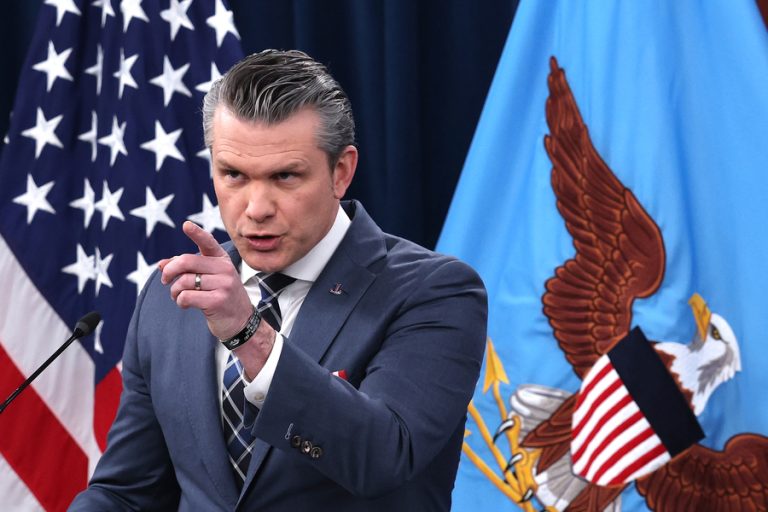
According to reports from the Associated Press and the New York Post, on Thursday, March 19 U.S. Secretary of War Pete Hegseth and Chairman of the Joint Chiefs of Staff Dan Caine held a joint press conference at the Pentagon, briefing the latest results of “Operation Epic Fury,” which began on Feb. 28.
Hegseth announced that U.S. forces have successfully struck more than 7,000 Iranian military infrastructure targets, reducing Iran’s missile and drone attacks against U.S. forces by 90 percent. At the same time, joint U.S.-Israel operations have eliminated large portions of Iran’s senior leadership, severely crippling its military command system.
Hegseth: IRGC command decimated
While reporting on targeted eliminations of Iran’s top leadership, Hegseth claimed that due to rapid U.S. and Israeli military actions, Iran’s senior leadership positions now exist in name only.
He stated: “Right now, the least desirable job in the world is being a senior leader in Iran’s Islamic Revolutionary Guard Corps or the Basij militia. These have all become temporary positions.”
According to the briefing, since the outbreak of the war, the U.S. and Israel have killed dozens of senior Iranian officials, including Supreme Leader Ali Khamenei, who reportedly died within hours of the war’s onset.
Success
You are now signed up for our newsletter
Success
Check your email to complete sign up
In the joint operations, the U.S. and Israel have adopted a clear strategic division of labor: Israel focuses primarily on targeting Iran’s leadership and core regime figures, while U.S. forces are responsible for destroying Tehran’s military capabilities and infrastructure. Recently, Israel reportedly killed Basij commander and de facto leader Ali Larijani, as well as Intelligence Minister Ismail Khatib.

Military devastation: precision strikes cripple retaliation capability, missile production
On military progress, Hegseth said that U.S. forces have “struck more than 7,000 targets in Iran and its military infrastructure.” He emphasized that Thursday would see “the largest wave of strikes to date,” noting that U.S. operational capabilities are increasing while Iran’s ability to retaliate continues to decline.
“We directly hit hundreds of their defense industrial sites. The most severely impacted may be their ability to manufacture new ballistic missiles,” Hegseth said.
According to military data, since the operation began on Feb. 28, Iran’s ballistic missile attacks on U.S. forces have dropped by 90 percent, and one-way drone attacks have also decreased by 90 percent.
Regarding Iran’s continued missile launches toward Israel and Gulf Arab states, Hegseth said: “Iran will still launch them—we know that. If they could do more, they would—but they can’t.”
On Iran’s naval forces, Hegseth quoted World War II U.S. Navy Admiral Ernest King:
“We decided to share the ocean with Iran—we gave them the bottom half.”
He confirmed that U.S. forces have damaged or sunk more than 120 Iranian naval vessels, and that Iran’s surface fleet “no longer poses a threat.”
General Caine also confirmed that U.S. forces are continuing to push deeper into Iranian territory and have deployed helicopters to strike Iran-aligned militias in Iraq.
On Wednesday, in response to Israel’s strike on the South Pars gas field—shared by Iran and Qatar—and Iran’s retaliatory damage to parts of Qatar, U.S. President Donald Trump publicly clarified the U.S. position.
Trump stated on the Truth Social platform: “Unless Iran unwisely chooses to attack a very innocent country like Qatar, Israel will not launch any further attacks on the extremely important and valuable South Pars oil field.”
It is reported that the Trump administration strategically aims to minimize damage to Iran’s oil and energy infrastructure in order to preserve essential facilities for postwar reconstruction.

Hegseth concluded by reiterating that U.S. military objectives remain unchanged: “Our goals were set directly by a president who follows an ‘America First’ policy, and they are exactly the same as on day one. These are not the media’s goals, nor Iran’s goals, nor new goals—they are consistent, and we are advancing according to plan.”
He added: “To destroy Iran’s missiles, launch systems, and defense industrial base so they cannot rebuild. To destroy its navy. And to ensure Iran never possesses nuclear weapons. That is our objective.”
By Tian Jingxin