Israel’s systematic campaign to eliminate Iran’s top officials escalated sharply in the third week of March 2026, culminating in the assassination of three of Iran’s most senior security figures within 48 hours, including intelligence minister Esmail Khatib in a targeted strike on Tehran on March 18. Iran retaliated immediately, launching missiles and drones at Israel and five Gulf states while imposing a selective blockade of the Strait of Hormuz, sending Brent crude above $100 per barrel. The head of the International Atomic Energy Agency also warned of growing nuclear safety risks as strikes hit near Iran’s Bushehr nuclear power plant.
The Israeli military announced on Wednesday, March 18, that Iran’s intelligence minister Esmail Khatib had been killed in a targeted strike on Tehran. According to CNBC, Khatib was the third senior Iranian official assassinated in just two days.
The previous day, Israel had announced the killing of Ali Larijani, Iran’s most senior security official, along with Gholamreza Soleimani, the commander of the Basij. The Basij is a regime-controlled paramilitary militia with a long record of violent domestic repression and ideological enforcement. Iranian state judicial media confirmed Soleimani’s death.
The Israeli military accused Khatib of directing crackdowns during domestic protests, running intelligence and attack operations against Israel and the United States, and playing a central role in the regime’s violent suppression of the nationwide uprising that erupted in 2022 after the death of Mahsa Amini. Amini, a 22-year-old woman, died in the custody of Iran’s morality police after being detained for allegedly violating the regime’s mandatory hijab law. Her death ignited months of protests across Iran that the regime crushed with mass arrests and lethal force.
Iran launched immediate retaliatory operations after its senior leadership came under systematic attack. According to the Associated Press, Iran expanded its strikes well beyond Israel, firing missiles and drones at Saudi Arabia, Kuwait, Bahrain, Qatar, and the United Arab Emirates.
Success
You are now signed up for our newsletter
Success
Check your email to complete sign up
Saudi forces intercepted a ballistic missile aimed at the Sultan Prince Air Base and shot down a drone headed for Riyadh’s diplomatic quarter. Interception explosions were heard over Dubai. Iran’s Islamic Revolutionary Guard Corps, the regime’s parallel military force that answers directly to the supreme leader, fired Khorramshahr-4 and Qadr multi-warhead missiles at central Israel in an attempt to overwhelm air defenses. Casualties were reported in Ramat Gan, a city adjacent to Tel Aviv.
Iran also struck regional energy infrastructure and imposed what it called a “selective blockade” of the Strait of Hormuz, aiming to drive up global oil prices and pressure the United States into restraining Israel.
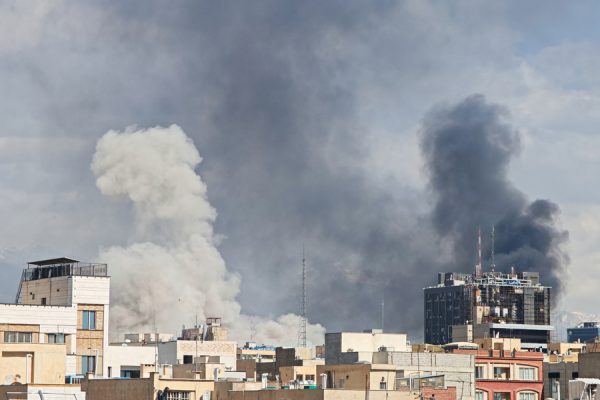
Oil tops $100 per barrel as the IAEA warns of nuclear risks near Bushehr
The escalation placed severe strain on global energy markets. Brent crude held above $100 per barrel, up more than 40 percent since the conflict began. The Strait of Hormuz, through which approximately one-fifth of the world’s oil supply transits daily, was under acute threat from Iran’s partial blockade and ongoing military operations in the waterway.
Rafael Grossi, the director general of the International Atomic Energy Agency, warned that the widening conflict risked triggering a nuclear safety crisis. Israeli strikes had previously landed near Iran’s Bushehr nuclear power plant on the Persian Gulf coast. The strikes caused no reported damage to the reactor, but the proximity raised alarms across the international community about the risk of a radiological incident.
Reports also emerged of attacks on facilities linked to Iran’s South Pars offshore natural gas field, one of the largest gas reserves in the world, shared between Iran and Qatar. Responsibility for those strikes remained unclear.
To mitigate the risk of a prolonged Hormuz blockade, Iraq and the Kurdistan region reached an agreement to reroute oil exports through Turkey’s Ceyhan port on the Mediterranean. Saudi Arabia increased its pipeline shipments through the Red Sea as an alternative route.
The war intensified Iran’s domestic repression alongside its external military operations. On the same day that Khatib was killed, Iran’s judiciary executed a man named Kourosh Keyvani on charges of conducting espionage for Israel’s Mossad intelligence agency. The regime routinely uses espionage accusations to justify executions during periods of internal and external pressure, and independent verification of such charges is rarely possible.
Separately, an airstrike hit a court facility in southern Iran, killing at least eight people.
On the broader regional battlefield, Israel continued high-intensity strikes against Hezbollah, the Iranian-backed militia and political organization in Lebanon. Multiple buildings in Beirut were destroyed in the attacks, killing at least 10 people, including media figure Mohammed Sherri. Israel said the targeted buildings housed facilities used to finance Hezbollah’s military operations.
The sustained Israeli bombing campaign in Lebanon has displaced more than one million people from their homes. Since the conflict between Israel and Iran began, more than 1,300 people have been killed inside Iran.
The United States also faced mounting pressure as the conflict widened. The U.S. embassy in Baghdad came under repeated attack. President Trump voiced frustration that allied nations had not joined operations to keep the Strait of Hormuz open to international shipping, declaring that “America doesn’t need anyone’s help.” His remarks reflected growing tension between Washington and European and Gulf allies over burden-sharing in the conflict, even as the economic consequences of a prolonged Hormuz disruption threatened to affect energy prices worldwide.