Energy, organic molecules, and liquid water are the three conditions scientists consider essential for life. Among them, water has become the most practical guide. In NASA’s research, the search for life often begins with a simpler question: where is the water?
Water begins long before planets exist
Water did not originate on Earth. Its ingredients are far older.
Hydrogen emerged shortly after the Big Bang. Oxygen formed later, inside massive stars. When those stars reached the end of their lives, they expelled these elements into space. In the surrounding gas, hydrogen and oxygen combined, forming water molecules that drifted through the galaxy.
Astronomers have detected these molecules in places where stars are dying and being reborn. The Helix Nebula, observed by the Hubble Space Telescope, contains water within the expanding shell of a dying star. In regions like the Orion Nebula, water is still forming in enormous quantities. The output is so vast that, over the course of a single day, it would exceed the volume of Earth’s oceans many times over.
Those materials do not remain in place. Over time, they become part of new stars, new planets, and new systems.

Success
You are now signed up for our newsletter
Success
Check your email to complete sign up
Earth’s oceans carry that history
When the solar system was young, Earth was not a water-rich world. Its oceans accumulated gradually.
Asteroids and comets, many of them containing water or ice, repeatedly struck the planet. Over millions of years, these impacts delivered the material that would become Earth’s oceans. Chemical signatures in seawater today still point to asteroids as the primary source.
Evidence from objects such as asteroid Vesta and comet 67P/Churyumov–Gerasimenko supports this picture. Water was not created here. It arrived.
Today, water covers about 71 percent of Earth’s surface, with a total volume exceeding 326 trillion gallons. Nearly all of it is saltwater. Freshwater makes up less than 3 percent, most of it locked in ice sheets and glaciers.
Even now, the distribution is shifting. Satellite data tracked by NASA shows sea levels rising year by year, while ice in Greenland and Antarctica continues to decline.
Not all oceans survive
Having water does not guarantee keeping it.
Venus may once have had oceans. Over time, a powerful greenhouse effect drove surface temperatures higher and higher. Without a protective magnetic field, water vapor in the atmosphere was broken apart and gradually lost to space.
Mars tells a different version of the same story. It once had a thicker atmosphere and, likely, large bodies of water. As its magnetic field weakened, the atmosphere thinned. Much of its water disappeared with it. Estimates suggest Mars has lost about 87 percent of its original water, leaving behind ice deposits and traces beneath the surface.
Oceans hidden beneath ice
In the outer solar system, water has not disappeared. It has simply changed form.
Several moons are now considered “ocean worlds,” where liquid water exists beneath thick layers of ice.
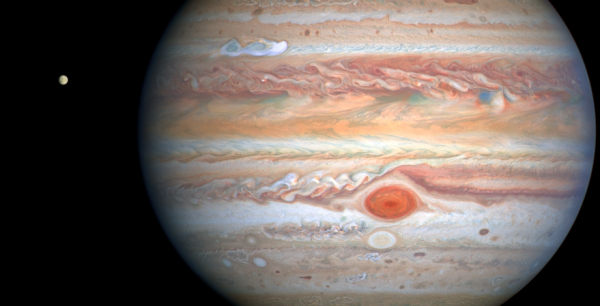
Europa, orbiting Jupiter, is thought to contain a salty ocean below its frozen crust. Observations have detected what appear to be plumes of water erupting into space.
Ganymede, another Jovian moon, also holds a subsurface ocean and possesses its own magnetic field.
Saturn’s moon Enceladus releases jets of water vapor mixed with organic compounds from fractures near its south pole. Titan, Saturn’s largest moon, combines a hidden ocean below with lakes of methane and ethane on its surface.
Even Pluto, once considered geologically inactive, shows signs that suggest a buried ocean may still exist.
Across these environments, water appears in different states: ice, vapor, and liquid, shaped by local conditions.
Water beyond the solar system
The pattern extends far beyond our planetary neighborhood.
Astronomers have detected water vapor in the atmosphere of HAT-P-11 b. Kepler-22 b orbits within its star’s habitable zone, where temperatures could allow liquid water to persist. Kepler-452 b and Kepler-62 f are also considered candidates where similar conditions may exist.
These observations point in the same direction. Water is not rare, and it is not confined to a single planet.

A common thread across worlds
Water forms in stars, travels across space, gathers on planets, and, in some cases, disappears again. It moves through different environments, but the pattern repeats.
Earth’s oceans are part of that process. They reflect events that began long before Earth itself formed.